The Musqueam ‘rights recognition agreement’ treats the Musqueam Indian Band as if it were a nation state, like Canada.
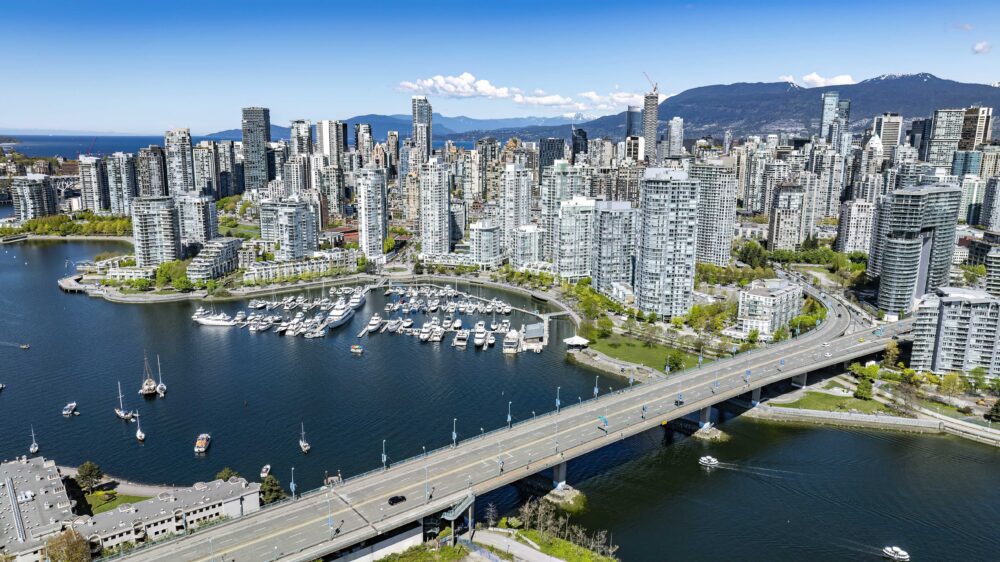
An aerial view of Vancouver on May 2, 2024. Sebastien ST-JEAN / AFP
If you live anywhere in Metro Vancouver, you may wish to ask what government you will pay taxes to in the future: It might well be the 1,300-member Musqueam Indian Band.
In February, just before the long weekend, the federal government signed an agreement with the Musqueam Indian Band, recognizing the Musqueam’s aboriginal title over the entirety of the Greater Vancouver area in British Columbia.
This was a profound act of self-emasculation on the part of the federal government.
The agreement is a consequence of many years of constitutional and legislative events, starting with the 1982 enactment of Section 35 of the Constitution, which recognized and affirmed the rights of “Aboriginal peoples.” This was followed by the Supreme Court of Canada’s 2004 Haida Nation decision, which invented the aboriginal consult and accommodate obligation. Following that was the 2014 Tsilhqot’in decision, which affirmed the constitutional legality of aboriginal title—essentially, the right to possession, ownership, and control of land and to its economic benefits.
On the political side, the B.C. government’s 2019 Declaration on the Rights of Indigenous Peoples Act (DRIPA) and the federal government’s 2021 United Nations Declaration on the Rights of Indigenous Peoples (UNDRIP) legislation have further eroded the ability of federal or provincial governments to legislate over public and private land.
Altogether, these legal events comprise an unprecedented devolution of state power to “Aboriginal peoples,” effectively amending the Canadian Constitution by making them a third order of constitutional power in relation to matters affecting them, virtually co-equal in aboriginal matters with Ottawa and the provinces.
The agreement with the Musqueam also has many other problematic aspects.
Problem 1: The Side ‘Narrative’ Attached to the Agreement
Normally, a proper legal agreement seeks to achieve certainty and finality. But the agreement opens with a three-page “Musqueam Narrative” entitled “Our Ancestors’ Ways Continue,” which claims many things to be objective fact, but which are in fact purely subjective and highly debatable assertions.
Physical places are allegedly “storehouses” for Musqueam “teachings” and “place-based knowledge”; the Musqueam allegedly have a distinct pre-contact-like “land-based” culture and the right to “steward and control” land where “sacred laws and teachings … are alive and thriving to this day”; the Musqueam supposedly have an independent “legal system” and “inherent rights” independent of rights created by the Canadian state or recognized by Canadian law.
This narrative is not formally part of the agreement—it’s essentially Musqueam propaganda—so it should not be in the agreement document at all. But because Crown negotiators permitted it to be included in the agreement, during future disputes the Musqueam and their lawyers will likely attempt to use the narrative as evidence of the Crown’s agreement with its assertions.
Problem 2: Competing Claims From Others
The Musqueam aboriginal title area also includes areas over which the Squamish, the Tsawwassen, and the Cowichan also claim aboriginal rights. In fact, on Aug. 7, 2025, the B.C. Supreme Court ruled that the Cowichan Tribes are the aboriginal title holders of certain lands and waters in Richmond, a suburb of Vancouver.
The Cowichan trial lasted four years and was preceded by years of pre-trial proceedings.
The federal government’s position in that case was limited to acknowledging the Cowichans’ right to fish on the south bank of the Fraser River, but only if the court ruled that the Cowichan did not need permission from the Musqueam to fish there.
In retrospect, as evidenced by the agreement, it seems that Ottawa had secretly decided that the Musqueam, not the Cowichan Tribes, were the proper aboriginal title holders of the claimed Richmond area.
It was unethical for the government not to have advised the court or the Cowichan Tribes of this decision. The Cowichan legal proceeding might have gone an entirely different way had the government been straight with the court and all other parties about its secret unequivocal support for the Musqueam.
And now the federal government has blindly acknowledged Musqueam aboriginal title over an area that just six months ago the Supreme Court of B.C. ruled belongs to the Cowichan Tribes, and over other Greater Vancouver areas that are subject to rival claims from the Tsawwassen and the Squamish.
Problem 3: No Certainty and No Finality
Clearly, the Musqueam agreement will not settle anything. It will only create more endless litigation, paid for by Canadian taxpayers.
It took a 20-year litigation process before the Supreme Court of Canada declared aboriginal title to the Tsilhqot’in band over a 1,900-square kilometre portion of (former) B.C. Crown land in the middle of the province. The Cowichan case took at least 11 years from start to finish.
But inexplicably, with respect to the Musqueam claim, Ottawa threw in the towel without a fight. No court action or judicial ruling was deemed necessary. No formal proof of claim was required. The negotiations leading up to the signing of the agreement were conducted in secret. Neither the B.C. government nor the Vancouver area municipalities were ever advised or consulted.
So, what are the consequences of granting aboriginal title to an aboriginal band, especially in an urban area such as Greater Vancouver?
Problem 4: Musqueam Primacy Over Ottawa, BC, and the Courts
Once Aboriginal title is recognized or ceded in a particular area, the aboriginal expectation, according to aboriginal law expert Louise Mandell, stating her interpretation of the 2024 agreement between the B.C. government and the Haida Nation, is that “the Crown will gradually vacate ‘jurisdictional space’ and Aboriginal law will govern Haida Gwaii.”
In other words, the aboriginal title holder will have the exclusive prior and senior right to use and control the land and enjoy its benefits, including the right to grant official permissions for others to use the land upon payment of compensation.
Many important federal and provincial laws may no longer apply in the Greater Vancouver area, or at a minimum, there will be many conflict of laws issues and disputes.
The private property and other rights of non-Aboriginals who reside there will be called into question.
Regardless of aboriginal assurances that they “are not going after” private property, aboriginal title is senior and prior in nature to “fee simple” title, the most common form of property ownership in Canada.
This uncertainty will create a permanent cloud over all private property titles in that area, including government lands. Indeed, Vancouver land appraisers are now warning property owners that their reports do not consider the effects of aboriginal land claims.
And aboriginal title holders can always change their minds about “going after” private property, if only for the purpose of extracting more reconciliation compensation from governments.
For aboriginals living within the aboriginal title area, in accordance with the 2024 Supreme Court of Canada Vuntut Gwitchen decision, the Musqueam Band’s chief and council will be able to legally abrogate their members’ Canadian Charter of Rights and Freedom rights if the stated purpose for doing so is to protect “Indigenous difference.”
Clearly, great confusion, fear, and legal chaos results from any area becoming subject to aboriginal title. The Musqueam agreement blithely skates over all these adverse consequences and declares that “the existence of Musqueam’s unextinguished Rights and Title … is not dependent on recognition by court declaration or any agreement.”
This is legally impossible.
Legal rights do not emerge out of thin air. Legal rights must be created or recognized by a state or a state institution, such as a court. Rights aren’t rights if there aren’t state institutions and mechanisms to enforce them.
If Musqueam rights were not dependent on recognition by court declaration or agreement, then there would be no need for the agreement. The fact that the Musqueam entered into the agreement belies their statement that their rights exist independent of court declaration or agreement. This is why both parties to the Haida Nation aboriginal title agreement thought it fit and necessary to have it judicially confirmed.
Problem 5: Ottawa Just Told the Musqueam Canada Is Illegitimate
In the Cowichan case, the court ruled that because the Cowichan aboriginal title was never extinguished, the Crown never owned the land it purported to issue Crown patents for. Thus, titles to all private property holdings in the aboriginal title area—to the extent that they exist at all—are junior and secondary to the senior and prior Cowichan aboriginal title.
Following this logic, given Ottawa’s voluntary acknowledgment of Musqueam aboriginal title over Greater Vancouver, it can reasonably be said that no Crown and no private property owner now or in the past ever owned any land in Greater Vancouver. It has always been “owned” by the Musqueam. It follows further that the agreement is superfluous and unnecessary because Canada, never having had a Crown interest in the land, has no legal status to concede, give up, or acknowledge anything.
Underlying the agreement is the federal government’s acknowledgment that it has always been a legally illegitimate presence in Greater Vancouver, and in fact all of non-treaty B.C., which in its entirely is subject to aboriginal title claims similar to the Musqueam claim.
Reality Check: 1,300-Member Bands Are Not Nations
According to the agreement, aboriginal “Rights and Title” include “self-government rights,” which Canada acknowledges as part of its “nation-to-nation, government-to-government approach” to “reconciliation” with the Musqueam Indian Band.
But a key provision in the agreement completely belies the notion that the band is an independent nation capable of truly dealing with Canada on a “government-to- government” basis, because the agreement declares as a “fundamental principle … that the overall fiduciary relationship between the Parties shall continue as circumstances dictate” and that “the fiduciary obligations of Canada to Musqueam shall be as determined by jurisprudence respecting fiduciary relationships and fiduciary obligations.”
Any fiduciary relationship is characterized by dependency, weakness, and vulnerability on the part of one party in the relationship to the superior, discretionary power of the other party in it.
The agreement describes and treats the Musqueam Indian Band as if it were a nation state, like Canada.
It’s not. It’s a wholly dependant, 1,300-member “band.”
Historian Robert Kaplan writes that legitimate nation states have hierarchical, coherent governing structures and rules-based orders developed organically over centuries. He states that they’re capable of providing and maintaining law and order, and are supported by independent institutions and organized bureaucratic systems interacting with each other on an impersonal secular basis. They have a functioning economy and a large, educated population to maintain it.
The Musqueam Indian Band possesses none of these basic state characteristics, so it’s not realistic to describe the agreement as a “nation-to-nation, government-to-government” agreement.
Finally, the agreement declares that “naca?mat ct”—which apparently means “we are all one”—is a fundamental principle guiding the Musqueam and Canada in the implementation of the agreement.
Again, the very existence of the agreement—which purports to legally and socially divide Greater Vancouver residents on the basis of ancestry and allocate and divide power and resources on the basis of race—ensures that Greater Vancouverites, and aboriginal and non-aboriginal Canadians generally, will never be “one” under any agreement like the Musqueam Indian Band agreement.
This is the fundamental illiberal tragedy of Canada caused by Section 35 of the Constitution and the legal events described above, which the Canada-Musqueam Indian Band agreement only perpetuates.