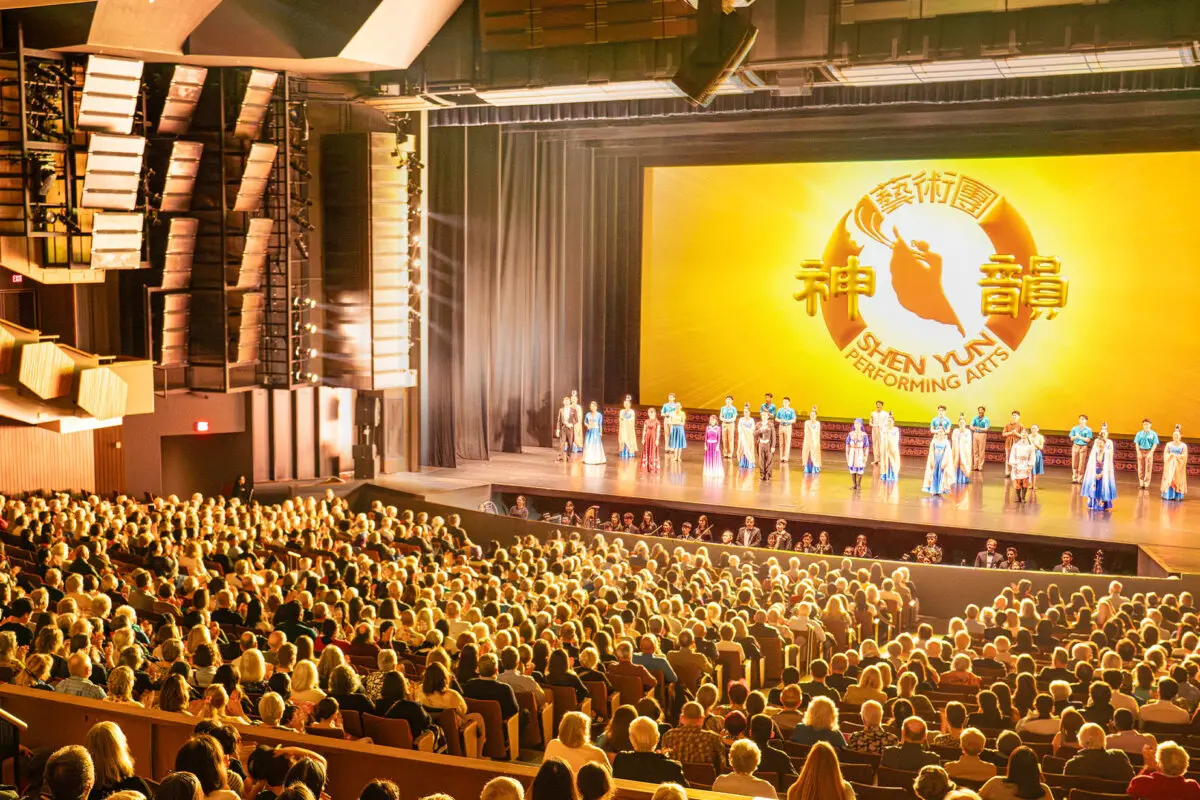
The performers of Shen Yun Performing Arts during a curtain call at the Queen Elizabeth Theatre in Vancouver in April 2026. The Epoch Times
Conservative MP Shuvaloy Majumdar is warning that the Chinese regime is suppressing Canada’s creative industries, as Culture Minister Marc Miller concluded a three-day visit to China in an effort to advance Canada’s commercial cultural and diplomatic relations in the country.
“Just concluded a productive trip to China,” Miller said in a May 29 social media post, adding that Canada’s creative industries and cultural organizations have the “talent, expertise, and creativity needed to seize opportunities on the world stage” as the government focuses on diversifying trade and building new partnerships.
Majumdar responded to Miller’s post, saying that the Chinese Communist Party (CCP) suppresses Canada’s creative industries in a number of ways, such as through “preemptive script cleansing” from criticism of CCP leaders; portrayals of Taiwan, Tibet, and Hong Kong; as well as “visual retrofitting” of images and “active narrative shaping, like flattering portrayals of CCP officials.”
Meanwhile, he noted the Canadian Security Intelligence Service (CSIS) has warned Canadians that local content outlets are used by the CCP to promote propaganda from Chinese state media China News Service.
Majumdar also said apps like Chinese social media and messaging app WeChat operate under algorithmic suppression mandated by Beijing’s Cyberspace Administration, China’s top internet regulator, and the work of local content creators and independent journalists are censored.
The Foreign Interference Commission in 2024 released an intelligence assessment conducted by CSIS and the Privy Council Office on how the CCP influences Chinese-language media in Canada.
“Communist Party of China (CPC)-friendly narratives inundate Chinese-language media in Canada,” the report, dated July 2023, said. “Censorship (including self-censorship) is pervasive and alternative media voices are few or marginalized in mainstream Chinese-language media.”
This includes traditional media like newspapers as well as online platforms and applications such as WeChat, the report said.
“The CPC’s ability to influence Chinese-language media, and therefore shape overseas public opinion, also plays a critical enabling role in its other activities, including transnational repression efforts and attempts to influence electoral outcomes,” the report added.
Majumdar said the federal government appears to be expanding operations with Chinese state media companies, which he said validates China’s “state propaganda apparatus” and threatens Canada’s independence and sovereignty.
Following Miller’s trip to China, Canadian Heritage said the visit “helped strengthen the trade relationship between Canada and China, identify new opportunities to and expand cultural exchange, people-to-people ties, and trade in the creative and cultural sectors between the two countries.”
The department said Miller and his Chinese counterpart explored bilateral opportunities and collaboration in the areas of culture, creative industries, the arts, and heritage. They also signed a memorandum of understanding (MOU) between Library and Archives Canada and the National Library of China, as well as a second MOU between the National Gallery of Canada and the National Art Museum of China.
Beijing’s interference in Canadian creative industries has also been seen through the recent CCP-linked disruption of Shen Yun Performing Arts in various cities across Canada.
Shen Yun is a New York-based classical Chinese dance and music company formed in 2006 by leading Chinese artists who practise Falun Gong, also called Falun Dafa, a Buddhist-based spiritual discipline that has been persecuted by the CCP since 1999. The company travels around the world each year with the stated mission of reviving China’s traditional culture, which the group says has been decimated under decades of communist rule.
The Falun Dafa Association of Canada, the national organization representing Falun Dafa associations in different cities that serve as local presenters of Shen Yun, says Shen Yun in recent years has faced an escalated global campaign to stop the show. Tactics have included diplomatic pressure, baseless lawsuits, and some 150 hoax bomb threats worldwide. A public awareness campaign documenting the situation—including a petition—is available at LetShenYunPerform.ca.
Chinese Foreign Minister Visits Canada
While Miller was visiting China, Chinese Foreign Minister Wang Yi was on a three-day trip to Canada where he met with Carney and Foreign Affairs Minister Anita Anand in Ottawa on May 29.
Measures were taken to limit media coverage of Carney’s meeting with Wang, as only official photographers were initially allowed to capture Carney and Wang’s handshake. However, after pushback from the Parliamentary Press Gallery, media were allowed to briefly enter Carney’s office to capture the handshake for less than 30 seconds.
Neither Wang nor Carney made any comments to reporters and no press conference was scheduled for that day.
Speaking to reporters on May 29, Conservative Leader Pierre Poilievre criticized Carney’s approach to relations with Beijing, saying the prime minister “won’t do anything to make Beijing unhappy.”
“A year after Mark Carney said that China was the single biggest risk to Canada, he claimed that we were going to have a full rupture with the United States in favour of a strategic partnership for a new world order with the dictatorship in Beijing,” the Tory leader said.
He said Canada should be willing to talk and trade with China but should do so “with our eyes open” so that Canada will not be “vulnerable to the aggressive instincts of a foreign dictatorship.”
Wang’s visit to Canada came after Carney visited China in January, where he declared that Ottawa and Beijing were in a “strategic partnership” and said progress made in the relationship “sets us up well for the new world order.”
Before meeting with Carney, Wang met with Anand at the Global Affairs Canada headquarters in the morning, where the two ministers offered public opening remarks at the beginning of the meeting.
Anand said Carney and Chinese leader Xi Jinping have established an “ambitious vision” for a “recalibrated relationship” between Canada and China, but that each country “must address critical issues and priorities to ensure the safety and security of our people.” She also said Canada aims to increase exports to China by 50 percent by 2030 while “safeguarding Canada’s economic and national security interests and values.”
Wang said engagement between Ottawa and Beijing has increased dramatically in recent months, which he noted shows both sides are willing to improve relations. He also said there have been “ups and downs” in the bilateral relationship that have provided “many important lessons.”