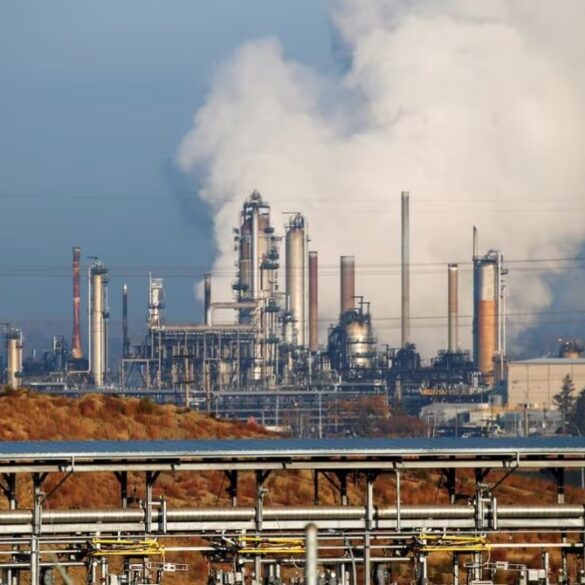
The Imperial Strathcona Refinery which produces petrochemicals is seen near Edmonton, Alberta, Canada, October 7, 2021. REUTERS/Todd Korol/File Photo

Alberta has recorded an $8.3 billion surplus, according to Finance Minister Nate Horner’s recent financial update.
It is $8 billion more than the provincial government expected, and was due to oil and gas revenue for 2024/2025, as well as more tax revenue from the province’s growing population, Horner said at a June 27 news conference.
He said it was Alberta’s fourth consecutive surplus in as many years.
“Personal income tax revenue was a record $16.1 billion, or $516 million higher than budget, driven by strong growth in personal incomes and population,” he said. “Corporate income tax revenue was $8.1 billion, up $1.1 billion from budget due to strong corporate profits in sectors such as oil and gas, construction, and finance.”
Horner also said that oil production grew to nearly 4 million barrels a day.
“The average price of oil was $74.34 per barrel, slightly higher than the $74 projected at budget 2024. Rig drilling activity increased by 4.4 percent, and natural gas production also increased despite weaker prices.”
Adding to the provincial surplus was a Canada-wide settlement in a lawsuit against tobacco companies, which brought in $713 million, Horner said.
Horner said that the surplus would be divided between paying down debt, savings, and the Alberta Fund.
Some of the province’s biggest expenses over the past fiscal year include $29.6 billion for health. It is 2.9 percent higher than what was budgeted, with the government noting it began a substantial revamping of its health system this year.
The provincial health system, Alberta Health Services, transitioned from a single service provider into four different sectors: acute care, primary care, continuing care, and mental health and addiction care.
Alberta also said some of its health care funding went to provide for more surgeries and lab services, and to recruit more doctors.
The government also spent $17.2 billion for education, 1.1 percent more than budgeted.
Alberta said it also spent $1.9 billion in disaster relief, including $702 million to fight wildfires, $191 million for evacuation and recovery, and $1 billion to support farmers and producers facing drought challenges.
Horner cautioned that deficits are forecast for the next three years and the province needs to be prepared: “While oil prices have fluctuated in past weeks, ongoing unrest and geopolitical uncertainties continue to keep the price of oil unpredictable. We continue to experience trade uncertainties with the United States, and the tariff situation will certainly impact our revenues.”
He also said that the growing population would require more services.
Opposition NDP finance critic Court Ellingson told reporters that the government did not appear to have a plan for the upcoming deficits.
“We have a government that is falling behind in health-care investments, falling behind population growth and inflation, and we haven’t heard the government talk about how they’re going to be making strategic investments in those areas,” Ellingson said.
Chandra Philip is a news reporter with the Canadian edition of The Epoch Times.