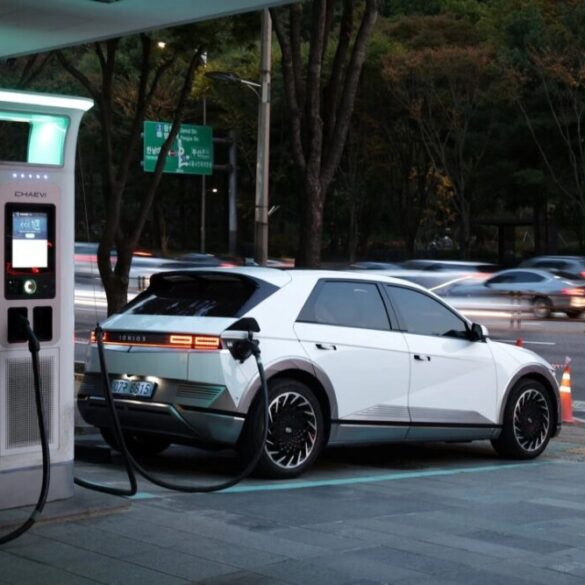
A Hyundai Ioniq 5 electric vehicle is charged at Chaevi Stay Charging Station in Seoul, South Korea, on Oct. 18, 2023. Kim Hong-Ji/File Photo/Reuters

Ottawa’s decision to pause the implementation of its electric vehicle (EV) mandate has been welcomed by the car industry and Conservative politicians who have been calling for its cancellation.
Prime Minister Mark Carney announced on Sept. 5 that vehicles for model year 2026 would be waived from the Electric Vehicle Availability Standard requirements. The mandate required automakers and importers to sell 20 percent of EVs in 2026 or face penalties. The target is set to increase to 100 percent of sales by 2035.
Carney also announced an immediate 60-day review of the mandate while saying options will be explored to bring more affordable EVs on the market.
Brian Kingston, CEO of the Canadian Vehicle Manufacturers’ Association, called the announcement an “important first step.” Kingston had requested Carney abandon the mandate earlier this summer.
“The EV mandate imposes unsustainable costs on auto manufacturers, putting at risk Canadian jobs and investment in this critical sector of the economy,” Kingston, who represents the Canadian operations of Ford, GM, and Stellantis, said in a statement.
The industry has been impacted by the sectoral tariffs imposed by U.S. President Donald Trump, who has repeatedly said he wants car manufacturing brought back to his country. Carney’s announcement on Sept. 5 touched more than on the EV mandate, as he presented various programs to bolster sectors of the economy impacted by the tariffs.
Kingston repeated his call for a “full repeal” of the mandate, saying it’s the best way to provide relief to the industry.
Carney recognized the concern during his press conference, saying that automakers have “enough on their plate right now” with the financial challenges caused by U.S. protectionist trade actions.
The EV mandate was introduced by the previous Liberal government under Justin Trudeau as part of his climate action plan. It seeks to reduce greenhouse gas emissions from the transportation sector as Liberals aims to reach net-zero emissions by 2050.
Another industry association, this time representing car companies from Europe and Asia, also welcomed the pause of the EV mandate without calling for its complete removal.
Global Automakers of Canada said it has been calling for a “pause and review,” adding its members are “fully committed” to electrification but the conditions currently don’t exist. The group’s CEO David Adams said in a statement he is pleased Ottawa has “recognized that consumer adoption of electric vehicles [is] not where either government nor industry had anticipated it would be a few short years ago.”
Adams also called on Quebec and B.C., which have their own EV mandates with “more aggressive targets,” to pause their programs.
On the political side, federal Conservatives have called for the full repeal of the EV mandate, vowing earlier this summer to launch a “nationwide campaign” to put pressure on Ottawa.
Tory Leader Pierre Poilievre said on Sept. 5 that Carney’s move is proof that his party has the correct stance on the harm the EV mandate will cause to industry and consumers.
“He’s finally admitted that the Conservatives were right, just like we were right on the carbon tax, but he’s doing a clumsy retreat,” Poilievre said, adding that businesses need more certainty.
Alberta Premier Danielle Smith, who has been calling for the repeal of the EV mandate as well as other federal climate-related policies, said she’s “encouraged” by the pause announced by Carney. She said, however, that it should be “scrapped entirely along with the other bad laws that are holding our country back.”
“The federal government should not be dictating what cars Canadians can and cannot drive, this kind of market interference will only drive up costs for everyday Albertans and Canadians,” Smith said in a statement.
On the pro-net-zero-emissions policy side, Carney’s move has been criticized by the Canadian Climate Institute, an Ottawa-funded charity.
The institute’s president Rick Smith called the pause a “missed opportunity” for Carney to “reiterate the clear benefits of good climate policy.”
“The evidence shows very clearly that the federal EV standard will help Canadians find better, more affordable automobile options, while also creating flexibility for vehicle manufacturers,” said Smith in a statement.
Carney defended his government’s net-zero emissions policies during the announcement, saying that dealing with climate change is a “moral obligation” and trade and competitiveness is “imperative.”
The prime minister said he intends to strengthen tax credits to increase investments in clean energy and that the carbon pricing for industry will stay at the same level.
The pausing of the EV mandate for 2026 marks a second break on net-zero emissions policies with the Trudeau government. The first one was the removal of the consumer carbon tax after Carney took power in March.
The federal government’s website on zero-emission vehicle (ZEV) mandates as of Sept. 5 still touted the benefits of the mandate, saying “Canada is committed to decarbonizing the country’s transportation sector and becoming a global leader in zero-emission vehicles.”
Noé Chartier is a senior reporter with the Canadian edition of The Epoch Times. Twitter: @NChartierET