Ottawa rescinded the tax on June 29, after US President Donald Trump terminated trade talks in objection to the tax on June 27.
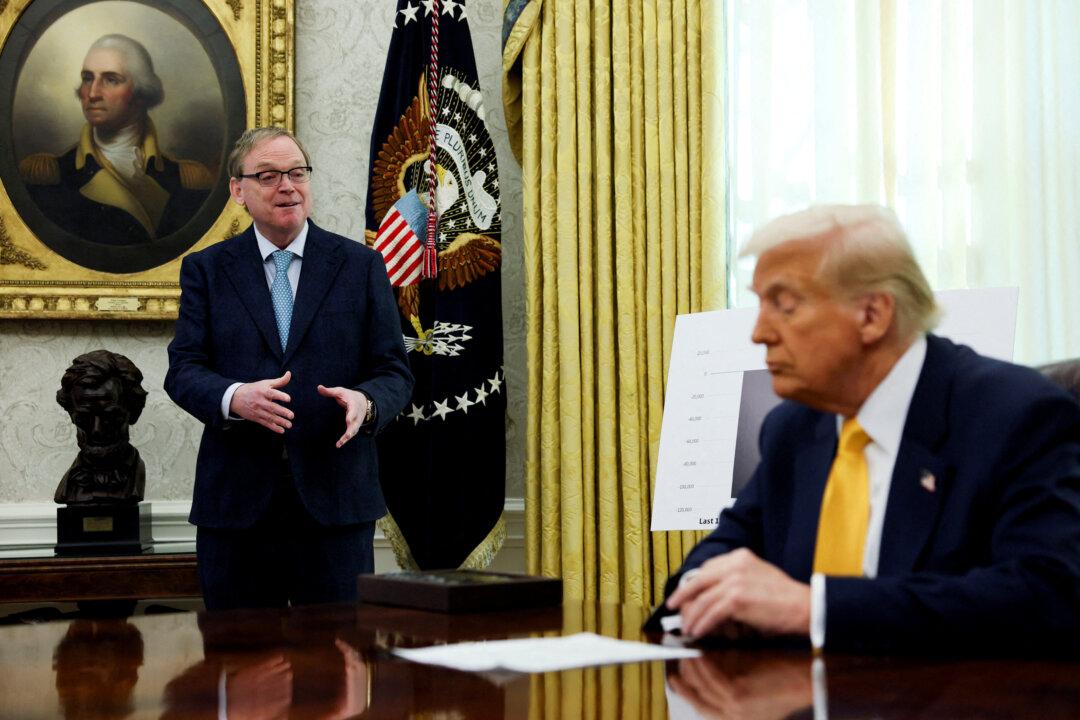
White House economic adviser Kevin Hassett speaks next to President Donald Trump in the Oval Office in Washington on March 7, 2025. Leah Millis/File Photo/Reuters

Trade negotiations between Canada and the United States are resuming immediately after Ottawa promised to drop its Digital Services Tax impacting U.S. tech giants, according to a White House official.
U.S. President Donald Trump said talks had been terminated at the end of last week because Canada was implementing its Digital Services Tax (DST). Ottawa responded on June 29 by saying it would introduce legislation to rescind the tax.
Kevin Hassett, director of the Economic Council in the Trump administration, told Fox News on June 30 that trade talks are “absolutely” resuming immediately.
Hassett said Trump requested the DST’s removal when he met with Prime Minister Mark Carney at the G7 Summit in Canada on June 16.
“It’s something that they’ve studied, now they’ve agreed to, and for sure that means that we can get back to the negotiations,” Hassett added.
The DST came into force in June last year and applies retroactively from 2022. Foreign and domestic large businesses required to make DST filings to the Canada Revenue Agency had until June 30 of this year to do so.
The tax applies at a rate of 3 percent on revenue earned from certain types of digital services such as marketplaces, social media, advertising, and the sale of user data.
Ottawa has long been aware that the DST is a trade irritant for the United States, including throughout the Biden administration.
“As the United States noted in comments to Canada in 2021 and 2023, most DSTs have been designed in ways that discriminate against U.S. companies, as they single out U.S. firms for taxation while effectively excluding national firms engaged in similar lines of business,” says the U.S. Trade Representative in its 2024 report on foreign trade barriers.
Finance Minister François-Philippe Champagne defended the DST shortly after the G7 Summit, describing it as an applicable law in Canada.
“This was voted by Parliament, so we’re going ahead with the DST,” Champagne told reporters on June 19 when asked whether he was considering a pause.
“But obviously, you know all of that is something that we’re considering as part of broader discussions … but the DST is enforced and it’s going to be applied,” he said, adding there were “extensive” discussions at the G7 about the different taxation regimes in the world. He said the DST is “not the big thing” as opposed to value-added taxes, which is a consumption tax that is levied on the value added at each stage of production for a good or service.
Before the June 30 DST filing deadline arrived, Trump said on June 27 the tax is a “direct and blatant” attack on the United States. He accused Canada of copying the European Union and announced the termination of all trade talks with Canada.
This dashed hopes for the two countries to reach a trade deal after Carney’s office said during the G7 Summit the two leaders had agreed to aim for an agreement within 30 days.
The United States has imposed three different sets of tariffs on Canada since Trump took office, which have been met by retaliatory tariffs. The trade actions have been dampened by various exemptions on both sides.
The finance department issued a statement after Trump’s announcement, saying it would introduce a bill to rescind the DST in a bid to advance “broader” trade talks with Washington.
“Rescinding the digital services tax will allow the negotiations of a new economic and security relationship with the United States to make vital progress and reinforce our work to create jobs and build prosperity for all Canadians,” Champagne said.
Carney said his government’s move will support the resumption of negotiations to make a deal before July 21 as decided at the G7 Summit.
The finance department said it preferred a multilateral agreement on the taxation of digital services but had gone ahead with its own regime to fill a taxation gap, saying large companies are not paying tax on revenues generated from Canadians.
U.S. Commerce Secretary Howard Lutnick thanked Canada for removing its DST in a social media post on June 30, saying it was “intended to stifle American innovation and would have been a deal breaker for any trade deal with America.”
Noé Chartier is a senior reporter with the Canadian edition of The Epoch Times. Twitter: @NChartierET