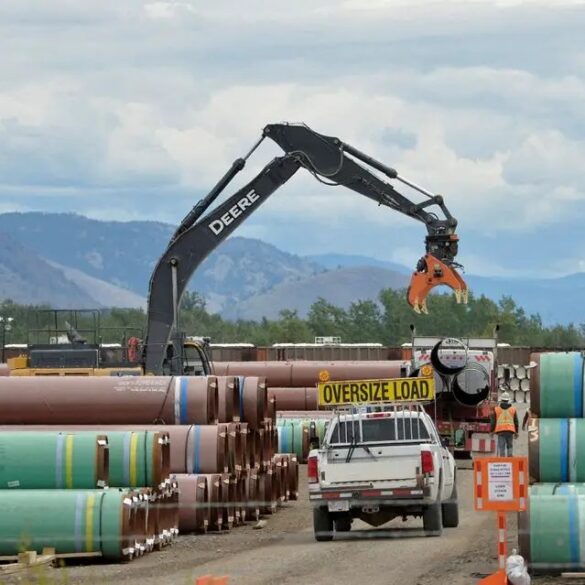
A pipe yard servicing government-owned oil pipeline operator Trans Mountain is seen in Kamloops, British Columbia, on June 7, 2021. (Reuters/Jennifer Gauthier/File Photo)
Prime Minister Mark Carney and Alberta Premier Danielle Smith have signed an energy agreement they say could pave the way for construction of a new oil pipeline to the West Coast to start as early as Sept. 1, 2027.
The agreement “clearly sets out a pathway to the construction of a new oil pipeline,” Smith told reporters in Calgary on May 15, adding the pipeline would be capable of transporting over 1 million barrels of oil per day to Asian markets.
An official speaking on background at a briefing prior to the press conference said the Alberta government expects the pipeline to be completed no later than 2034.
Smith said the agreement would keep the industrial carbon price “substantially lower than the previous federal policy,” which she said could save industry an estimated $250 billion in compliance costs over the next 20 years.
The document that Carney and Smith signed in Calgary decrees that Alberta’s effective industrial carbon price will increase to $130 a tonne by 2040. The Liberal government had previously proposed to increase it to $170 per tonne by 2030. Smith had rejected this rate and said it would lead to caps on oil and gas production.
Smith said that Ottawa and Alberta plan to finalize agreements around clean energy regulations, the proposed oil and gas emissions cap, and impact assessment cooperation on methane equivalency this year. The two governments will also work together to advance the Oil Sands Alliance carbon capture project.
The Alberta premier said her province plans to submit the pipeline proposal to the Major Projects Office by July 1, which would designate it as a project of national interest and accelerate its approval.
Smith added that Alberta and Canada will continue to consult with First Nations and indigenous communities to ensure their rights are protected, while supporting “opportunities for ownership and partnership.”
As part of the agreement, Ottawa and Alberta will also work toward doubling the grid by 2050 including by expanding nuclear, wind, and solar energy, launch a joint Electricity Working Group to identify projects needed to achieve net-zero emissions in Alberta by 2050, and better enable investment for renewables and expand supply of electricity for AI and data centre projects.
Carney told reporters that the agreement builds the “trust” of investors by showing that “Alberta and Canada are reliable and attractive destinations where opportunities are plentiful, the rules are clear, and one project means one review.”
The prime minister said the construction of the pipeline would also require cooperation with First Nations, which will see economic benefits and opportunities for co-ownership. Carney said British Columbia will also benefit from the project, and that tens of thousands of “high-paying” jobs will be created as part of the pipeline’s construction.
Eby, Poilievre React
B.C. Premier David Eby had told reporters on May 13 that with the rest of Canada at a national standard of $170 for carbon pricing, his province would “not be in a competitive position if Alberta has a special federal carbon price that the rest of us don’t have access to.”
Eby said he and Carney had discussed ways to ensure that projects in B.C. receive the “same amount of attention” as the proposed pipeline, which he added does not yet have a private proponent.
Smith has said a private-sector proponent for the pipeline would likely come when there is “some certainty” that it will get built.
Conservative Leader Pierre Poilievre also told reporters on May 14 that the industrial carbon tax increase will further raise the cost of homebuilding and food production, and that “the industrial carbon tax should be zero.”
Poilievre said while the Conservatives want to see the pipeline built, the federal government has been moving too slowly and has yet to decide on a route, consult with indigenous groups, or approve a permit.
“We want Prime Minister Carney to announce tomorrow that he will permit a pipeline to the Pacific within 100 days of getting Alberta’s application, and that that pipeline will be under construction before this Christmas,” Poilievre said.