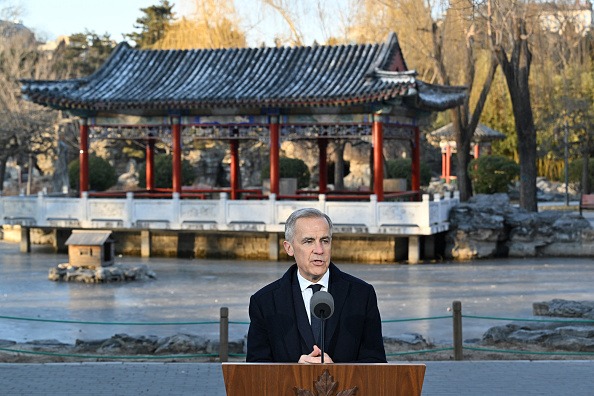
Canada’s Prime Minister Mark Carney speaks during a press conference at Ritan Park in Beijing on January 16, 2026. ( Adek BERRY / AFP via Getty Images)
By NTDTV Staff,
Prime Minister Mark Carney concluded his visit to China by announcing that Canada will significantly reduce its tariffs on Chinese electric vehicles, a move that marks a departure from current U.S. policy.
Speaking to reporters in Beijing on Jan. 16, Carney said the decision is intended to support Canada’s broader effort to deepen economic ties with China while diversifying trade away from the United States.
In “exchange for a small piece” of the Canadian auto market, Carney said he expects Chinese automakers to invest in Canada, including potentially building manufacturing facilities.
“That’s the plan,” he said in French.
The Prime Minister’s Office (PMO) said the tariff changes are part of a broader effort to establish a “new partnership” with China. As part of the agreement, Canada will remove its 100 percent surtax on up to 49,000 Chinese-made electric vehicles annually, instead applying the most-favoured-nation tariff rate of 6.1 percent. The quota will gradually increase to about 70,000 vehicles after five years.
The move reverses a policy introduced in late 2024 under former prime minister Justin Trudeau, when Canada imposed steep tariffs on Chinese EVs, steel, and aluminum. Those measures mirrored steps taken by the United States and were intended to protect domestic manufacturing and encourage local EV production.
While U.S. President Donald Trump has moved away from EV subsidies since taking office in 2025, his administration has retained a 100 percent tariff on Chinese electric vehicles. Trump has argued the policy has helped U.S. automakers remain competitive.
“In Europe, China’s taking over the auto business,” Trump said on Jan. 13 during a visit to a Ford plant. “Here, we have a 100 percent tariff on any car coming in from China.”
Carney said Canada’s revised approach would still limit Chinese EV penetration, noting that the reduced-tariff quota represents about three percent of the Canadian car market.
“We’re returning to the levels of Chinese automobiles as a cap that we had two years ago,” he said.
In exchange, Ottawa expects Beijing to ease trade restrictions on Canadian agricultural and seafood products. The PMO said China will reduce its tariff on canola seed from roughly 85 percent to 15 percent starting March 1. Tariffs on products such as canola meal, peas, crab, and lobster are also expected to be lifted until at least the end of the year. No changes were announced regarding China’s 25 percent tariff on Canadian pork.
The announcement drew criticism from Ontario Premier Doug Ford, who said the deal would give China a “foothold” in Canada’s auto market “at the expense of Canadian workers.” Ford said the agreement lacked firm guarantees of investment and urged Ottawa to reduce regulatory burdens on domestic automakers.
Conservative Leader Pierre Poilievre also criticized the deal, saying there was “no guarantee” that Chinese tariffs on Canadian exports would be fully or permanently removed.
“Meanwhile, Canadian pork farmers still will keep paying the 25% tariff,” he said. Poilievre added that allowing roughly 50,000 Chinese EVs into Canada could “jeopardize our security and auto jobs.”
He also questioned Carney’s shift in tone toward Beijing, noting that during the 2025 election campaign the prime minister described China as Canada’s “biggest security threat,” but now refers to it as a “strategic partner.”
Saskatchewan Premier Scott Moe, whose province has been heavily affected by China’s canola tariffs, welcomed the agreement.
“This deal is a very positive signal that will restore existing trade volumes and open avenues for further opportunities for Canadians,” Moe said.
Carney’s decision comes amid heightened trade tensions with the United States and days after a Chinese state-run media outlet suggested Canada would need to distance itself from Washington to improve relations with Beijing.
“If Ottawa still chooses to subject its China policy to the will of Washington,” China Daily wrote on Jan. 12, “it will only render its previous efforts to mend ties with Beijing in vain.”