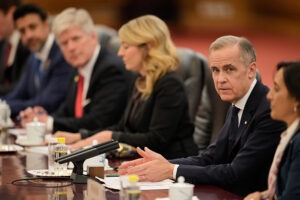
Canada’s Prime Minister Mark Carney’s China visit. (Vincent Thian – Pool/Getty Images)
By NTDTV Staff
Conservative MPs are alarmed by Prime Minister Mark Carney’s comments during his visit to China, after he described Canada and China as “strategic partners” preparing for a “new world order.”
“Canada does not belong in Beijing’s ‘New World Order.’ Our people deserve freedom, not subjugation before the Chinese Communist Party,” Conservative MP Shuv Majumdar said in a post on X on Jan. 15, responding to Carney’s remarks during a meeting with Chinese Premier Li Qiang in Beijing.
During the meeting, Carney thanked Chinese leader Xi Jinping for his efforts in advancing relations between Ottawa and Beijing ahead of the visit.
“This sets the stage for these important discussions on a wide range of issues where we can be strategic partners,” Carney said. He added that Canada is entering a “new era of relations” with China and that progress made in recent months positions the two countries “well for the new world order.”
Carney said his government is seeking cooperation with China on energy, security, people-to-people exchanges, and multilateral issues. He has also argued that Canada must diversify its trade relationships as its ties with the United States evolve under President Donald Trump, with a goal of doubling non-U.S. trade over the next decade.
During the 2025 federal election campaign, Carney described China as Canada’s top security threat and said Beijing did not share Canadian values. While he emphasized the importance of Asian markets, he singled out China as a challenge due to concerns about security and governance.
In recent months, however, the Liberal government has adopted a more conciliatory tone. Foreign Affairs Minister Anita Anand has avoided reaffirming the government’s previous characterization of China as a “disruptive” global power under Canada’s Indo-Pacific Strategy, instead referring to Beijing as a “strategic partner” in areas such as energy, agriculture, security, and the environment.
While in Beijing, Carney also met with Xi, who said through a translator that he was “heartened by the progress” made in “resuming and restarting cooperation across the board.”
In his remarks to Xi, Carney said, “Together, we can build on the best of what this relationship has been in the past to create a new one, adapt it to new global realities that will deliver stability, security, and prosperity to our peoples on both sides of the Pacific.”
On Jan. 16, Carney announced an agreement to reduce Canada’s 100 percent tariffs on Chinese electric vehicles to 6.1 percent for the first 49,000 vehicles imported annually, in exchange for China lowering its tariffs on Canadian canola from 84 percent to 15 percent.
Opposition MPs criticized the move and the broader framing of the visit. Majumdar said Canada should prioritize closer ties with countries such as Japan and South Korea. Conservative MP Michelle Rempel Garner questioned what Carney meant by a “new world order,” calling the remarks “deeply disturbing.”
Conservative MP Matt Strauss criticized the government’s messaging around the trip, saying China is “ruled by a communist dictatorship” and objecting to promotional videos posted by the government on social media.
Former Canadian ambassador to China David Mulroney said it was concerning that Ottawa appeared to be downplaying security risks, while academic and former national security adviser Dennis Molinaro warned that framing the relationship as a “new era” ignored long-standing security concerns.
Industry Minister Mélanie Joly, who accompanied Carney on the trip, said Ottawa is engaging with China “with eyes wide open.”
“We know this,” Joly said, referring to concerns about foreign interference, espionage, and human rights. “When we engage with China… we put everything on the table to address these risks.”
Carney and several cabinet ministers remain in China until Jan. 17. The visit has included agreements on cooperation in areas such as energy and lumber, in addition to changes to EV and agricultural tariffs.