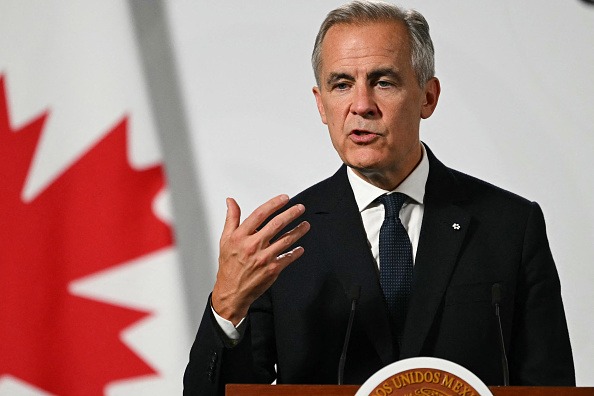
Prime Minister Mark Carney speaks during a joint press conference at the National Palace in Mexico City on September 18, 2025. (Photo by Yuri CORTEZ / AFP)

Prime Minister Mark Carney has announced updates on some benefit programs, including provisions for automatic tax filing and benefits for low-income Canadians, ahead of the release of the federal budget in November.
The prime minister said on Oct. 10 that tax filing will be made automatic for low-income Canadians so they don’t miss qualifying for benefits. He also announced the national school food program will be made permanent, and the Canada Strong Pass for free or discounted admission to national sites will be extended.
Carney made the announcement at a press conference at a recreation centre in an Ottawa, saying the three new measures will be included in the upcoming federal budget, to be tabled on Nov. 4.
As part of the measures, beginning in the 2026 tax year, low-income Canadians will receive automatic federal benefits, with the Canada Revenue Agency automatically filing their taxes to allow them to receive benefits like the GST/HST credit, Canada Disability Benefit, and Canada Child Benefit.
The prime minister said millions of Canadians do not file their taxes, “either because they don’t have the resources to do so, or because they think that their income is too low for it to matter.” He said this means they often miss out on benefits that they are entitled too.
The national school food program will also be made permanent, which will provide meals for up to 400,000 Canadian children.
“The challenges that it addresses are essential; they’re fundamental. So today we’re announcing we’ll move forward with the funding and legislation to make it permanent,” he said, adding that Ottawa will work with the provinces and territories to expand the program to more children.
The Canada Strong Pass, which allows for free or discounted access to various cultural and national sites, will also be renewed for the holidays and for summer 2026. The pass, launched in the summer of 2025, also provides student discounts on VIA Rail train travel.
Carney said the pass had been a “big hit” and resulted in VIA Rail ridership increasing by 13 percent and visitors to Canada’s parks, museums, and historic sites rising by 15 percent.
The prime minister said all three announcements would be “operational” expenses. The Liberal government said during the last election that it intends to split all spending into operational and capital expenditures, and balance operational expenditures within three years.
The Conservatives have criticized the Liberal government for separating operational spending from capital funding in federal budgets, with Tory MP and finance critic Jasraj Singh Hallan saying the change is meant to “bury the deficit in new columns to trick Canadians.” The government says the change is intended to better prioritize budget allocation on major projects and provide a “clearer picture” of the different types of expenditure.
During the announcement, Carney said the upcoming budget would “meet this hinge moment in Canadian history” and would require making “responsible and pragmatic choices.” He said the budget would involve less spending on government operations while protecting programs and initiatives that support the most vulnerable Canadians.
“We’ll take decisions that reinforce the programs that help bring down costs for hard-working Canadian families, and we will build programs that help all Canadians get ahead,” Carney said.
The prime minister also highlighted measures Ottawa has taken to reduce costs for Canadians, such as cancelling the “divisive” consumer carbon tax to bring down gas prices, as well as cutting taxes for 22 million Canadians.
During the last federal election, Carney’s platform projected there would be a deficit of $62.3 billion in the 2025–2026 financial year, which was $20 billion more than the last official projection in the Fall Economic Statement of 2024.
The interim Parliamentary Budget Officer (PBO) recently projected that the federal deficit could reach $68.5 billion this year, which is up from an estimated $51.7 billion last year. PBO Jason Jacques also told the government operations committee on Sept. 25 that “everybody should be concerned” with the looming deficit.