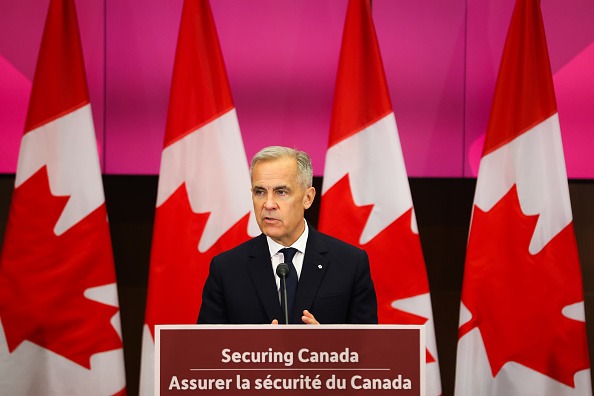
Canadian Prime Minister Mark Carney speaks at a national defense spending announcement on June 9, 2025 in Toronto, Canada. (Photo by Cole Burston/Getty Images)

Prime Minister Mark Carney says he wouldn’t label his government’s approach to international relations as a “feminist foreign policy,” a term embraced by the former Trudeau government.
“We have that aspect to our foreign policy, but I wouldn’t describe our foreign policy as feminist foreign policy,” Carney told reporters at a Nov. 23 press conference in Johannesburg, South Africa, where he attended the 2025 G20 leaders’ summit.
Carney’s comments represent a shift from former Prime Minister Justin Trudeau’s Feminist International Assistance Policy, which had a focus on promoting gender equality and access to abortion. Trudeau’s policy, introduced in 2017, required 95 percent of Canada’s bilateral aid investments to take gender equality into account in funding decisions.
Secretary of State for International Development Randeep Sarai said during a House of Commons foreign affairs committee meeting last month that Canada still had a “very firm commitment” to its Feminist International Assistance Policy.
However, unlike the Trudeau government’s Budget 2024, the Carney government’s Budget 2025 makes no mention of the Feminist International Assistance Policy. The budget also forecasts $2.7 billion in cuts to foreign aid over the next four years, from 2026–27 to 2029–30. Domestically, however, the Carney’s 2025 budget has significantly more funding for initiatives focused on gender issues compared to the 2024 budget under Trudeau.
Carney said discussing issues related to gender-based violence and women’s rights remains part of Canada’s policy, noting that such discussions help to make “broader progress” in establishing trade relations with other countries. He added that the issue of gender-based violence affects all G20 countries but that some countries prioritize the issue higher than others.
“It’s not an economic issue, first and foremost. It is an issue of justice. It affects Canada, it affects everyone around that table. Different countries put a different priority on it,” Carney said.
Carney said work on the issues of gender-based violence and female equality was one of the priorities of the South African presidency. The G20 South Africa leaders’ declaration said the countries are committed to ending “gender-based violence and the killing of women and girls because of their gender.”
He also said with reference to the European Union, “We have similar values … in terms of gender equality, LGBTQ rights, and all of that reflects so the level of economic cooperation, defence cooperation, security cooperation.”
G20 Summit
The G20 world leaders’ summit, held Nov. 22–23 in Johannesburg, was the first G20 summit held in Africa. It was also Carney’s first trip to South Africa since taking office as prime minister earlier this year.
When asked by reporters whether he thought U.S. President Donald Trump’s decision not to attend the summit was “doing any damage to multilateralism,” Carney said there were approximately 62 leaders at the summit, as countries were invited beyond the core G20 members. “That’s multilateralism,” Carney said.
“I look at it more from who shows up, who engages, who does the work, and who builds, and Canada shows up and Canada engages. I think collectively. We’ve made a lot of progress,” the prime minister told reporters.
Trump withdrew U.S. participation from the summit on Nov. 7, citing abuses against white farmers and criticizing South Africa’s foreign policy. The South African Department of International Relations and Cooperation called Trump’s remarks “regrettable” and said his claims were inaccurate.
Carney also noted that this year’s G20 summit “brought together nations representing three-quarters of the world’s population, two-thirds of global GDP, and three-quarters of the world’s trade,” adding that this was without the United States attending.
“It’s a reminder that the centre of gravity in the global economy is shifting,” he said.
Asked by reporters whether he has talked with Trump recently, Carney said the two leaders have “had discussions” but that “I’ve been busy” with the launch of his government’s budget and establishment of new trade agreements with other countries.
“We’re busy, he’s got other things to do, and we’ll re-engage when it’s appropriate,” Carney said.
“I look forward to speaking to the president soon, but I don’t have a burning issue to speak with the president about right now. When America wants to come back and have the discussions on the trade side, we will have those discussions.”
Trade talks broke down between Canada and the United States last month after the Ontario government sponsored a $75 million anti-tariff advertising campaign in the United States that featured portions of a 1987 address by late U.S. President Ronald Reagan. Trump called off trade negotiations with Canada because of the ad campaign, saying it misrepresented Reagan’s address and was meant to interfere with a U.S. Supreme Court decision on his administration’s use of tariffs.
Evgenia Filimianova, Matthew Horwood, and The Canadian Press contributed to this report.
Olivia Gomm is a news reporter with the Canadian edition of The Epoch Times.