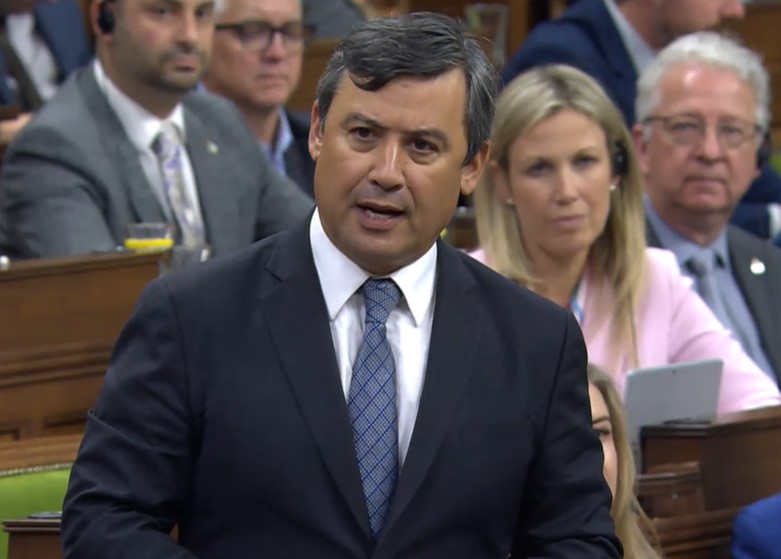
Conservative MP Michael Chong rises during question period in the House of Commons on Parliament Hill in Ottawa on Oct. 18, 2023. (Screenshot from ParlVu)
By NTDTV Staff
Conservative MP and foreign affairs critic Michael Chong says any proposed parliamentary exchanges between Canada and China must be conditional on Beijing lifting sanctions against Canadian parliamentarians and committees.
Chong, who was sanctioned by the Chinese regime in 2021 for speaking out against human rights abuses, made the remarks following Prime Minister Mark Carney’s recent visit to China. During that trip, Carney stressed “the importance of ongoing parliamentary exchanges and opportunities for enhanced understanding and communication between the two countries” in a meeting with Zhao Leji, chairman of the Standing Committee of China’s National People’s Congress, according to a Prime Minister’s Office statement released Jan. 15.
In a statement issued Feb. 5, Chong said such exchanges are impossible without reciprocity. “These exchanges cannot take place unless there is reciprocity between Canada and [China],” he said. “That means there cannot be any sanctions on Canadian Members of Parliament or on Canadian parliamentary committees if any parliamentary exchanges are to take place.”
Chong’s comments follow similar developments in the United Kingdom. While visiting China last week, British Prime Minister Keir Starmer said he had received assurances from Chinese leader Xi Jinping that sanctions against sitting UK parliamentarians would be lifted. Beijing had imposed sanctions on nine UK individuals in March 2021 in retaliation for British sanctions targeting Chinese officials accused of abuses against Uyghurs and other minorities in the Xinjiang region.
Chong noted that the European Union faced a comparable situation. Last year, China lifted sanctions imposed on members and a subcommittee of the European Parliament, a move Chong said was a precondition set by the EU before talks with Beijing could resume. “Following on the Prime Minister’s new agreements with [China], I expect a similar outcome for Canada,” he said.
China announced sanctions against Chong in 2021 while he was serving as vice-chair of the House of Commons Standing Committee on Foreign Affairs and International Development. Beijing also sanctioned Canada’s parliamentary Subcommittee on International Human Rights, as well as Gayle Manchin, chair of the U.S. Commission on International Religious Freedom, and Tony Perkins, its vice-chair. The measures came after Canada and the United States imposed sanctions on Chinese officials over rights violations in Xinjiang.
Those sanctioned by China are barred from entering mainland China, Hong Kong, and Macau, and are prohibited from doing business with Chinese individuals or entities.
Chong’s criticism of Beijing has also had personal consequences. In 2023, the Canadian Security Intelligence Service revealed that members of Chong’s family in Hong Kong had been targeted by the Chinese regime in connection with his advocacy on human rights.
While Chong said he expects sanctions against him and the parliamentary subcommittee to be lifted if exchanges proceed, he emphasized that Canada’s own sanctions should remain intact. He said Ottawa must ensure that sanctions imposed on Chinese “officials and entities responsible for the genocide against the Uyghur people nonetheless remain in place.”
In 2024, Canada sanctioned eight senior Chinese officials for what Global Affairs Canada described as “grave human rights violations” against Uyghurs, Tibetans, and Falun Gong practitioners. Then–Foreign Affairs Minister Mélanie Joly said at the time, “Canada is deeply concerned by the human rights violations in Xinjiang and Tibet and against those who practise Falun Gong. We call on the Chinese government to put an end to this systematic campaign of repression and uphold its international human rights obligations.”
Those sanctions include asset freezes and bans on providing financial or related services to the listed individuals.
Chong said lifting Beijing’s sanctions would also send an important signal. It would “make it clear that the imposition of sanctions is not a legitimate tool to counter those voicing concerns about human rights and the rule of law,” he said.