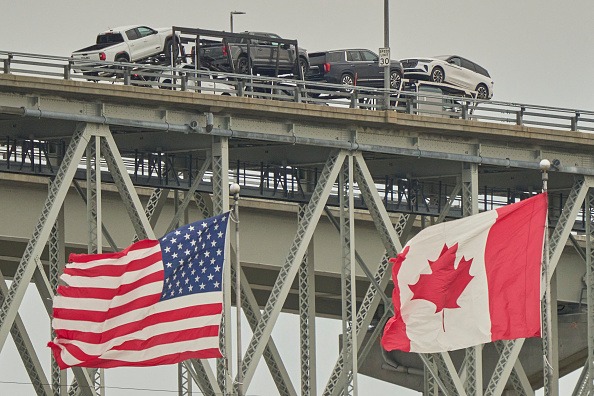
A truck with vehicles crosses the Blue Water Bridge border crossing into the United States from Sarnia, Ontario, Canada on April 3, 2025. (Photo by Geoff Robins / AFP)
Despite stronger-than-expected economic growth this year, Canada’s trade dispute with the United States and elevated energy prices are expected to significantly hamper growth in the year ahead, according to a recent report from Deloitte Canada.
The professional services firm raised its fall 2026 forecast for Canadian economic growth from 0.7 percent to 0.9 percent following stronger-than-expected economic performance in the second quarter.
However, it lowered its 2027 growth projection from 2 percent to 1.6 percent, citing the impact of U.S. tariffs and Canadian counter-tariffs, along with higher energy costs.
“The effects of the recent flare-up in trade tensions are expected to become more pronounced in 2027 with growth forecast to slow sharply in the final quarter of this year and into early 2027 as the economy adjusts to the initial Section 338 tariffs and the Canadian government’s retaliation,” Deloitte Canada chief economist Dawn Desjardins wrote in the Sept. 29 analysis.
Desjardins noted, however, that Canada’s GDP is still expected to grow by 1.6 percent in 2027 despite the slowdown.
The United States imposed previously announced 50 percent tariffs on roughly $27.6 billion of Canadian goods on Aug. 22. Washington subsequently announced import bans covering specified Canadian alcoholic beverages, dairy products, and motorcycles, which took effect Sept. 29, as well as moving to exclude Canadian-origin goods from the U.S. federal procurement system. Canada imposed retaliatory tariffs covering a similar value of American goods on Sept. 8.
Deloitte’s report factors in the 50 percent tariffs and Canada’s counter-tariffs that went into effect Sept. 8 but does not consider the subsequent changes to the U.S. tariff list or American import bans.
Forecast
The report notes that Canada’s economy pulled out of a technical recession after the first quarter of 2026 experienced growth, moving to a growth rate of 3.3 percent per year in the second quarter, with the rebound supported by stronger exports, consumer spending, and business investment.
However, the analysis identifies trade as the “dominant downside risk” and says the 50 percent U.S. tariffs are expected to weaken exports materially through late 2026 and into 2027. It cites key industries vulnerable to ongoing U.S. tariffs and duties such as aluminum, steel, auto manufacturing, and lumber.
Canada’s exports increased at an annualized rate of 15.1 percent in the second quarter of 2026, but Deloitte projects they will decrease by 0.9 percent in the third quarter and 5 percent in the fourth quarter. Total exports are forecast to increase by only 0.3 percent in 2027.
The report states that the impact of the ongoing trade dispute is amplified by the uncertainty it creates for Canadian businesses.
“Many firms are stuck in a wait-and-see mode as tariff exposure and uncertainty over future US market access cause some firms to postpone capacity expansions,” the report says.
The report also identifies productivity and investment as key ongoing challenges. “Canada’s long-term challenge remains productivity and investment,” Deloitte said.
In terms of monetary policy, Deloitte forecasts the Bank of Canada will keep its policy rate at 2.25 percent for the rest of this year before raising it four times in 2027 to 3.25 percent. The central bank kept its rate at 2.25 percent on Sept. 2 but cautioned that higher energy prices and tariffs were increasing inflation risks.
Despite its conclusions for the coming year, Desjardins said Deloitte is still “cautiously optimistic” that new trade and supply-chain relationships, government-supported projects and efforts to encourage investment will allow Canada’s economy to “weather this latest blow.”
Deloitte’s forecast comes as the federal government continues efforts to encourage private investment, including measures announced at the Canada Investment Summit held Sept. 14 and 15 in Toronto. At the summit, Prime Minister Mark Carney unveiled the “Productivity Mega Deduction,” which expands the range of business investments eligible for immediate deduction.
The federal government says the summit generated nearly $500 billion in new investment commitments. The Conservatives have argued that government regulations and taxes are discouraging investment.