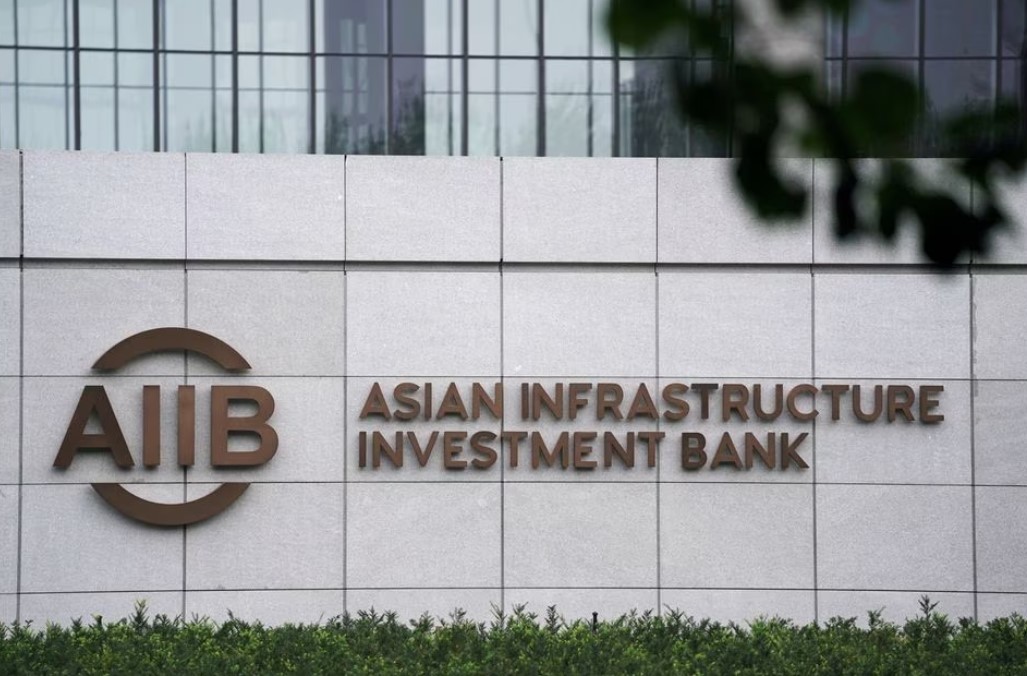
The headquarters of Asian Infrastructure Investment Bank (AIIB) in Beijing, China, July 27, 2020. (REUTERS/Tingshu Wang)
By Andrew Chen
Canadian communications consultant Bob Pickard, known for blowing the whistle on Beijing’s substantial influence within the Asian Infrastructure Investment Bank (AIIB), shared his “traumatic” experiences working at the institution with MPs.
Mr. Pickard was invited to testify before the House Special Committee on the Canada–People’s Republic of China (PRC) Relationship on Dec. 11, sharing insights into his role as the AIIB director general of communications and concerns about the Chinese Communist Party’s (CCP) influence within the multilateral bank, which prompted his abrupt resignation from the position on June 14.
He noted that CCP members hold some of the most influential positions within AIIB, including its president, Jin Liqun, whom he identified as a CCP member and former Red Guard. He further alleged that Mr. Jin “often articulates Chinese government policy.”
“Even though I was supposedly in charge of all global communications for the bank, I subsequently discovered that Mr. Jin’s office, dominated by Communist Party members, was directly involved in crafting messaging with PRC media for the domestic Chinese market that differed from what the bank was communicating in English to overseas audiences,” he said.
Among these messages was the effort to separate the AIIB from Beijing’s contentious Belt and Road Initiative, an infrastructure plan spearheaded by Chinese leader Xi Jinping, which Mr. Pickard characterized as the regime’s “geopolitical expansion project.”
Mr. Pickard also noted how G7 countries like Canada were “brandished like trophy members” to help attract Western capital for the AIIB and to mitigate potential hostile policy consequences from U.S. authorities.
Alleged Control by CCP Agents
Mr. Pickard, who took the initiative to apply for his position at the Beijing-headquartered bank, indicated that he was aware of China’s intention in creating the AIIB in January 2016 to have the institution serve as a “rival to the World Bank” and other Western-led multinational financial institutions.
Before assuming his role, Mr. Pickard said he had concerns about whether Beijing was “exercising undue influence at the bank.” However, he found reassurance in the bank’s published governance and the presence of Western members, which, he said, “allayed these concerns.”
However, he stated that after joining the bank, he quickly realized that the Chinese regime had been meticulously exerting control within the institution, including the placement of its agents.
“In my own department, a CCP member … was appointed as my personal assistant,” Mr. Pickard told MPs. “I found out that this Communist Party member, appointed as my assistant, was secretly reporting directly to the most senior party member in Mr. Jin’s office.”
He further alleged that in 2022, after he had joined the AIIB for several months, the CCP’s influence within the president’s office gained strength with the arrival of a new colleague. The newcomer’s job description remained unclear, except for being known as “the new Party guy.” Shortly thereafter, Mr. Jin’s office underwent renovations, installing security locks to control access for all AIIB staff. This change meant even non-Chinese officials, including the vice president, had to be buzzed into his office for the first time, according to Mr. Pickard.
“This cocooning of the AIIB president is consistent with how the information he receives and the issues he decides are filtered through two CCP officials whose offices were closest physically to his inside of this bubble,” Mr. Pickard said.
Resignation
Mr. Pickard told MPs that he first attempted to resign in May 2022 to protest “the CCP’s pronounced, profound, and pervasive influence in the everyday operating business of the bank, and its toxic impact on the culture.”
“I was kind of shocked that the bank did not deny and did not confirm my allegations or concerns about CCP influence. I was simply informed that the president’s office did not like my raising the taboo CCP topic,” he said.
On June 14, Mr. Pickard made a second attempt to leave the bank, and this time, he said he had first sought refuge in Japan. He previously revealed that this was due to concerns about potential retaliation from the CCP.
The AIIB issued a statement on June 14, accepting Mr. Pickard’s resignation. The bank denied his allegations, describing them as “baseless and disappointing.” In July, the AIIB published a report after conducting an internal review, stating that it has found “no evidence of undue or improper influence” in the decision-making of its senior management.
Mr. Pickard rejected the bank’s report and noted that, following his resignation, he has become a target of online misinformation.
“Hundreds of pro-AIIB, pro-CCP bots on Twitter targeted me with insults and I was accused of being an American agent of espionage, a white supremacist, a neo-colonialist, or part of some nefarious Canadian government plot to embarrass China,” he told the House committee.
Shortly after Mr. Pickard announced his resignation on the platform X, Ottawa said it was freezing ties with AIIB and committed to probing the allegations against the bank.
On Dec. 8, Finance Minister Chrystia Freeland announced that Canada is expanding its probe into AIIB and will also indefinitely freeze its participation in the institution.
Ottawa’s review will encompass several key aspects, including analyzing AIIB’s investments, governance, and management frameworks. It will also examine the bank’s existing environmental and social governance safeguards, particularly regarding issues such as forced labour, complaints handling, and environmental impacts.
Reform
Canada applied to join the AIIB and was accepted in March 2017, becoming the bank’s first North American member. It officially joined the bank in March 2018 and proceeded to ratify its membership by committing roughly $256 million to acquire shares in the bank over five years. Including Canada, the bank currently has 109 approved members worldwide.
The Opposition Conservatives have long called on Ottawa to divest its shares in the AIIB. On Oct. 23, MPs voted in favour of a motion asking the House of Commons Special Committee on Canada-China Relations to invite Ms. Freeland to appear as a witness in the committee’s examination of “Canada’s freeze in government-led activity” with the AIIB.
Mr. Pickard depicted his approximately 16-month tenure at AIIB as a “traumatic, dramatic” experience, stating, “I felt that [Canada’s] membership in this organization was not giving this country a single thing of tangible value that we could proudly explain to people here in our country, that their membership in the Asian Infrastructure Investment Bank would be delivering them back home.”
Mr. Pickard expressed disbelief in the prospect of an improved AIIB with the CCP at its helm.
“At the bank, I would say that so long as we have the current geopolitical situation, and so long as we have the Chinese Communist Party, trying to work to undermine Western democracies and to have China replace the United States as the number one power, it is impossible for that to happen,” he said.