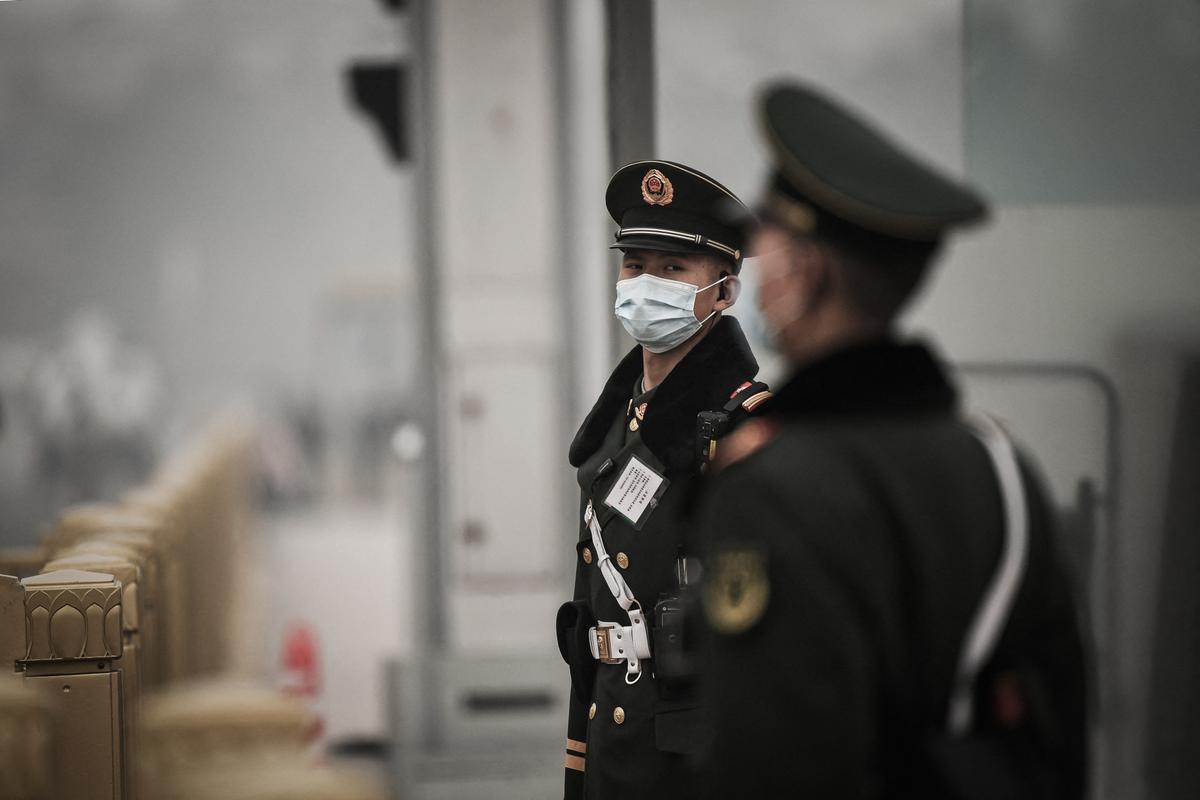
Chinese paramilitary police stand guard on Tiananmen Square in Beijing on March 10, 2021. Noel Celis/AFP via Getty Images
The RCMP deputy commissioner’s remark equating partnerships with Chinese police to those with the FBI is raising concerns among former law enforcement officials and politicians, who say the Beijing regime should not be treated the same as Canada’s democratic allies.
During a Senate national finance committee meeting earlier this week, RCMP Senior Deputy Commissioner Bryan Larkin faced questioning about the contents of the memorandum of understanding (MOU) Ottawa signed on cooperation between the RCMP and China’s Ministry of Public Security while Prime Minister Mark Carney visited Beijing in January.
Larkin told the Senate the agreement is “very standard,” and compared it to MOUs the RCMP has with the FBI, the CIA, the U.S. Drug Enforcement Administration, as well as other police agencies in Canada.
He said such agreements involve how law enforcement agencies share information, disclose information, conduct mutual investigations when requesting information, and address the cost of investigations.
Larkin noted he could not speak to the specifics of what is in the MOU and referred to the Chinese regime as a “partner.”
“We would not disclose anything in the agreement without their permission, and mutually they would do the same,” he told the Senate.
The federal government has so far kept details of the MOU confidential, though other MOUs signed during Carney’s China visit have been made public.
Conservative MP Dean Allison called Larkin’s comments “a complete failure of judgment.”
“The idea that Chinese police are being described as a ‘partner’ on par with the FBI is outrageous on its own,” Allison said in an April 22 post on X.
“But being told that Canadians can’t even see the details of that arrangement without Beijing’s permission? That’s not partnership. That’s submission to a foreign authoritarian regime.”
Allison noted the Chinese Communist Party (CCP) has been “repeatedly accused of interference, intimidation, and operating illegal police stations on Canadian soil,” and now they have a say in what Canadians are allowed to know about Beijing’s relationship with the RCMP.
He called it “completely unacceptable” that Canadians are unaware of what is contained in the MOU, “while a hostile regime is treated like a trusted ally.”
“Who is actually in control here?” he said, adding that the issue raises concerns in terms of transparency and Canada’s sovereignty.
The Conservatives have repeatedly pressed Canada’s minister of public safety to allow parliamentarians to review the agreement if it cannot be released to the public.
‘Not Comparable’
RCMP and Canadian military intelligence veteran Scott McGregor told The Epoch Times that Allison’s concern is “not theoretical.”
He cited the example of British Columbia’s Justice Institute previously training Chinese police personnel in the province. Parliamentary testimony in 2023 indicated one of the Chinese law enforcement students who graduated from the B.C. program was charged in the United States in connection with repression activity targeting critics of the Chinese regime in the United States.
“That history matters,” McGregor said. “It shows why Canadians should reject any language that normalizes the CCP’s policing apparatus as equivalent to trusted democratic partners.”
China’s Ministry of Public Security is “not comparable” to U.S. institutions, he noted, adding that “pretending” otherwise weakens Canada’s response to foreign interference.
McGregor said the attempt to equate Chinese police with American police is “not a minor verbal slip” and reflects a “serious failure” to understand the difference between democratic law enforcement and the security arm of an authoritarian one-party state.
He noted that while the FBI operates within a constitutional system with judicial oversight, legislative scrutiny, and a rule of law culture, China’s Ministry of Public Security serves the interests of the CCP and “has been tied, through open source reporting, parliamentary study, and allied law enforcement cases, to transnational repression, surveillance, intimidation, and covert policing activity beyond China’s borders.”
A public inquiry probing foreign interference in Canada that concluded last year determined China is the most active foreign power meddling in Canada’s affairs.
McGregor noted that Parliament has also acknowledged the presence of illegal Chinese police stations in Canada. A House of Commons report released in 2023 said “at least five” illicit police stations were operating secretly in Canada.
A 2022 report by Spain-based NGO Safeguard Defenders also said secret police operations target those sought by the Chinese regime, including dissidents and democracy activists, and “eschew official bilateral police and judicial cooperation.”
The Canadian Security Intelligence Service has said the stations serve in part to collect intelligence and monitor Chinese dissidents living in Canada as part of a “broader transnational anti-corruption, repression and repatriation campaign.”
Canada, along with G7 partners, signed a joint statement last year, condemning transnational repression and pledging to support those who may be targets of this “aggressive form of foreign interference.”
‘Guard Rails’
Garry Clement, former national director of the RCMP’s proceeds-of-crime program, told The Epoch Times that the federal government’s MOU with Beijing on police cooperation is not comparable to MOUs signed “with democratic countries that uphold the rule of law.”
“This cannot be said for China and thus should have contained well-defined guard rails,” he noted.
Clement told a parliamentary committee last month that the MOU is signed with the same Chinese ministry that was involved in operating illegal police stations in Canada.
“Law enforcement in China is part of the PRC [People’s Republic of China] apparatus,” Clement said. “You can’t separate them from the government, and they do not operate under the rule of law. I experienced it firsthand.”
He also noted that Ottawa and Beijing are “not even close” to being equal partners and have “totally different” agendas.
“I don’t see how the RCMP can operate under this secret agreement,” he said, adding that the agreement is “flawed” and “dangerous” to Canada’s security interests.
Chinese Police Went ‘Missing’
The comments follow testimony by RCMP Supt. Peter Tsui’s testimony earlier this week in a case before the B.C. Supreme Court, saying three Chinese police officials went “missing” for six hours while on an RCMP-escorted visit in Vancouver in 2018, raising concerns they could be involved in repatriating individuals targeted by Beijing.
Approximately 14 Chinese police officers with China’s Ministry of Public Security were hosted by Canadian police in Vancouver and Toronto at the time to work on “mutual files,” related to fraud, money laundering, and “economic fugitives” cases, Tsui said.
Tsui’s April 20 testimony came during the trial of former RCMP officer William Majcher, who has pleaded not guilty to allegations he helped Beijing in a scheme to “induce” a Chinese expat to turn himself over to China, where he was accused of financial crimes.
William Hetherington contributed to this report.