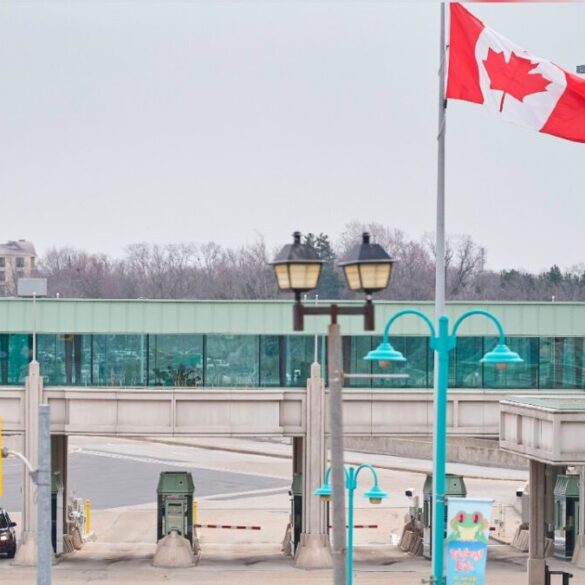
Canadian customs booths in Niagara Falls, Canada, on March 18, 2020, (Geoff Robins/AFP via Getty Images)

Ottawa’s Strong Borders Act could infringe upon Canadians’ Charter rights, including equality rights and privacy implications, a report by the Library of Parliament suggests.
The Strong Borders Act, also known as Bill C-2, aims to strengthen the country’s national security by providing law enforcement with “enhanced tools” to secure Canada’s borders. The report warns that the “wide reach” of the legislation could have Charter implications.
“Balancing national security and public safety with the protection of individual rights remains a complex and evolving challenge,” the Library of Parliament said in the preliminary version of its legislative summary report on the bill.
“While governments have a legitimate interest in implementing measures to safeguard the public, these efforts must be carefully weighed against the rights and freedoms guaranteed under the Charter.”
Should the legislation be enacted, it would empower immigration officials to pause, cancel, or suspend immigration applications and reject asylum claims. The report suggests that this may breach section 15 of the Charter, which ensures the right to equal treatment under the law. Racial minorities, people fleeing violence, and individuals from authoritarian regimes may be disproportionately affected by the new powers, the report said.
Law enforcement and other government agencies would receive surveillance and data-sharing powers if Bill C-2 were passed, which the parliamentary study says could lead to discriminatory profiling and targeting.
Additionally, law enforcement officials would be able to access internet subscriber data and data-sharing between Canadians and foreign authorities without a warrant, which could also “disproportionately impact racialized and immigrant communities,” the report says.
Bill C-2’s full name is “An Act respecting certain measures relating to the security of the border between Canada and the United States and respecting other related security measures.” It was tabled by Public Safety Minister Gary Anandasangaree on May 26 and received its first reading on June 3.
It must pass second and third reading in the House of Commons before it can be sent to the Senate for approval. The bill must also pass through three readings in the Senate before receiving royal assent to become law.
The bill was introduced amid negotiations with the Trump administration to achieve an agreement on trade and security, and it followed Ottawa’s adoption of a $1.3 billion border security plan in late 2024 in a bid to avoid U.S. tariffs.
Privacy Concerns
Section 8 of the Charter protects Canadians’ right to privacy under the right to be secure from unreasonable search or seizure. While there can be limits to privacy rights in some circumstances, such as at the border, the report says the new powers granted under the legislation—to law enforcement agencies, the immigration department, and Canada Post—to collect and share information, may infringe on Canadians’ privacy rights.
Canada Post would be authorized to open letters that have previously been exempt from inspection. Canada Post can currently open mail if there are reasonable grounds to suspect a letter or parcel contains a dangerous substance or contraband.
The parliamentary report also says Bill C-2 aims to change immigration and asylum procedures, which omit certain safeguards like guaranteed access to legal counsel or judicial review and appeal before deportation, which could contravene section 7 of the Charter. This section guarantees the right to life, liberty, and personal security, which includes the right to a fair legal process, protection from arbitrary detention, and access to legal remedies when rights are infringed.
The report notes that individuals may be removed from Canada without a “full and fair” assessment of the risks they face, which is “particularly concerning” for those coming from countries with poor human rights records.
The Library of Parliament’s report serves as a preliminary legislative summary of Bill C-2. It will be updated with an official version when it becomes available.
Charter Statement
Canada’s Justice Department released a Charter statement on Bill C-2 on June 19, which said the bill contains multiple provisions that could impact Charter rights, including extending the powers of Canada Post to be able to search letters. It said these powers have the “potential to engage section 8 of the Charter.”
However, the Charter statement says, “The inspection power promotes important objectives, such as protecting the safety of the public and postal workers, preventing the postal system from being used for unlawful purposes, and assuring an efficient postal system.”
Allowing law enforcement officers to demand information about a client from a service provider without authorization from a judge on “reasonable grounds to suspect” an offence has or will be committed, could be perceived as infringing on section 8 of the Charter, the statement said. However, the statement said the obtained information wouldn’t reveal the content of communications and that “reasonable suspicion” would need to be adhered to.
The proposed law has also raised civil liberty infringement concerns from opposition parties and advocacy groups who say it is too broad to actually strengthen border security.
Conservative MP Michelle Rempel Garner has raised concerns about the bill’s “snooping provisions” while Bloc Québécois MP Rhéal Éloi Fortin said he was concerned with the security of personal information. Anandasangaree, however, has said the bill would not violate civil liberties or Charter rights.
He said it was necessary to modernize the legislative environment around lawful access to information and that the bill was fulfilling the government’s pledge to keep communities safe and work with the United States to bolster border security.
The Department of Justice says the federal government is not consulted in the development of the Library of Parliament’s legislative summaries of bills.
“Bill C-2 contains a variety of proposed amendments intended to keep Canadians safe by ensuring law enforcement has the right tools to investigate crimes, keep our borders secure, combat transnational organized crime, stop the flow of illegal fentanyl and crack down on money laundering,” a spokesperson from the department told The Epoch Times in an Aug. 28 email.
“It is intended to bolster Canada’s response to increasingly sophisticated criminal networks and enhance the integrity and fairness of our immigration system while respecting Canadians’ privacy and Charter rights.”
The Epoch Times reached out to Public Safety Canada for comment but didn’t hear back by publication time.
Noé Chartier contributed to this report.
Olivia Gomm is a news reporter with the Canadian edition of The Epoch Times.