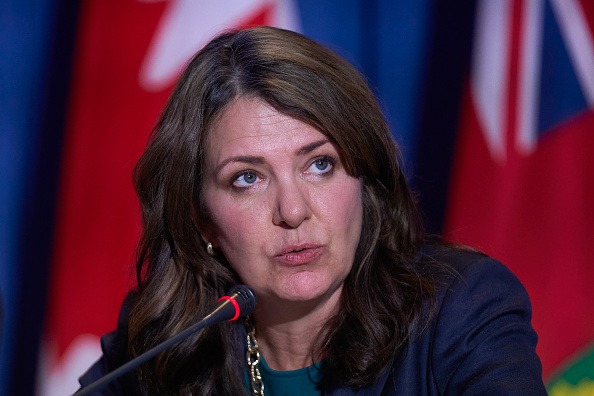
Alberta Premier Danielle Smith speaks during a press conference at Canada’s Premiers Conference in Toronto, Ontario, December 16, 2024. (Photo by Geoff Robins / AFP) (Photo by GEOFF ROBINS/AFP via Getty Images)
The newly U.S.-approved Alberta–Wyoming oil pipeline is an economic win for Canada, but is only one step in getting the country in a position where it can truly maximize benefits from its energy resources, industry watchers say.
U.S. President Donald Trump signed off on the proposed pipeline on April 30 with an executive order. The project supports the export of more than half-a-million barrels of crude oil per day, and would increase Canada’s oil exports to the United States by up to 12 percent.
The South Bow–Bridger Pipeline project would bring Alberta one step closer to Premier Danielle Smith’s long-term goal of reaching 7 million barrels per day of oil production, up from roughly 5 million today.
The announcement comes as oil prices remain elevated following the Iran war and ongoing disruption of shipping through the Strait of Hormuz, increasing the political and economic focus on a secure North American supply.
Pipeline
Trump’s April 30 executive order grants Bridger Pipeline authorization to build and run the pipeline from where it enters the United States in northern Montana down to Wyoming.
Its Canadian partner on the pipeline is South Bow, the Calgary-based pipeline company spun out of TC Energy that now owns the Keystone pipeline system and previously led the since-cancelled Keystone XL project.
According to South Bow and Bridger, the pipeline would transport Canadian crude oil from South Bow’s export terminal in the central Alberta town of Hardisty using approximately 150 kilometres of pipe to reach the U.S. border. This part of the line would use large portions of pipeline that had already been constructed for the Keystone XL pipeline and are still permit-ready.
At the border, the pipeline would then connect to 1,038 kilometres of line running from Phillips County, Montana, to Guernsey, Wyoming.
Guernsey is a major crude storage and pipeline nexus in Wyoming, where Canadian oil can be transported to broader U.S. transport networks serving large refineries further south.
The project is still in development and will depend on shipper commitments and consultation with stakeholders, in addition to state-level regulatory greenlights on the American side, with South Bow asking for commitments from Canadian producers amounting to at least 450,000 barrels per day (bpd) before they move forward with the project.
The original Keystone XL pipeline was first proposed in 2005 with capacity to ship 830,000 bpd from Alberta to Nebraska, but was cancelled by then-U.S. President Joe Biden in 2021.
Smith’s Plan
Smith’s long-standing advocacy for exporting more of Alberta’s energy resources dovetails with her backing for the South Bow–Bridger proposal, according to Heather Exner-Pirot, director of energy, natural resources and environment at the Macdonald-Laurier Institute.
“Danielle Smith has long advocated for doubling Alberta’s oil production. A new export pipeline to the United States was a key part of that plan,” Exner-Pirot told The Epoch Times. But she noted that additional expansions are needed to meet the goal the Alberta premier has set.
Exner-Pirot said that Smith could achieve her goal of 7 million bpd production if the Enbridge Mainline is optimized into the U.S. Midwest, the Trans Mountain Expansion is further expanded, the South Bow–Bridger line becomes operational, and a new pipeline is built from Alberta to the B.C. Coast.
Alberta signed a memorandum of understanding with Ottawa on Nov. 27 of last year proposing to work together to approve a proposed pipeline carrying 1 million bpd of crude oil from Alberta to the B.C. coast in order to reach Asian markets. The project needs to have a private backer. It also faces opposition from B.C. Premier David Eby, along with disagreement expressed by various indigenous groups.
Exner-Pirot added that while the South Bow–Bridger line is part of Alberta’s energy export aims, “the question will turn to how to attract the capital needed to fill over two million barrels of pipeline egress – the investment in upstream production, not just pipelines.”
Will It Get Built?
Dan McTeague, president of Canadians for Affordable Energy, said it is likely that, at least on the American side, capital can be secured and the pipeline completed before Trump’s second term ends in January 2029.
“It seems to me this would be a no brainer. Let the capital markets do what they do best at when they’re unfettered and unburdened by woke ESG [environmental, social, and governance framework] climate nonsense that has frustrated any kind of development in Canada,” he said, adding that Canada should be increasing production and transport further.
McTeague said that the market case for such a pipeline is stronger than it’s been in years, particularly amid heightened global instability of the recent Iran war and renewed concern over secure energy supplies.
Markets have already begun reacting positively, McTeague noted, adding that the Canadian dollar has picked up over a penny and a half on the news.
“This is our best road ahead,” McTeague said, adding that greater export capacity will also narrow the gap between Western Canadian Select (WCS) pricing and West Texas Intermediate (WTI) pricing and improve purchasing power for Canadians.
WCS generally sells for considerably less than WTI as Canada has less routes to market and fewer buyers. However, if the price gap narrows, McTeague said that Canada can earn more on the oil it is producing, bringing in greater revenue for what it does sell and potentially further strengthening the Canadian dollar.
Jack Mintz, president’s fellow at the University of Calgary’s School of Public Policy, also said the project is more likely to get built than Keystone XL ever was.
“I think it’s very good news,” Mintz told The Epoch Times. “I think this one’s likely going to happen.”
“I mean, if you can get more pipelines going to the Pacific coast, that’s another story. But at least this is good news,” he added.
Mintz noted that he also believes the pipeline is likely to be completed before Trump leaves office. He said that much of the pipeline route uses already built piping on the Canadian side and that the U.S. route will follow a simpler corridor than the former Keystone XL proposed route to Nebraska.
“I can’t see the regulatory process being terribly slow in this,” he said, adding that for the Canadian side of the equation, “The question is whether the oil sands plants will respond with more production. That’s going to be the big issue.”
For her part, Premier Smith said Ottawa’s recent decision to lift its proposed oil and gas emissions cap puts Alberta in a strong position going forward to “produce more of the oil that the world needs.”
American Ties
Mintz and Exner-Pirot expressed some concern over Canada’s overall lack of energy export diversification.
“Certainly, we’re not diversifying very much,” Mintz said. “Already 90 percent of our oil goes down to the United States.”
Exner-Pirot said, “It’s unfortunate that it is easier to send Alberta oil to the United States than to Asian markets via B.C.”
For McTeague, however, the deepening of energy ties with the United States represents a strategic advantage for Canada, whose heavy crude oil is precisely the kind needed to fuel the American economy.
“The Americans are doing this because they recognize Canada’s a reliable provider of a kind of a particular product,” McTeague said. “Heavy oil is the very thing that built, makes the kind of diesel on which the global economy thrives.”
Although Venezuelan oil starting to come back online and flow into U.S. refineries may have some impact, McTeague said Canada is perfectly positioned to profit and deepen ties from the American need for heavy crude oil, which continues to be the lifeblood of its industrial base, agricultural sector, and national security framework.
“America wants to say it’s really energy independent, right? They have a problem. Their production is 13-and-a-half million barrels a day, but the consumption is 21,” he said. “To fill that gap, you’re going to need a lot more Canadian oil.”
Smith echoed McTeague’s views on the importance of U.S. ties, commenting that the South Bow–Bridger pipeline would be an important part of Canada’s close economic relationship with the United States.
“The U.S. is our most important trading partner,” the Alberta premier said in an April 30 statement regarding Trump’s signing of the executive order. “We will continue to deliver energy to help secure North American energy dominance.”