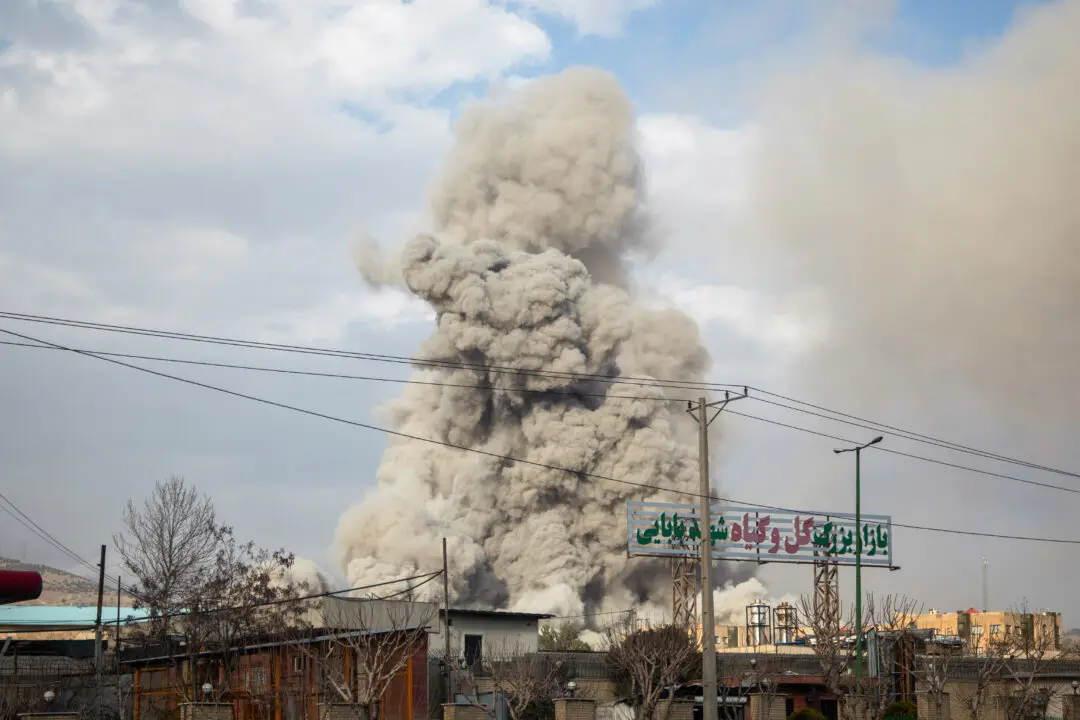
Explosion in Tehran, Iran, on March 2, 2026. Majid Saeedi/Getty Images
Iran has effectively shut down the Strait of Hormuz and targeted ships and oil infrastructure in response to the attacks launched by the United States and Israel over the weekend, which will have impacts on Canada’s energy sector as well as fuel prices.
Analysts have previously predicted that oil could hit more than US$100 a barrel in the event of the Strait of Hormuz being closed, as it serves as a key passageway essential for global energy supply. These higher energy prices would likely trickle down into higher food costs for Canadians.
While Brent crude oil rose from US$71 a barrel on Feb. 27 to US$78 by March 2, Dan McTeague, president of Canadians for Affordable Energy, said prices will continue rising the longer the conflict goes on.
McTeague estimated this could translate into an increase at the gas pump of between 10 and 20 cents per litre.
He said the conflict could also lead to global energy shortages, which will be “impactful” on Canada’s economy. McTeague noted this is especially true for diesel, which is used as fuel for transport trucks, farm machinery, and construction equipment.
“It looks like it’s not going to end overnight. And so I think we have to brace for an inflationary hit, and we also have to brace for an increase in the cost of living,” McTeague said.
He said Alberta will benefit from the higher oil prices that will increase profits for its oil and gas sector.
US-Israel War With Iran
The United States and Israel launched air and missile strikes on Iran on Feb. 28 after negotiations over Iran’s nuclear program broke down. The attacks also resulted in the death of Iranian Leader Ayatollah Ali Khamenei.
In response, Iran has launched missile and drone strikes against U.S. military positions and other strategic targets in the region, and has warned commercial vessels against transiting the Strait of Hormuz—a critical chokepoint for roughly one-fifth of global oil shipments—causing a sharp reduction in tanker traffic.
At least four commercial tankers in the region have been hit as of March 2, and an accompanying rise in shipping insurance rates has led to very few vessels attempting to cross the waterway.
The closing of the Strait of Hormuz impacts several oil-rich countries in the Middle East, such as Saudi Arabia, Iraq, Bahrain, Qatar, Kuwait, and the United Arab Emirates. Those nations, along with Iran, made up over 32 percent of the U.S. dollar value of global oil exports in 2024, with more than 15.5 million barrels exported per day.
Iran also allegedly used drones on March 2 to bomb Saudi Aramco’s Ras Tanura facility, which handles nearly 7 percent of global oil supply. QatarEnergy, which supplies 20 percent of global Liquid Natural Gas (LNG), also announced it had stopped production following Iranian drone attacks.
McTeague noted that increased insurance costs for ships, along with the threat of Iranian assaults, will cause the majority of vessels to steer clear of the Strait. As global oil demand hovers at around 105 million barrels per day, an oil shortage and increased energy costs are expected to occur as a result of the reduction in tanker traffic.
McTeague also said there are no “swing producers” that can “come to the rescue” and bring more oil supply to market. While the Organization of the Petroleum Exporting Countries (OPEC) recently pledged to increase oil production, McTeague said that is “very much up in the air” due to the situation in the Strait of Hormuz.
He noted diesel has already dramatically increased in price. Diesel prices rose by around 17 percent when markets opened on March 2, rising from $2.59 on Feb. 28 to $2.88. That was larger than the increase for Brent crude oil, which rose by 13 percent.
McTeague noted diesel tends to be reflected in the cost of goods “much faster than gasoline” because it is used as a carry-through for most product inputs. Diesel is used in industrial facilities, hospitals, generators, farming and construction equipment, and in transport vehicles.

Dhows are anchored off Khasab, on northern Oman’s Musandam Peninsula overlooking the Strait of Hormuz on June 24, 2025. World markets fear that Iran could shut the Strait of Hormuz, a chokepoint for about one-fifth of the world’s oil supply. Photo by Giuseppe Cacace/AFP via Getty Images
Alberta Energy
McTeague said a rise in energy prices will benefit the province of Alberta, which will see its revenues from oil and natural gas increase.
Alberta recently forecasted a $9.4 billion deficit in its 2026 budget, which it attributed to lower oil prices. The budget estimates were based on a forecasted average price for West Texas Intermediate (WTI) crude oil of US$60.50 per barrel for the coming fiscal year.
McTeague said while Alberta’s ability to produce oil is “certainly there,” federal energy policies have hindered its ability to transport that oil to market.
Alberta Premier Danielle Smith said on March 2 that ongoing tensions in the Middle East “underscore the importance” of expanding Canada’s oil production and exports. She said with Asian markets sourcing 60 percent of their oil from the Middle East, “Alberta can be the answer to global energy security.”
Smith reiterated her call for a new energy pipeline to bring 1 million barrels of oil per day from Alberta to the West Coast. Prime Minister Mark Carney and Smith signed a memorandum of understanding in November 2025 that would pave the way for the building of a new oil pipeline to the B.C. coast if a private proponent comes forward and other conditions are met.
Canada has not focused on increasing its global oil exports, which McTeague argues has caused the Canadian dollar to fall in value compared to the U.S. dollar. It is currently valued at roughly 73 cents to the U.S. dollar.
McTeague pointed out that while the Canadian dollar was on par with the U.S. dollar during the financial crisis of 2008, it is unlikely this will occur again.
He said higher inflation could “be back,” and while it could be a temporary phenomenon, the conflict between Iran and the United States may not be resolved in the short term. U.S. President Donald Trump has said military operations could last four to five weeks.
Food Prices
Dalhousie University Agri-Food Analytics Lab director Sylvain Charlebois said the closing of the Strait of Hormuz is “of great concern for the agriculture sector.” In addition to diesel being used in the production and transportation of food, Charlebois noted that 30 percent of chemical fertilizers, which are made using natural gas, pass through the Strait.
Charlebois said if the war and the closure of the Strait last more than a few weeks, it will have “ripple effects” on Canadian energy, transportation, and eventually food costs. Charlebois also said the reverberations could be worse than what was seen during the onset of the Russia-Ukraine War.
Russia’s invasion of Ukraine in 2022 led to supply chain disruptions and higher prices for oil, natural gas, fertilizer, and food. Charlebois said while the conflict mainly resulted in supply chain disruptions concerning agricultural goods, which caused a rise in food prices, the current conflict in the Middle East is “all about energy.”
“If things get resolved quickly, we could actually see oil prices go even lower than they were last week, so it really depends,” he said.
The 2026 edition of Canada’s Food Price Report had expected grocery prices would rise by 4 to 6 percent this year, costing the average family of four in Canada an extra $994.63. The report was released before the conflict in the Middle East and does not account for potential price impacts of the geopolitical tensions.
The report said that gas and food prices are “highly interconnected” and that any shocks to the price of gas would be “directly felt by the food industry” as higher prices for fertilizers, farm fuel, and transportation ripple through the supply chain.
Despite gas prices being lower in 2025, the report said Canadians have still been “feeling the impacts of the last few years of high energy spikes in their grocery bills.” The report said food inflation is quick to rise in response to higher energy costs, but takes a longer time to stabilize and come down.