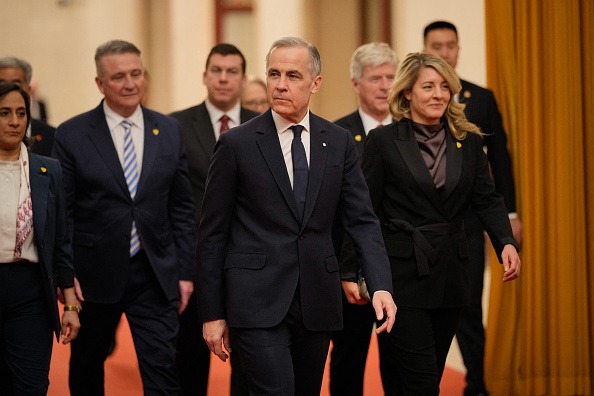
Prime Minister Mark Carney (centre), Industry Minister Mélanie Joly (right), and other Canadian ministers arrive at the Great Hall of the People in Beijing for a meeting with Chinese President Xi Jinping on Jan. 16, 2026.
By NTDTV Staff
Industry Minister Mélanie Joly says Canada should pursue free trade with a range of countries, including China, as the United States adopts more protectionist trade policies.
Speaking to reporters in Beijing on Jan. 15 after a day of meetings with Chinese officials and business representatives, Joly said Canada must reduce its reliance on the U.S. market by expanding trade relationships elsewhere.
“To counter the rise of protectionism, certainly the rise of U.S. protectionism, Canada must be able to work with different countries on free trade approaches,” Joly said. “Certainly with Europe, certainly with Asia, and also with China, because if we can’t work in a multilateral way with multiple countries, we’re going to be even more dependent towards the United States.”
Joly’s comments came during Prime Minister Mark Carney’s visit to China, which the federal government has framed as an effort to “recalibrate” bilateral relations after several years of strained ties. Ottawa is seeking to double non-U.S. exports and attract new investment as it responds to tariffs imposed by U.S. President Donald Trump.
Canada had previously explored free trade and closer economic ties with China under former prime minister Justin Trudeau. Those efforts stalled after Canada carried out a U.S. extradition request for a Huawei executive in late 2018, followed by China’s detention of two Canadians for more than 1,000 days.
Joly said Canadian businesses are increasingly seeking stability and predictability amid what she described as growing global uncertainty, including developments in the United States.
“We’ve seen since the beginning of the year, there’s lots of disruptions around the world… obviously, a lot of unpredictability south of our border,” she said. “There are a lot of things that we cannot control, but there are lots of things we can control, and who we do business with is something we can control.”
She said discussions in China focused on increasing Canadian exports and encouraging Chinese investment in Canada.
The tone of Canada’s engagement with China has shifted in recent months. After Foreign Affairs Minister Anita Anand visited Beijing in October 2025, she described the relationship as a “strategic partnership.” That marked a change from the April 2025 election campaign, when Carney described China as the “biggest security threat” facing Canada due to concerns over foreign interference.
Following a meeting between Carney and Chinese leader Xi Jinping in October, both sides referred to the relationship as being at a “turning point.” On Jan. 15, Joly echoed that language, speaking alongside Energy Minister Tim Hodgson.
“This is a new year, and we’re now in a new era of partnership with China,” Joly said.
Hodgson relayed comments he said came from senior Chinese officials, including from the chairman of the Standing Committee of the National People’s Congress, who described the relationship as “a full turnaround.” Hodgson also said Premier Li Qiang expressed a desire for “a new strategic partnership with Canada.”
Hodgson announced a memorandum of understanding aimed at increasing the use of Canadian timber in Chinese construction.
“This is just the beginning,” he said. “This is not a one-and-done.”
The ministers did not provide new details on the ongoing trade dispute between the two countries. China has imposed tariffs on Canadian agricultural and seafood products in response to Canada’s duties on Chinese steel, aluminum, and electric vehicles. Joly said negotiations are continuing and more information would be provided after Carney’s meetings on Jan. 16.
The visit has drawn criticism from Conservative MPs. MP Matt Strauss said China is “ruled by a communist dictatorship,” while MP Roman Baber noted that China accounts for about five percent of Canada’s exports, compared with roughly 80 percent for the United States.
Meanwhile, U.S. officials have not commented on Carney’s visit. Trump described the USMCA trade agreement as “irrelevant” on Jan. 13, ahead of its scheduled renegotiation later this year.
Asked whether Canada still views China as a “disruptive” global power, a term used in the 2022 Indo-Pacific Strategy, Joly said, “Currently there are many countries that are disruptive powers.”