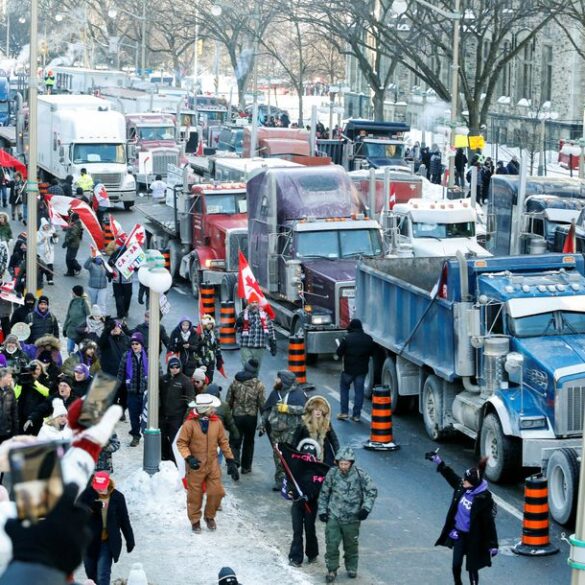
Trucks sit parked on Wellington Street near the Parliament Buildings as truckers and their supporters take part in a convoy to protest coronavirus disease (COVID-19) vaccine mandates for cross-border truck drivers in Ottawa, Ontario, Canada, January 29, 2022. REUTERS/Patrick Doyle

A judge of the Ontario Court of Justice has ordered the RCMP and TD Bank to produce records relating to the freezing of a man’s bank accounts during the 2022 Freedom Convoy protest, according to the Justice Centre for Constitutional Freedoms, which is involved in the case.
Evan Blackman was arrested in Ottawa during the protest against COVID-19 vaccine mandates and pandemic restrictions on Feb. 18, 2022. He was charged with mischief and obstruction but was acquitted in October 2023. However, the Crown appealed the acquittal in 2024 and a new trial is set to begin on Aug. 14, 2025.
As part of the federal government’s invocation of the Emergencies Act, Blackman also had his bank accounts frozen for over a week. The federal government invoked the act on Feb. 14 to give law enforcement expanded powers to arrest demonstrators, freeze the bank accounts of some protesters, and require towing companies to remove protesters’ vehicles from Ottawa’s downtown core.
Blackman’s lawyers are seeking the records concerning the freezing of his accounts to support an application under the Charter of Rights and Freedoms at the upcoming retrial.
Constitutional lawyer Chris Fleury told The Epoch Times that they are requesting these records to prove that the freezing of Blackman’s bank accounts was “a very serious violation of the Section 8 rights, and it warrants the stay of proceedings.”
The Justice Centre noted that the judge’s ruling for TD Bank and the RCMP is likely the first criminal case in Canada involving a proposed Charter application based on the freezing of personal bank accounts under the Emergencies Act.
Mosley also said that the invocation of the act infringed the charter’s Section 2(b), which deals with “freedom of thought, belief, opinion, and expression,” and Section 8, which deals with “the right to be secure against unreasonable search or seizure.”
He said the decision to freeze bank accounts was “not minimally impairing” because it applied everywhere in Canada, including in areas where there were no protests, and because there were other less impairing alternatives available to the government.
Mosley’s decision contradicted that of the Public Order Emergency Commission, which was created in the aftermath of the Freedom Convoy protest to determine whether the federal government was justified in invoking the Emergencies Act.
That commission, which heard from dozens of witnesses over the course of several months, ended with Commissioner Paul Rouleau determining in February 2023 that cabinet had met the “very high” threshold to invoke the act. Rouleau said the government had “reasonable grounds to believe that there existed a national emergency arising from threats to the security of Canada that necessitated the taking of special temporary measures.”
The RCMP and TD Bank did not respond to The Epoch Times’ request for comment before press time.
Matthew Horwood is a reporter based in Ottawa.