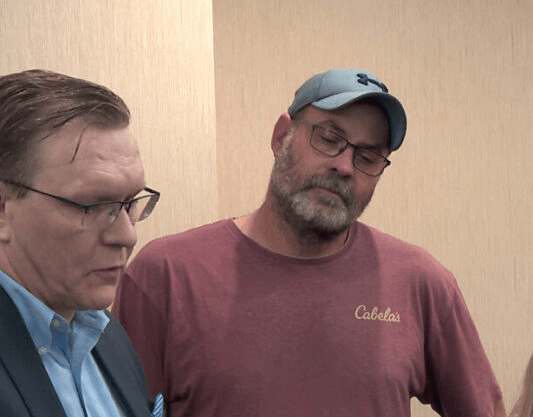
JCCF Lawyer Keith Wilson(L) and Freedom Convoy organizer Chris Barber (R) in Ottawa on Feb. 3, 2022. (Gerry Smith/NTD)

Freedom Convoy organizer Chris Barber will be able to keep his long-haul truck “Big Red” after a judge dismissed the Crown’s application to seize the vehicle used in the 2022 protest.
“The Crown’s application for the forfeiture of Big Red is denied, the court having found forfeiture of Big Red to be disproportionate,” Justice Heather Perkins-McVey said on Dec. 19.
Perkins-McVey said while the truck was used as offence-related property for the protest, forfeiture would have been disproportionate because the truck is used for Barber’s business and there is “no evidence” that Big Red will be used in future criminal offences.
“On the contrary, the evidence suggests that Big Red will continue to be used for its legitimate and intended commercial purposes as a work truck in the future, much the same way as it has been used since its purchase in 2004,” she said.
The judge did not accept the defence’s request for the Crown to pay compensatory costs, as this measure is “rare and exceptional” under the Criminal Code, and the Crown’s conduct did not “exhibit a hardball attitude or systemic disregard for legal standards.”
Barber and fellow organizer Tamara Lich were found guilty of mischief earlier this year, and Barber was additionally found guilty of counselling others to disobey a court order. Perkins-McVey did not find Lich and Barber guilty on charges of intimidation, counselling to commit intimidation, or obstructing police.
Barber’s defence lawyers argued during the trial that the Crown did not have jurisdiction to seize the vehicle because prosecutors didn’t file a related restraint order when Barber was arrested in February 2022. Defence lawyer Brendan Miller also noted the truck is no longer owned by Barber’s business, C.B. Trucking Ltd. Barber sold it to his parents’ business Springbank Farms Inc. to obtain the necessary collateral to buy his son a new truck.
Miller argued on behalf of Springbank Farms Inc. that the Crown’s application was fundamentally flawed and should be summarily dismissed. The lawyer also sought for the Crown to pay costs if the judge ruled in the defence’s favour on the seizure of Barber’s truck.
The Crown argued that Barber’s truck is offence-related property because he used it to participate in the protest and it was used as a symbol for the movement. The Crown also said Barber’s parents financially supported Barber during the protest, which meant they were not innocent third-parties.
Cross-Application to Dismiss
At the outset of her decision, Perkins-McVey denied the defence’s cross-application for summary dismissal of the Crown’s forfeiture application, as the application was not “manifestly frivolous.”
Perkins-McVey also said the Criminal Code does not require that the property at issue be seized or subject to a restraint order, and the Crown must merely prove that it is offence-related property.
The judge said the Crown had proved that Barber’s truck was related to the offences because “not only was ‘Big Red’ an instrument of mischief” by being used to block roads, but it “became part of the Freedom Convoy branding.”
While Perkins-McVey acknowledged that Barber moved his truck when police asked him to, she said the trial’s evidence showed that police directives about keeping emergency lanes open and limiting the number of vehicles on each street were not adhered to, and Big Red contributed to the blockage of Wellington Street.
The judge said Big Red was used in connection with Barber’s offence, and the Crown met its burden in determining that the truck was offence-related property.
When it came to relief from forfeiture for innocent third parties, which would have allowed for the property to be returned to its lawful owner, “where the justice is satisfied that the lawful owner appears innocent of any complicity or collusion in relation to the offense,” Perkins-McVey said both components of the remedy were not satisfied.
The judge said while she was satisfied that Barber and his parents did not coordinate the sale of the truck in order to avoid forfeiture, the third parties were “not innocent of complicity.” She said the trial evidence showed that Barber’s son and parents were aware of his role in the protest and supported him in committing offences.
Perkins-McVey said Barber’s son claimed he did not know Big Red was being used to block streets, but under cross-examination he said he drove the truck to the protest and assisted Barber in dealing with the truckers.
The judge said while Barber’s parents also claimed to have no knowledge of the truck being used to block roads, evidence during the trial showed they supported Barber’s protesting, knew when he was about to be arrested by police, and donated $500 to Barber so he could pay for living expenses and continue protesting.
Disproportionality Test
Perkins-McVey said the Criminal Code gives courts the discretionary power to relieve, in whole or in part, from a forfeiture order, and judges must consider the nature and gravity of the offence, the circumstances surrounding the commission of the offence, and whether the offender has a criminal record.
The judge said the available case law “offers very little guidance in this regard, particularly in relation to mischief and compelling others to disobey a court order,” but there were two previous cases to examine. In R. v. Craig, a woman pleaded guilty to producing marijuana in her home and selling it, but the judge declined to order the forfeiture of her home.
Perkins-McVey said in another case, R. v. Kabanga-Muanza, a judge ordered the seizure of a vehicle that was found to be “instrumental” in the storing of firearms and drugs, and the forfeiture was not disproportionate because there was a “real risk that the vehicle, if not forfeited, would aid in the commission of future offences.”
The judge said the disproportionality test will not favour the forfeiture of property when it is “intended to be used for legitimate purposes in the future or is intended to be used by a person other than the offender.”
Perkins-McVey said that Barber attempted to attenuate the impact of the mischief during the Freedom Convoy protest. She also said Big Red was not “modified, fortified or otherwise adapted to accommodate the commission of the offence,” and the continued operation of the truck would not pose any “public risk.”
The judge also acknowledged that the seizure of the truck would impact Barber’s business and the livelihoods of his employees. She also noted that Barber does not have a prior criminal record, so it is not a consideration in the risk of future offending.
“By all accounts, Christopher Barber is a hard-working family man; a truck driver who runs a small trucking company along with his son and contract drivers … The truck itself is used as part of a legitimate business. It was only offence-related property because of how it was used during the offence. There is nothing to suggest that confiscation would prevent future crimes,” she said.
The justice dismissed the defence’s application for the Crown to award costs, as that requires an unacceptable departure from prosecutorial standards, or exceptional circumstances where fairness demanded relief, and neither applied in this case.
“The application was pursued in good faith, grounded in law and evidence, and conducted with respect to procedural fairness … The Crown’s conduct does not meet the threshold for punitive or compensatory costs,” she said.
The judge said that with the application for the forfeiture of Big Red being denied, “this case has come to a final end.”
In a livestream conducted after the judge’s decision, Barber said the verdict was a “fail on the Crown.” Barber said he had been driving Big Red throughout the day while listening to the judge’s verdict via Zoom, and was currently parked in North Dakota.
“She has ruled in our favour. My nerves are a little shot, I think, right now,” Barber said. He added that he appreciated the support he had been shown, and the trial had been a “roller coaster ride.”
“I can deal with the sentence, I can deal with the 12 months of house arrest as long as I’m able to work, and I could deal with the curfew after that. But I couldn’t deal with them taking my truck and my livelihood. This truck has been my life for 22 years,” Barber said.
The Crown has filed appeals against the sentencing and acquittals of intimidation charges for Lich and Barber, and the two organizers have also appealed their sentences.
Matthew Horwood is a reporter based in Ottawa.