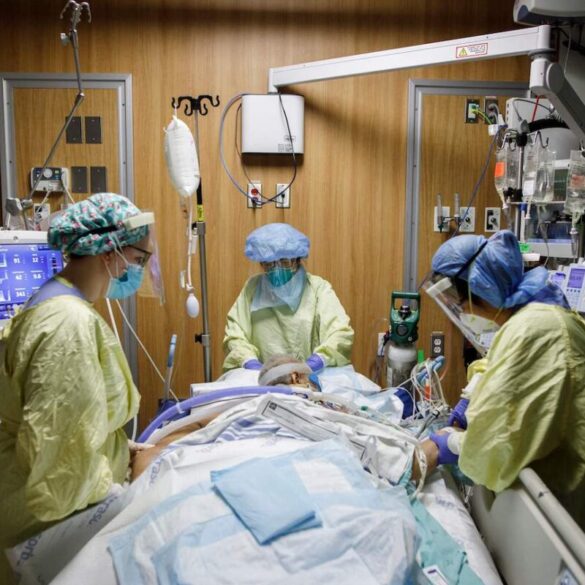
Respiratory Therapist Flor Guevara repositions a patient suffering from coronavirus disease (COVID-19), with the help of other healthcare workers, at Humber River Hospital’s Intensive Care Unit, in Toronto, Ontario, Canada, on April 29, 2021. (Photo by Cole Burston / AFP)

Excessive wait times for medically necessary surgery and treatment cost close to $3.6 billion in lost wages and productivity in 2022, according to a new research report by the Fraser Institute, a non-partisan think tank.
The Private Cost of Public Queues for Medically Necessary Care, 2023, released May 9, values only the hours lost during the average work week. It said an estimated nearly 1.23 million Canadians were on waiting lists for medical treatment in 2022.
With an average wait time averaging 14.8 weeks between seeing a specialist and receiving treatment, the cost per patient waiting worked out to $2,925.
“This is a conservative estimate that places no intrinsic value on the time individuals spend waiting in a reduced capacity outside of the work week. Valuing all hours of the week, including evenings and weekends but excluding eight hours of sleep per night, would increase the estimated cost of waiting to $10.9 billion, or about $8,897 per person,” said a summary of the findings by the study’s co-authors, policy analyst Mackenzie Moir and director of health policy studies Bacchus Barua, both with the Fraser Institute.
“Waiting for medically necessary treatment remains a hallmark of the Canadian health-care system, and in addition to increased pain and suffering—and potentially worse medical outcomes—these long waits also cost Canadians time at work and with family and friends,” said Barua in a news release.
Backlog
The data for the study came from the Fraser Institute’s yearly survey of Canadian physicians to calculate the median waiting time for patients across the country.
The report does not include the additional 12.6-week wait before seeing a specialist after a referral from a family doctor, notes the study.
Added together, 12.6 weeks between general practitioner referral and specialist visit, plus 14.8 weeks between specialist visit to treatment date, the total median wait time in Canada for medical treatment was over 27 weeks in 2022, the longest wait time in the history of the survey.
The study notes that COVID-19 had a potential impact on wait times and the number of procedures performed in hospitals, which might account for the longer total wait time of 27.4 weeks in 2022 compared to 25.6 weeks in 2021.
This estimate only counts costs borne by the person waiting for treatment, the study said. It doesn’t attempt to place a value on costs borne by family members caring for the individual waiting for treatment, such as their lost productivity due to difficulty or mental anguish.
Also not included in the estimate are non-monetary medical costs, such as increased risk of mortality or adverse events that result directly from long delays for treatment.
“Because wait times and incomes vary by province, so does the cost of waiting for health care. Residents of Manitoba in 2022 faced the highest per-patient cost of waiting ($4,463), followed by Nova Scotia ($4,230) and New Brunswick ($3,691),” said the news release.
“From a historical perspective, the estimated $2,925 private cost of waiting for treatment per patient in 2022 is 65% higher than the $1,771 (inflation adjusted, 2022 dollars) estimated for 2004,” the study said.
The ability of individuals waiting to enjoy leisure time and earn an income is diminished by physical and psychological pain and suffering, the study says.
It also notes that friends and family may be asked to help those patients waiting for treatment, or may suffer similar reductions in their productive lives because of their own psychological pain.