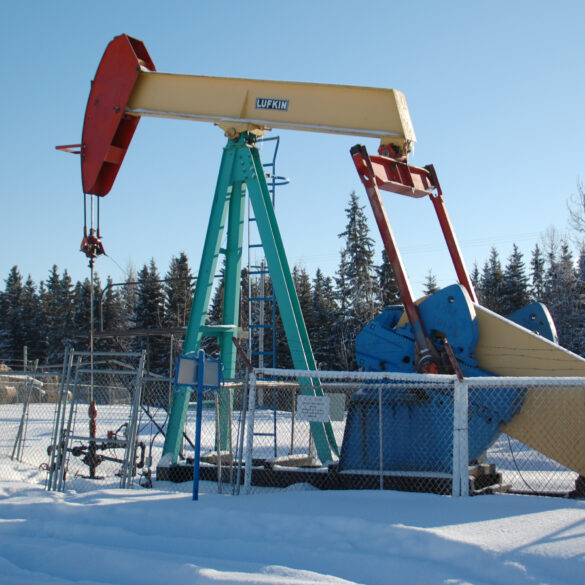
Pumpjack in Drayton Valley, Alberta. (By Achim Raschka/ Licensed under CC-by-SA-4.0)

European Parliament President Roberta Metsola says there is a demand in Europe for Canadian oil and gas, and indicated European Union (EU) countries might be prepared to pay a premium for Canadian conventional energy, as they strive to reduce their reliance on Russia’s resources.
Russia’s invasion of Ukraine left the EU reliant on “a very unreliable partner for gas and oil,” Metsola said during a recent interview on CTV Question Period, and that means the EU is now looking for more reliable partnerships.
The EU has been working to divest itself from Russian energy, both by doubling down on its climate goals but also by looking for alternative sources, Metsola said, noting that its plans for renewable energy are “not enough” to fill the gap.
“And where do we go? Where do we look? We have to look across the Atlantic,” she said. “And the discussions are absolutely in that direction.”
Metsola, who was in Ottawa last week for a meeting of the G7 countries’ speakers, said energy supply conversations between the EU and Canada are happening “right now.” She said paying more for Canadian gas and oil may not be more costly in the long run if it means dealing with an ally and reliable provider.
“At the end of the day, what do you mean by cost? We have had to go into very, very expensive divestment when we had to uncouple from Russia,” she said. “We also have other perhaps more unreliable partners in which we are importing fossil fuels, because we need to keep our energy bills low.”
Metsola said many European countries find themselves relying on “unreliable partners” because of their geographic proximity, but noted that being close in location is not necessarily the best criteria for selecting a supplier.
Partnerships between ally nations was a key topic at the recent G7 Speakers’ Summit hosted in Ottawa, Metsola said.
“And if there’s one thing that has dominated our discussion is precisely where are your friends and who are your allies in a time when the world seems to be on fire, you need those friends and allies, and Canada is that country that has always been our partner,” she said.
“That’s why we talk about joint partnerships. We don’t only talk about defence; we don’t talk about security. We talk about strategic autonomy, which also means that we need reliable and predictable sources of supply, and Canada comes into the mix.”
LNG Push
Since his election, Prime Minister Mark Carney has been seeking to fortify energy and economic relationships with Europe, largely to increase the country’s export markets due to Canada’s prolonged trade dispute with the United States.
One of Carney’s top cabinet members said last month that liquified natural gas (LNG) could play a role in turning Canada into an energy superpower.
Energy Minister Tim Hodgson has expressed confidence about the market potential for Canadian LNG and hinted that LNG could be on the government’s list of nation-building initiatives under its One Economy Act once Parliament reconvenes this fall.
He did not offer any details about specific projects the Liberal government is considering but said Ottawa’s discussions with its “allies” have proven that they are “very interested in Canadian LNG.”
Hodgson told reporters during an Aug. 27 press conference that Canada’s current lack of infrastructure on its Atlantic coast is not an issue.
“German companies today are looking at buying West Coast LNG and swapping it for deliveries into Europe so that they can take advantage of our production on the West Coast to supply German needs in the Atlantic,” he said.
Ottawa’s current enthusiasm for LNG is a departure from the era of former Prime Minister Justin Trudeau who said the country should focus on developing alternative energy sources such as green hydrogen.
Trudeau said in 2022 there wasn’t a market for shipping Canadian LNG to Europe and dismissed the idea of building an export terminal on the Atlantic coast, describing the project as too expensive. He said Canada would push ahead with LNG projects already under construction on the country’s West Coast, but wouldn’t invest in it further.
Canada currently operates only one major LNG export terminal although there are currently seven LNG export projects and one infrastructure project that are at various stages of development in British Columbia, according to Natural Resources Canada.
LNG Canada in Kitimat, B.C. started shipping Canadian gas at the end of June, mainly to Asian markets. Phase 2 of the project is still in the works.
Also in the works is the Woodfibre LNG Project in Squamish, B.C., which is set to be the world’s first net-zero LNG export facility and Tilbury LNG Phase 2, an expansion of the existing FortisBC facility in Delta that is currently awaiting government approval.
Cedar LNG has successfully completed its major regulatory and environmental approvals, while Ksi Lisims LNG, and Summit Lake PG LNG remain in the proposal stage.
Ottawa has said these ventures could require a capital investment approaching $109 billion and could yield a production capacity of 50.3 million tonnes of LNG annually.