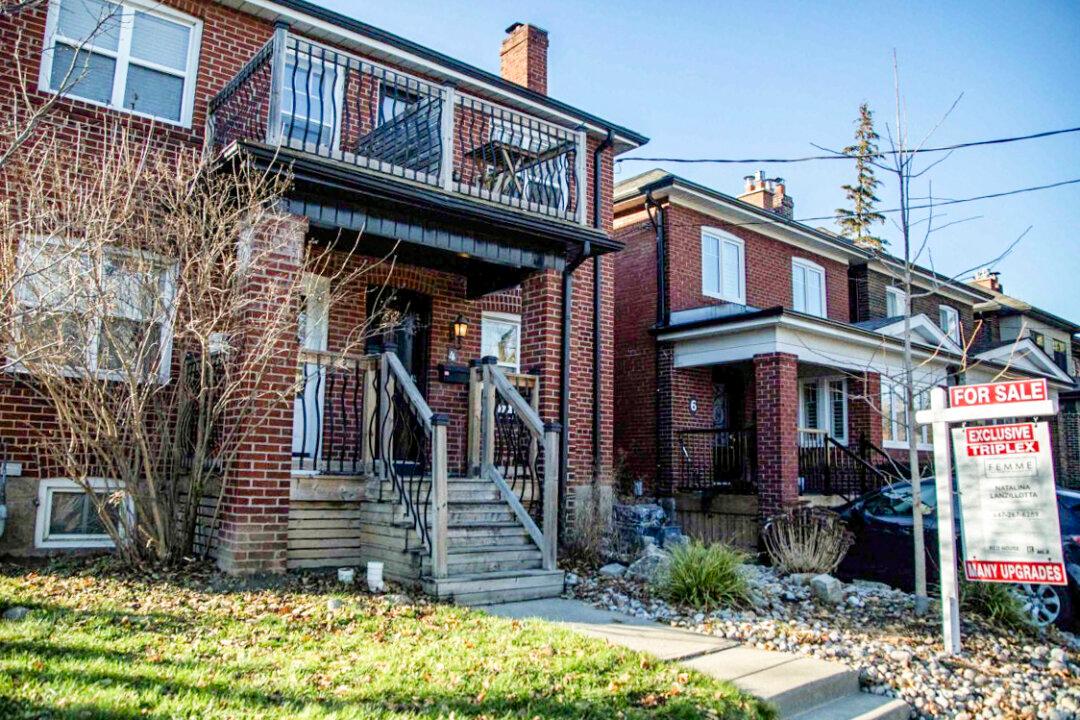
A for sale sign is displayed outside a home in Toronto on Dec. 13, 2021. Reuters/Carlos Osorio

Sixty percent of Canadian mortgage holders renewing their property loans in 2025 or 2026 can expect an uptick in their monthly payments, a new report from the Bank of Canada says.
The majority of these borrowers have a five-year fixed-rate mortgage and are likely to be hit with a 15 to 20 percent increase in their monthly payments, a staff analytical note released this week by the central bank said.
Rates will rise for many mortgage holders compared to December 2024 payments, but those who have to renew this year could end up paying more than those renewing in 2026, the bank said. The typical monthly mortgage payment may increase by 10 percent for individuals renewing in 2025, and by 6 percent for those renewing in 2026.
“These overall numbers, however, hide large differences between borrowers and between types of products,” the report said.
Those with a five-year fixed-rate mortgage could see their average payments rise by as much as 15 to 20 percent when they renew in 2025 or 2026, compared to what they paid in December 2024, the bank noted.
It could be a very different story for those who are planning to renew variable-rate fixed-payment mortgages, however. Property owners with this mortgage style could experience a massive increase or a small decrease in monthly payments.
At the highest point of the range, 10 percent of borrowers renewing in 2026 will face an increase greater than 40 percent, the bank said. Meanwhile, at the lower end, a quarter of borrowers renewing in 2026 will see a decrease of at least 7 percent.
“This wide range mainly reflects the principal payments some borrowers have made since origination or the previous renewal,” the report said. “Some borrowers have increased their monthly payment to make sure it continues covering the interest and principal. These borrowers will face smaller payment increases at renewal than borrowers who are in negative amortization, where the monthly payment does not fully cover the interest, which is then added to the principal.”
Dealing With Higher Payments
Borrowers subject to payment hikes during renewal are expected to face a steeper increase in their mortgage debt service (MDS) ratio when contrasted with borrowers who see payment reductions, the bank said. The MDS is the portion of income used for mortgage payments.
The median MDS ratio is anticipated to increase from 15.3 percent in December 2024 to 18 percent by the conclusion of 2026 for individuals experiencing rising payments. In contrast, borrowers facing decreasing payments are expected to witness a decline in their median MDS ratio from 19.7 percent to 18.6 percent.
These estimates are based on the assumption that income remains unchanged, although the bank noted that numerous borrowers likely experienced income growth since their last mortgage term which will help them in handling higher payments.
Borrowers unable to manage higher payments with their incomes can explore a few different alternatives to maintain affordability, the central bank said.
Many borrowers with a five-year term will have the option to extend the amortization of their mortgages. The bank said roughly half of borrowers facing higher payments would be able to eliminate increases by extending their payment period by five years.
A “short-term solution” for other property owners could be to tap into the equity of their home to access more borrowing room from home equity lines of credit, the note said.
While the bank anticipates some homeowners will be able to absorb increased costs, it noted that others will find the payments more difficult to meet.
“Some borrowers with higher payments at renewal will face challenges,” the bank said. “Many of them will need to change their spending to manage higher mortgage payments. And some may struggle to meet their other financial obligations.”
Jennifer Cowan is a writer and editor with the Canadian edition of The Epoch Times.