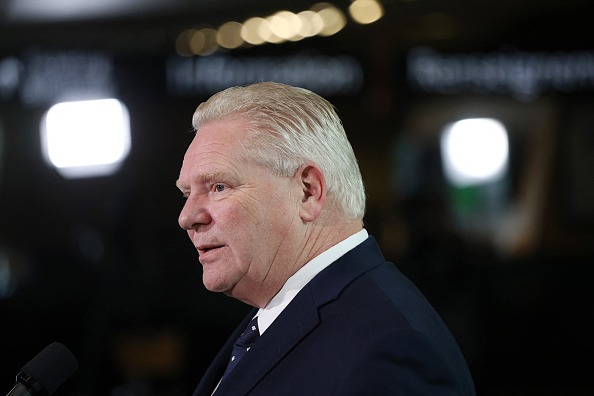
Canada’s Ontario Premier Doug Ford speaks to the press during the first Ministers Meeting in Ottawa, Canada on March 21, 2025. (Photo by Dave Chan / AFP) (Photo by DAVE CHAN/AFP via Getty Images)
Ontario Premier Doug Ford is embarking on a campaign in the coming months that will see him travel to the United States to oppose tariffs placed on Canada by U.S. President Donald Trump.
Ford will head across the border this spring for a meeting with Texas Governor Greg Abbott and other political connections ahead of the July review of the United States-Mexico-Canada Agreement (USMCA).
Ford told a press conference this week that his message to his U.S. counterparts is that neither country ultimately benefits from tariffs.
“I’ve always said a tariff on Canada is a ta on the U.S., and I’m going to be spreading that message,” he said while speaking with reporters at Queen’s Park.
The meetings are taking place as Canada prepares for the review of the USMCA. Ford said the country needs to be prepared for the possibility that Trump could opt to “blow up” the deal.
“We have to have plans for everything,” said Ford, who has met several times with Prime Minister Mark Carney and other premiers to discuss tariffs and the upcoming negotiations of the trade deal.
U.S. Trade Representative Jamieson Greer has said the Trump administration was considering breaking up the USMCA into separate agreements—one with Canada and one Mexico—because the United States has a “very different” economic relationship with each country.
Ford said he also plans to lobby state governors at regional meetings he’ll attend with other premiers in South Carolina and Utah in the lead-up to the U.S. mid-term elections set for November.
He will visit Greenville, South Carolina, in June for the Southeastern United States-Canadian Provinces Conference. The event will be attended by the premiers of Quebec, New Brunswick, Nova Scotia, Prince Edward Island, and Newfoundland and Labrador, as well as the governors of Alabama, Georgia, Mississippi, North Carolina, South Carolina, and Tennessee.
He will then travel to the Western Governors’ Association annual meeting in Deer Valley, Utah, which runs from June 30 until July 2. Governors from 22 states including the economic giants like California, Texas, Washington, and Arizona will be in attendance.
The goal of all of his meetings, Ford said, is to push for a more robust economic partnership between the two nations and advocate for the elimination of tariffs, which he said is wreaking havoc on both sides of the border.
“People are listening down in the U.S.,” he said. “People are feeling the crunch. They don’t see the prices going down with food and other goods.”
Trump said in his State of the Union address on Feb. 24 that the price of groceries and housing has fallen, adding that the “cost of chicken, butter, fruit, hotels, automobiles, rent is lower today than when I took office.”
Canadian food prices surged roughly 6.2 percent to 7.3 percent year-over-year in early 2026, according to Statistics Canada, while U.S. food inflation was roughly half of that, hovering at just under 3 percent.
Negotiations
Canada and the United States were on the verge of finalizing an agreement concerning tariffs on steel, aluminum, and energy last fall, but negotiations were cut short by Trump.
The negotiations were suspended in late October following Trump’s adverse reaction to an anti-tariff television advertising campaign run by the Ontario government, that featured a speech about tariffs by former President Ronald Reagan.
Ford said he is glad Canada hasn’t rushed into a deal with the White House, saying “no deal is better than a bad deal.” He cited the example of the UK and Japan as countries that moved quickly to make deals with the United States and later faced unpredictable actions from the U.S. administration.
The U.S. and UK forged a new trade deal last May, but Trump announced a 10 percent tariff last week to replace broad duties under an emergency law struck down by the U.S. Supreme Court. The new tariff also led the European Union to pause the ratification process for its trade deal with the United States.
The Supreme Court last week invalidated the reciprocal tariff framework imposed by Trump under the International Emergency Economic Powers Act.
Trump announced after the ruling a 10 percent global tariff under Section 122 of the Trade Act of 1974 and threatened to increase it to 15 percent on Feb. 21. Greer has said the rate could still rise to 15 percent for some countries in the future.
Trump wrote in a Feb. 23 Truth Social post that “any Country that wants to ‘play games’ with the ridiculous supreme court decision, especially those that have ’Ripped Off’ the U.S.A. for years, and even decades, will be met with a much higher Tariff, and worse, than that which they just recently agreed to. BUYER BEWARE!!!”
Those types of seemingly spontaneous changes from Trump means Ottawa needs to be cautious, Ford said,
“We’re going to be very cautious, and that’s a message to the federal government,” he said. “Let’s make sure we have a proper deal.”