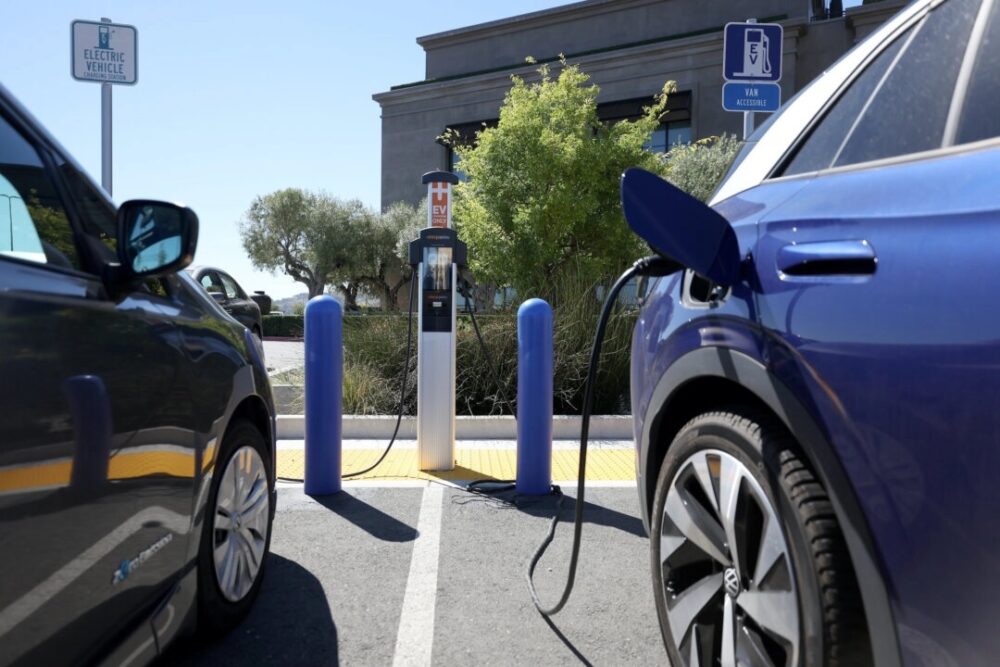
Electric cars sit parked at a charging station. (Justin Sullivan/Getty Images)
NTDTV Staff
Prime Minister Mark Carney says his government will repeal Canada’s electric vehicle sales mandate and replace it with tougher emissions regulations, arguing the new approach will still drive widespread adoption of electric vehicles without imposing rigid production requirements on automakers.
Carney announced on Feb. 5 that Ottawa will scrap the mandate requiring automakers to sell only electric vehicles by 2035. Instead, the government will implement more stringent greenhouse gas (GHG) emissions standards for model years 2027 through 2032. Under the revised framework, Ottawa aims for electric vehicles to account for 75 percent of new vehicle sales by 2035 and 90 percent by 2040.
“The more stringent emission standards will enable the government of Canada to repeal the electric vehicle accessibility standard,” Carney said during an announcement in Vaughan, Ont.
The government will also reintroduce consumer purchase incentives through a five-year, $2.3 billion EV Affordability Program. The program will offer rebates of up to $5,000 for battery electric and fuel-cell vehicles and up to $2,500 for plug-in hybrids. Incentives will apply to vehicles priced at $50,000 or less from countries with free trade agreements, with no price cap for Canadian-made EVs and hybrids.
Ottawa will further invest $1.5 billion in charging and hydrogen refuelling infrastructure through the Canada Infrastructure Bank. Carney said a new national electricity strategy will be unveiled in the coming weeks, with the goal of doubling Canada’s grid capacity to support EV adoption and deliver “more efficient and affordable electricity.”
The previous EV mandate, introduced in 2023, required automakers and importers to ensure EVs made up 20 percent of sales by 2026, rising to 60 percent by 2030 and 100 percent by 2035. Companies that failed to meet early targets could buy compliance credits from competitors and restrict sales of internal combustion engine vehicles.
The decision to abandon the mandate follows sustained pressure from automakers and several provinces, which argued the targets were unrealistic amid high costs, slow consumer uptake, and rising trade uncertainty. Carney had already paused the 2026 sales targets in September 2025 and launched a 60-day review of the program.
That pause came as the United States imposed 25 percent tariffs on Canadian vehicles and auto parts, and U.S. President Donald Trump moved to block EV mandates in California and 17 other states.
As part of the Feb. 5 announcement, Ottawa also committed $3 billion from the Strategic Response Fund to help automakers adapt and diversify, maintain counter-tariffs on U.S. auto imports, and expand worker supports, including retraining and employment assistance for up to 66,000 workers.
Carney said Canada will push for a zero-tariff regime in the automotive sector during the upcoming review of the Canada–United States–Mexico Agreement. However, he warned that if Washington “insists on some form of auto tariffs,” Canada will “ensure that companies that sell vehicles in Canada are strongly incentivized to produce in Canada.”
Federal officials said 11 vehicle makes and 20 models priced at $50,000 currently qualify for the new incentives, and the government expects the subsidy program to apply to about 840,000 vehicles. Vehicles manufactured in China will not qualify, officials said.
Ottawa recently announced an agreement with Beijing to reduce tariffs on Chinese EVs from 100 percent to the most-favoured-nation rate of 6.1 percent on a capped number of imports, while China is expected to lower tariffs on Canadian agricultural exports.
Officials acknowledged that emissions modelling for the new framework is still underway. “It will depend on how the stringency of the GHG standards changes year over year,” one official said, adding the process will involve consultations to ensure the standards are “ambitious but also achievable.”
Asked whether Ottawa intends to eventually phase out internal combustion engine production, an official said the focus is on enabling Canada’s auto sector to build the “vehicle of the future,” one that is “increasingly electrified and increasingly connected.”