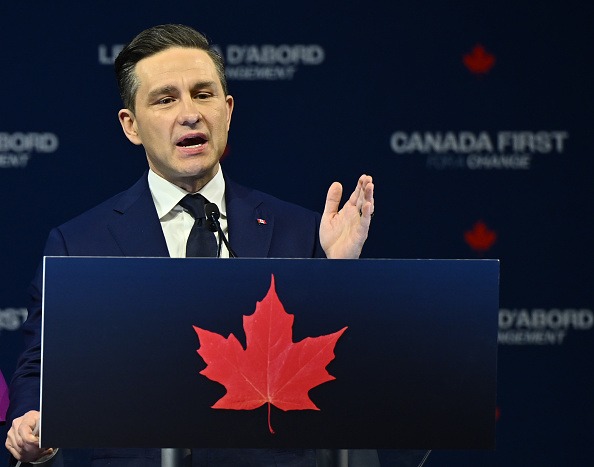
Conservative Party Leader Pierre Poilievre speaks to his supporters after losing the Canadian Federal Election on April 29, 2025 in Ottawa (Photo by Minas Panagiotakis/Getty Images)
Conservative Leader Pierre Poilievre has announced his proposed “auto pact” with the United States that he says will eliminate U.S. tariffs on autos and increase auto production for both countries.
Poilievre said at an announcement in Windsor, Ont., on March 15 that the Conservatives’ proposed “tariff-free auto pact” would double production of automobiles in Canada and give Canada leverage in trade talks with the United States.
“I’ve got a plan that would advantage both Americans and Canadians if we get to [a] tariff-free deal and a one-for-one production-to-sales ratio,” Poilievre said.
“What we’re putting forward here is a realistic plan to get the tariffs removed, not because we expect the Americans are going to do it to be nice, but because we’ve got a plan that actually increases their production as well as ours.”
The proposed plan would remove the GST from all Canadian-made cars, a move that Poilievre said would give a “major price advantage” to Canadians to buy vehicles made in Canada.
The plan would also implement a rule that for every car produced in Canada, the same manufacturer would be allowed to sell a car made in the United States or Mexico in Canada duty-free, in an effort to incentivize U.S. and Mexican automakers to relocate production back to Canada.
The plan would maintain the minimum 75 percent North American content and existing United States-Mexico-Canada Agreement (USMCA) rules of origin, create a harmonized North American cybersecurity and data standard, while banning vehicles that use Chinese or Russian-connected software, and align with North American partners on Chinese tariffs.
In addition, the plan would involve scrapping the Liberal government’s electric vehicle mandate and rebates, which the Tory leader said currently subsidize people buying foreign-made cars.
Poilievre said he believes the U.S. administration would accept the proposed deal because it would bring American auto production “up from 11 million to 13 million.”
“In other words, [the United States] would win new and increased production as a result of this plan, which is exactly the stated policy objective of the U.S. administration,” he said. “Both the United States and Canada would see a massive production gain, fulfilling our shared objectives of re-industrializing the continent.”
Poilievre said Canada has no alternative to the U.S. auto market, noting that “the Americans buy 90 percent of the automobiles that Canada makes, and we buy almost all the rest, meaning there are almost no overseas exports of Canadian automobiles today, and that cannot be changed on a dime.”
The proposed plan is similar to the 1965 Canada-U.S. auto pact, under which Canada “produced 3 million vehicles,” he said. Meanwhile, Canada produced approximately 1.2 million passenger vehicles in 2025.
Access to US Auto Market
Poilievre accused Prime Minister Mark Carney of “waving the white flag” on regaining access to the U.S. auto market.
“He seems to have accepted that American tariffs are permanent,” the Tory leader said. “He also seems to think that he can carry out a permanent rupture with the United States’ market in favour of other markets.”
Poilievre’s comments come after Carney visited China in January and signed a deal with Beijing to significantly reduce tariffs on Chinese EVs in exchange for China reducing tariffs on Canadian agricultural products. The deal was made with the expectation that Chinese auto companies will make investments in Canada, including eventually building an auto plant in Canada.
The deal came as Carney has been seeking to diversify trade away from the United States amid tariffs imposed on Canada by the U.S. administration.
Poilievre said in late February that having a free-trade agreement with the United States is important for attracting investments from other countries, and that relations with the United States should not be ruptured by seeking closer ties with China.
His comments were made in reference to Japan saying continued access to the U.S. market under the USMCA is “critical” for Japanese investment in auto manufacturing in Canada.
The United States imposed 25 percent tariffs on Canadian vehicles and automotive parts last year. U.S. President Donald Trump also said in January that the United States doesn’t need cars made in Canada or Mexico, and that he wants to bring more manufacturing to the United States.
Canadian Vehicle Manufacturers’ Association President and CEO Brian Kingston told the House of Commons industry committee in October that Ottawa needs to prioritize getting the United States to remove auto tariffs. He said that with 90 percent of Canadian automotive production heading south of the border, “there is no industry without U.S. access.”
Trade talks between Canada and the United States came to a halt last October after the Ontario government aired an anti-tariff advertising campaign on American networks.
US Trip
Poilievre’s March 15 announcement came after his trip to Detroit, Michigan, over the weekend to meet with U.S. elected officials and automotive industry leaders to discuss Canada-U.S. relations. He told reporters that automakers in Detroit also want to see tariffs removed and believe they could increase production on their side of the border if auto tariffs are put to an end.
The visit to Detroit was part of a week-long trip starting March 13 to the United States, where the Tory leader said he would advocate for Canada’s auto and energy sectors.
Poilievre is expected to head to Houston, Texas, on March 16 to meet with energy executives and visit an energy facility, before heading to Austin, Texas, on March 17 to meet with state officials, as well as energy, agriculture, and business leaders.
He is set to wrap up the trip by delivering a keynote speech on the Canada-U.S. relationship in New York on March 19. He is not expected to travel to Washington, D.C., to meet with White House officials during the trip.