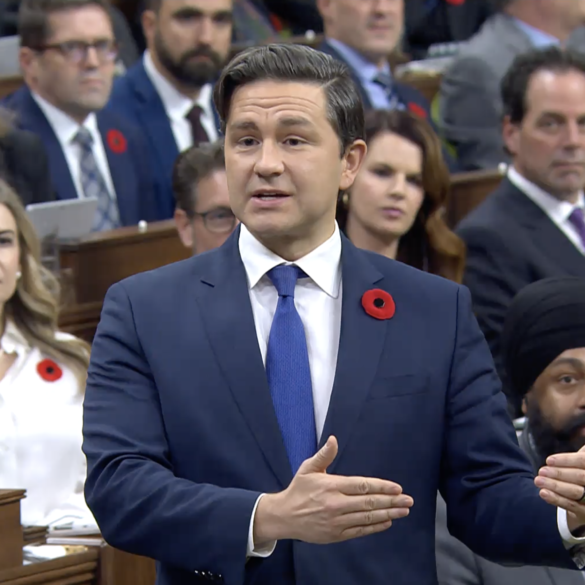
Conservative Leader Pierre Poilievre asks a question during question period in the House of Commons on Parliament Hill in Ottawa on November 1, 2023. (Screen Shot)

Conservative Leader Pierre Poilievre says Ottawa must keep tariffs on Chinese-made electric vehicles (EVs) due to national security risks. He adds that Canada should “toughen up” in response to Beijing’s trade actions rather than make concessions to lift Chinese tariffs on Canadian canola, as some are suggesting.
Poilievre made the comments during an interview with The Elev8 Podcast, aired on Aug. 28, where he was asked for his thoughts on the tariffs Ottawa imposed on Chinese EVs last year, given Beijing’s recent imposition of additional tariffs on Canadian canola in apparent retaliation.
Some prominent figures, such as Saskatchewan Premier Scott Moe, have urged Ottawa to lift tariffs on Chinese EVs in hopes that Beijing will remove its tariffs on canola, a key export for his province.
“We have to be careful because the Chinese government wants to have the ability to track and surveil our people—we know that, they’ve had police stations set up in our country … they’re extremely intelligent and strategic,” Poilievre said.
“Do we want on our streets, in 10 years from now, a million rolling surveillance vehicles that have cameras and chips and other devices that are easy to track and potentially remote-controlled?”
Concerns have emerged around the security risks associated with Chinese-manufactured products. The U.S. administration earlier this year implemented rules banning Chinese-made cars from the U.S. market, citing espionage and control concerns.
China last month imposed 75.8 percent tariffs on Canadian canola. The announcement came days after Ottawa imposed additional tariffs on steel originating from China, saying the measures were necessary to protect the domestic industry from trade diversion.
Beijing said its decision for the tariffs on canola stemmed from a preliminary ruling of an anti-dumping investigation the regime launched last year shortly after Canada imposed 100 percent tariffs on Chinese-made electric vehicles and 25 percent tariffs on aluminum and steel products.
In announcing its tariffs on China last year, Ottawa said Canadian industries were at risk due to “unfair” competition from Chinese producers who benefitted from Beijing’s “intentional, state-directed policy of overcapacity and oversupply.”
The new Chinese tariffs came on top of the 100 percent duties China imposed earlier this year on Canadian canola oil, oil cakes, and pea imports, along with a 25 percent tariff on pork and seafood products.
Poilievre said in the Aug. 28 interview that, rather than making concessions to get Beijing to lift its tariffs, Ottawa should come up with a strong response.
“I think instead of trying to give in, we have to toughen up,” he said.
“We should cancel the billion-dollar taxpayer-funded loan that the Carney government is backstopping to buy Chinese-made ferries, and we should take other similar steps to punish these latest Chinese tariffs on canola, pork, seafood, etc., and defend our producers.”
The Conservatives have called for the cancellation of a $1 billion loan the federal infrastructure bank is providing BC Ferries, a publicly owned ferry operator, to purchase four new vessels from China Merchants Industry Weihai Shipyards, a Chinese state-owned company. The Tories say the ships should be built in Canada to support domestic industries.
The Chinese shipyard was selected by BC Ferries through a global procurement process that saw no Canadian firm bid for the contract. At least two Canadian shipyards—Seaspan and Davie Shipbuilding—have said they didn’t bid for the contract due to the difficulty of competing with countries with lower industry standards.
Following China’s latest tariffs, Poilievre renewed calls for the loan’s cancellation, saying the deal benefits a regime that “punished Canadian farmers with unfair and unjustified tariffs.”
Housing Minister Gregor Robertson, who oversees the infrastructure bank, said last month that while he was “disappointed” by BC Ferries’ decision to hire the Chinese shipyard, he will not interfere with the bank’s loan, noting it operates at arm’s length from the federal government.
He said earlier this week that Ottawa is working on a “Buy Canada” policy, a strategy he said needs work.
In the Aug. 28 interview, Poilievre also criticized Beijing’s trade practices in the steel and aluminum sectors, saying they threaten Canada’s industries, which are already under pressure due to U.S. tariffs.
“With the combination of Trump’s tariffs, Chinese dumping, and high taxes, we could lose our entire steel-making capability, which would be an enormous national security threat,” he said. Dumping involves selling products to another country at a price below their normal value.
“You cannot be a nation if you’re not able to make the bones of an economic civilization, which is steel and, to some extent, aluminum.”
Carolina Avendano has been a reporter with the Canadian edition of The Epoch Times since 2024.