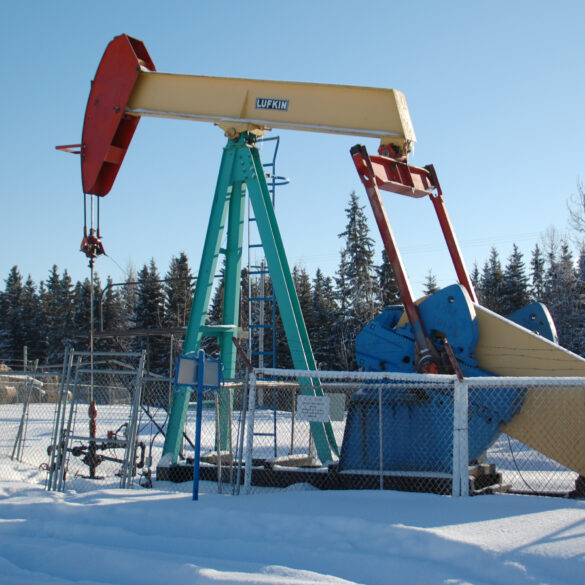
Pumpjack in Drayton Valley, Alberta. (By Achim Raschka/ Licensed under CC-by-SA-4.0)

Oilsands production is projected to hit a record high this year, according to a new S&P forecast, with an anticipated 5 percent growth in northern Alberta’s production in 2025 compared to last year.
The oilsands have the potential to boost output by an additional half a million barrels per day from last year’s figures by 2030, despite global crude price uncertainties, according to the latest forecast released by S&P Global Commodity Insights.
Production is anticipated to reach 3.5 million barrels daily this year and surpass 3.9 million barrels per day within five years.
The new estimates amount to a 3 percent rise from S&P’s previous 10-year forecast for the industry and represent the fourth consecutive upward adjustment. Production is anticipated to level off later this decade, reaching approximately 3.7 million barrels per day by 2035, an increase of 100,000 barrels per day compared to S&P’s prior assessment.
S&P chief Canadian oil analyst Kevin Birn said the rise in production from the oilsands is not propelled by any new projects, but rather by minor expansions and upgrades to current operations.
“The increased trajectory for Canadian oilsands production growth amidst a period of oil price volatility reflects producers’ continued emphasis on optimization—and the favourable economics that underpin such operations,” Birn said in a June 24 press release.
The era of constructing multibillion-dollar oilsands projects from the ground up has passed, Birn said. Instead, growth is now achieved by maximizing existing operations through the removal of bottlenecks, minimizing downtime, and boosting “throughput,” he added.
Prices for crude oil worldwide jumped well above US$70 a barrel almost two weeks ago, coinciding with the onset of the Israel-Iran conflict, which fuelled concern about supply.
The August crude oil futures contract on the New York Mercantile Exchange fell by more than 6 percent on June 24, closing at US$64.37 a barrel as U.S. President Donald Trump declared a ceasefire in the region, though it is uncertain how long it will remain in place.
Oilsands companies can easily cope with the reduced price, S&P said, forecasting an average break-even price of US$27 per barrel. This figure is significantly lower than it was 10 years ago.
“Many companies are likely to proceed with optimizations even in more challenging price environments because they often contribute to efficiency gains,” S&P director of crude oil markets Celina Hwang said in the release. “This dynamic adds to the resiliency of oilsands production and its ability to grow through periods of price volatility.”
The outlook could be impacted by limitations in export pipeline capacity, the analysis says. Export constraints could potentially resurface as early as next year in the absence of additional incremental pipeline capacity.
The expanded Trans Mountain pipeline to the Vancouver area commenced operations last year, serving as the only substantial route for Canadian crude to access markets outside of the United States.
While some provinces have been pushing for the construction of additional pipelines, no private-sector entity has stepped forward with a proposal, and Prime Minister Mark Carney has yet to identify a new pipeline as a priority project.
Despite the absence of a new pipeline project and the “lower price path,” Hwang expressed confidence that the industry will continue to prosper.
“The oil sands have proven able to withstand extreme price volatility in the past,” Hwang said. “The low break-even costs for existing projects and producers’ ability to manage challenging situations in the past support the resilience of this outlook.”
Oil Price Impact
RBC economists say the recent fluctuations in crude prices are likely to have a neutral effect on Canada’s gross domestic product while boosting revenue flowing into the oil and gas sector, and raising corporate profits and provincial government royalties.
It will also translate into higher costs for households, according to the new report written by senior economist Claire Fan and assistant chief economist Nathan Janzen.
“Consumers face higher prices at the pumps almost instantly when oil prices rise,” they wrote. “But with Canada being a major oil exporter, higher oil prices mean higher revenue from oil and gas production.”
Higher costs for Canadians fuelling their vehicles could translate into a reduced demand for other goods and services as consumers tighten their budgets to accommodate the elevated cost of gas, the authors said.
“The catch is that the benefits from increased corporate profits and higher natural resource royalties to provincial governments are typically concentrated in oil producing regions, while the cost of higher gasoline prices affect all consumers,” they wrote.
Should oil prices increase to US$75 per barrel and maintain that level for the rest of the year, the growth of the consumer price index would be 0.4 percent higher by the end of 2025 compared to RBC’s existing forecast of 1.9 percent growth, the report said, noting that the change is in the “range of what is considered normal volatility in consumer prices.”
The economists also don’t expect the Bank of Canada to act on the recent crude price changes, adding that it is unlikely companies would adjust their spending plans either.
“Higher oil prices driven by geopolitical instability will not lead to a resurgence in investment spending in the sector,” the authors said.
“Any spikes in prices due to geopolitical instability will not be seen as durable enough to warrant the kind of large capital-intensive investments that have mostly been dormant over the last decade in the Canadian oilsands.”
Jennifer Cowan is a writer and editor with the Canadian edition of The Epoch Times.