‘Chinese cars are surveillance packages on wheels,’ Sen. Elissa Slotkin said.
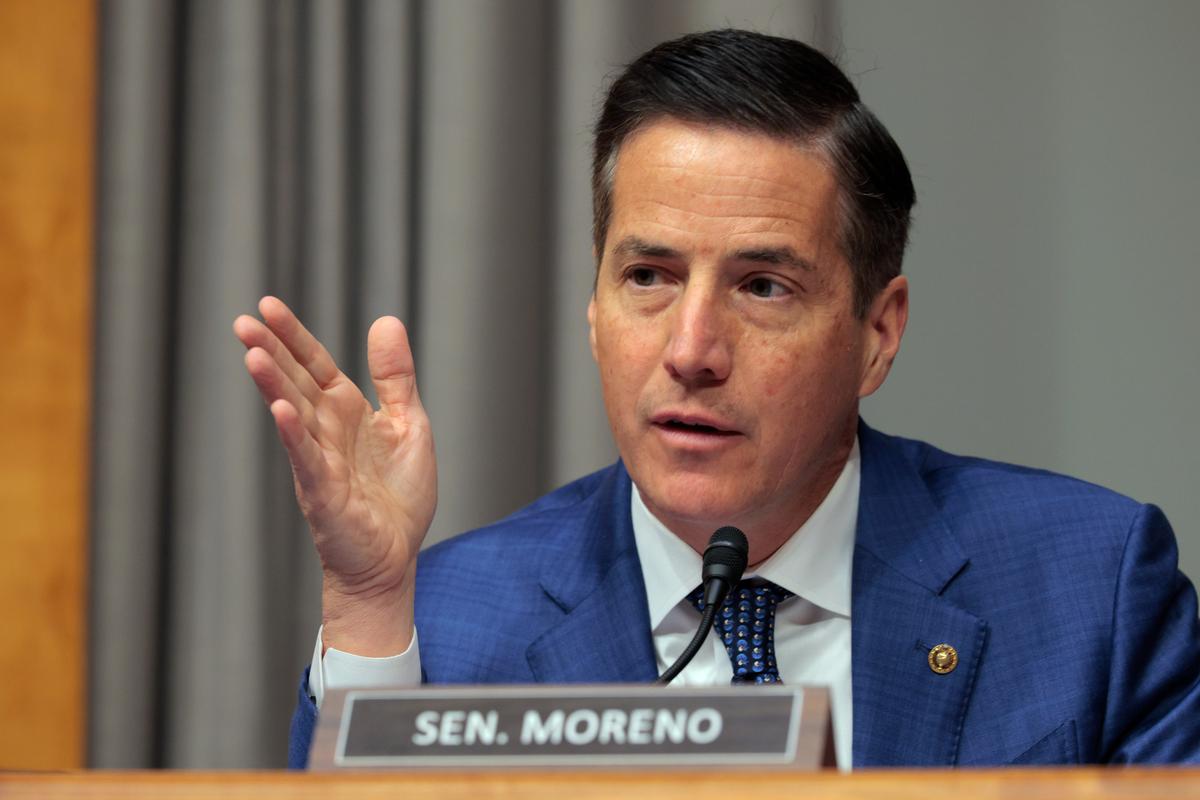
Sen. Bernie Moreno (R-Ohio) speaks during a hearing on oversight of the Department of Homeland Security before the Senate Homeland Security and Governmental Affairs Committee in the Dirksen Senate Office Building in Washington on Feb. 12, 2026. Chip Somodevilla/Getty Images
A bipartisan group of senators has introduced legislation aimed at strengthening a U.S. government ban on Chinese automakers accessing the U.S. market, citing national security concerns.
Sens. Bernie Moreno (R-Ohio) and Elissa Slotkin (D-Mich.) introduced the Connected Vehicle Security Act of 2026 on April 29, which would codify a Commerce Department rule that effectively bars all Chinese automakers from selling passenger vehicles in the United States and take other measures to block China from entering the U.S. light-duty market.
“The American auto industry is the backbone of the American industrial economy, we cannot afford to make the same mistakes globalists have made for decades and see these great American companies devastated by predatory and massively subsidized Chinese state enterprises hellbent on the destruction of our economy,” Moreno said in a statement.
“As Europe, Mexico, and others allow their markets to be overrun by Chinese predators, the U.S. must act before it’s too late. The answer is simple: Chinese vehicles can never be allowed into the U.S. market—the fate of the American auto industry and countless autoworkers depends on it.”
The legislation would ban internet-connected vehicles and related hardware and software tied to the Chinese regime or other foreign adversaries from being imported, manufactured, sold, or resold in the United States.
It would empower the Commerce Department to identify and block technologies or parts deemed national security threats from entering the U.S. market.
Under the legislation, enforcement measures, including civil penalties, are established to stop restricted vehicle systems and components from entering the U.S. market.
The restrictions would be implemented in two phases, with limits on internet-connected vehicles and related software taking effect in 2027, followed by hardware-related restrictions around 2030.
“Chinese cars are a serious threat to America’s national security and Michigan’s economic security,” Slotkin said in a statement.
“Chinese cars are surveillance packages on wheels, with the ability to collect on American citizens and sensitive sites.
“The Chinese Communist Party’s playbook of heavily subsidizing their product, underselling the competition, and then having a monopoly over that sector puts Michigan’s auto industry and our millions of workers at risk. We need to act now, and get this right.”
The legislation is backed by the United Auto Workers union (UAW), the Consumer Access to Repair (CAR) Coalition, American Compass, and General Motors.
“If we want to rebuild U.S. manufacturing and raise standards for the working class, we can’t keep offshoring and outsourcing our auto industry, driving a global race to the bottom for short term corporate profits. Our US auto industry must invest in cutting-edge technology and build affordable, high-quality vehicles for the American consumer, built by UAW autoworkers,” UAW President Shawn Fain said in a statement.
“By building on and strengthening the existing connected vehicles rule, this legislation puts common sense guardrails on a major threat to our nation’s auto industry.”
Oren Cass, chief economist for American Compass, called the legislation “a vital step toward keeping the [Chinese Communist Party] and its economic distortions” out of U.S. borders, according to a statement.
“America needs a hard break from China that restores our economic sovereignty and prevents the Chinese Communist Party from subverting our markets,” Cass said. “Nowhere is that priority more pressing than the automotive sector.”
Moreno’s office, in a one-pager explaining the legislation, warned that if Chinese electric vehicle makers like BYD and Geely were to control the technology inside electric vehicles, data collected—such as location, driving patterns, personal information, and nearby infrastructure—could end up in Beijing’s hands.
“Under China’s national intelligence laws, this sensitive information can be exploited for espionage, surveillance, or worse: remote takeover of vehicles on American roads. They represent a national security threat to the American people,” the office stated.