The planned meeting between Cheng Li-wun and Xi Jinping could deepen political divisions and shape messaging ahead of possible U.S.–China talks, analysts said.

Cheng Li-wun, chairwoman of Taiwan’s main opposition party, Kuomintang, arrives at the Taiwan Foreign Correspondents’ Club in Taipei, Taiwan, on March 23, 2026. I-Hwa Cheng / AFP via Getty Images
A planned meeting between Taiwanese opposition leader Cheng Li-wun and Chinese regime leader Xi Jinping is drawing mounting scrutiny in Taiwan, as analysts warn that it could deepen political divisions in Taiwan while advancing Beijing’s efforts to shape cross-strait narratives ahead of high-stakes U.S.–China talks.
Cheng, chair of Taiwan’s main opposition party, the Kuomintang (KMT), departed Taipei on April 7 for a six-day visit to China—the first such trip by a sitting KMT leader in a decade. The visit is expected to culminate in a closely watched meeting with Xi, an event widely referred to as the “Xi–Cheng meeting.”
A Politically Charged Visit
Even before Cheng’s departure, the trip had ignited protests. Pro-independence groups gathered at Taipei’s Songshan Airport, declaring that Cheng “cannot represent Taiwan” and warning that cross-strait peace is an international—not purely domestic—issue.
Taiwanese officials have also issued rare public cautions. Premier Cho Jung-tai warned that any exchanges with Beijing must not involve public authority or political agreements, while Taiwan’s Mainland Affairs Council cautioned the KMT against falling into Beijing’s “United Front” tactics, which seek to advance China’s interests abroad.
Taiwan is a self-governing island that has never been ruled by the Chinese Communist Party (CCP). However, the CCP has escalated its threats to invade Taiwan. In Taiwan’s political spectrum, the KMT is frequently viewed as pro-Beijing.
Analysts say the optics—and structure—of the visit signal Beijing’s broader intentions.
Yu Tsung-chi, a former dean at Taiwan’s National Defense University, told The Epoch Times that the meeting is designed to elevate pro-China voices within Taiwan while sidelining the ruling government led by the Democratic Progressive Party (DPP), which is pro-Taiwanese sovereignty.
“If the KMT can engage Beijing directly, bypassing the current DPP administration, it risks isolating Taiwan’s government while emboldening pro-China factions domestically,” Yu said.
He added that elements of the trip—such as Cheng flying on a Chinese airline and media access being routed through Beijing’s Taiwan Affairs Office—suggest that Taiwan is being treated as a “domestic” matter, implicitly undermining its sovereignty.
DPP lawmaker Wang Ting-yu accused Beijing of using the meeting to promote its “One China” narrative, saying the outcome appears pre-scripted. “The real question,” he said, “is how Taiwan’s voters will respond to politicians echoing Beijing’s positions.”
Even some within the KMT have expressed unease. Sean Lien, a vice chairman of the KMT, urged Cheng to exercise caution, a remark widely interpreted as concern over potential political fallout.
Ming Chu-cheng, emeritus professor of political science at National Taiwan University, said on April 3 on a panel discussion on the Chinese edition of NTD, a sister outlet of The Epoch Times, that dialogue with Beijing is not inherently problematic, but it depends on the terms.
He pointed out that the CCP uses “opposition to Taiwan independence” as a tool to divide Taiwan, so if anyone engages China on those terms without recognizing its strategy, it becomes counterproductive.
Effect on the Trump–Xi Meeting
The timing of the visit has raised additional concerns. It comes just weeks before a planned meeting between U.S. President Donald Trump and Xi, during which Taiwan is expected to be a key issue.
Ming suggested that Beijing could use the Xi–Cheng meeting as leverage, portraying cross-strait relations as stable to discourage U.S. arms sales to Taiwan, or even to push for a new joint communiqué opposing Taiwanese independence.
Yu echoed that view, saying Beijing may seek to signal to Washington that the Taiwanese public does not support purchasing U.S. weapons, especially as the KMT has recently opposed the ruling DPP government’s defense budget, which involves significant arms purchases from the United States.
“That creates a narrative the U.S. may find harder to counter,” Yu said. “It directly undermines U.S.–Taiwan relations.”
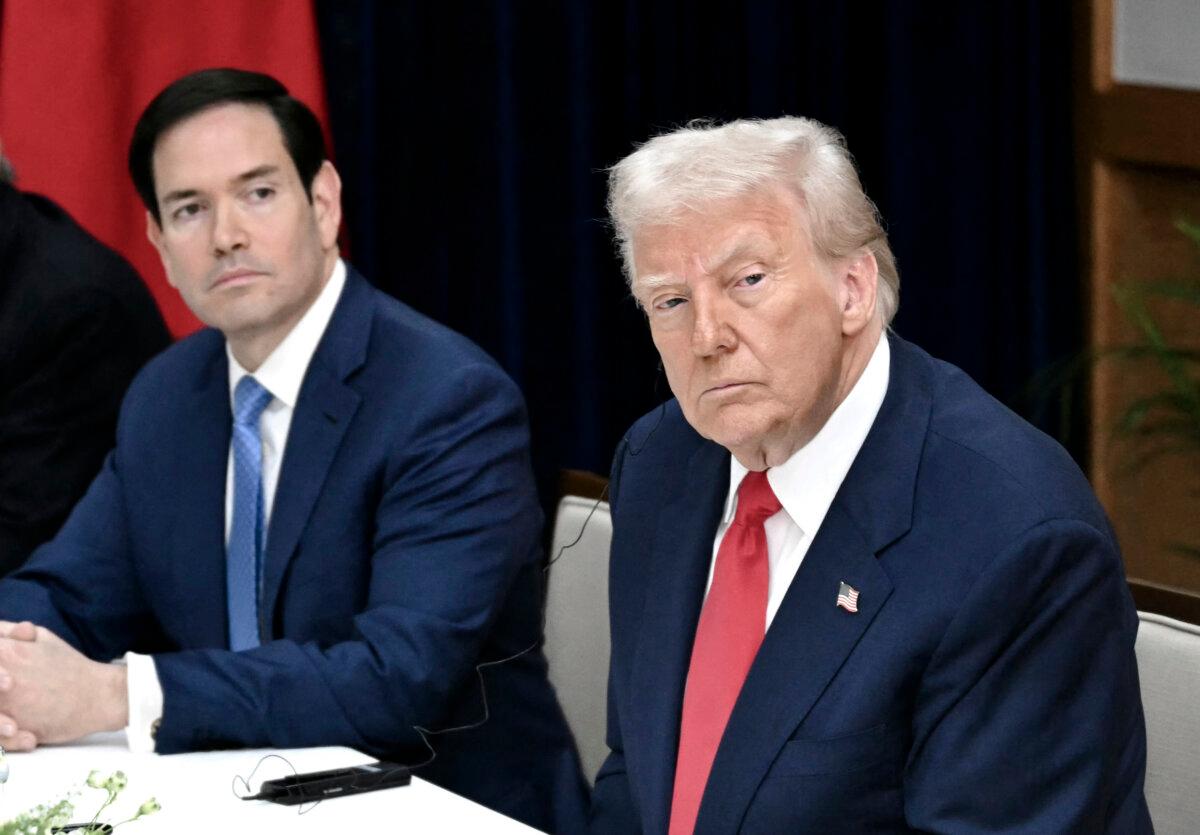
U.S. Secretary of State Marco Rubio (L) and U.S. President Donald Trump attend talks with Chinese regime leader Xi Jinping at Gimhae Air Base in Busan, South Korea, on Oct. 30, 2025. Andrew Caballero-Reynolds/AFP via Getty Images
Potential Fallout Within the KMT
The visit also risks exposing fault lines within the KMT itself.
Signs of internal distancing have already emerged. Senior KMT figures, including former party chairman Eric Chu, have offered only cautious support of the DPP’s defense budget.
Yu warned that a sharp divide could emerge within the KMT if Cheng is perceived as aligning too closely with Beijing, particularly on sensitive issues such as defense spending.
Recent polling suggests that Cheng’s stance may not align with mainstream opinion in Taiwan.
A survey released on April 1 by Taiwanese outlet My-Formosa found that just 23.9 percent of respondents trust Cheng, while 54.5 percent expressed distrust.
Lai Jung-wei, executive director of nonprofit organization Taiwan Inspiration Association, told The Epoch Times that mainstream public opinion in Taiwan favors maintaining the status quo across the Taiwan Strait—which rejects unification with China and maintains de facto independence—and does not support Cheng’s past assertion that she is Chinese.
Lai said Cheng’s position aligns closely with Beijing’s “One China” principle, a stance that he said lacks support both within the KMT and among the broader electorate. He added that such messaging, particularly if amplified by Beijing, could create the impression internationally that Taiwan’s public supports being part of China.
“Under deliberate manipulation by the CCP, this could blur the narrative and lead the international community to mistakenly believe that Taiwanese public opinion supports the idea that Taiwan is part of China,” he said.
Cheng’s meeting with Xi is expected to draw close attention, with its political impact likely to be measured not only in immediate cross-strait messaging but also in how it shapes public opinion in the months leading up to Taiwan’s local elections in November.