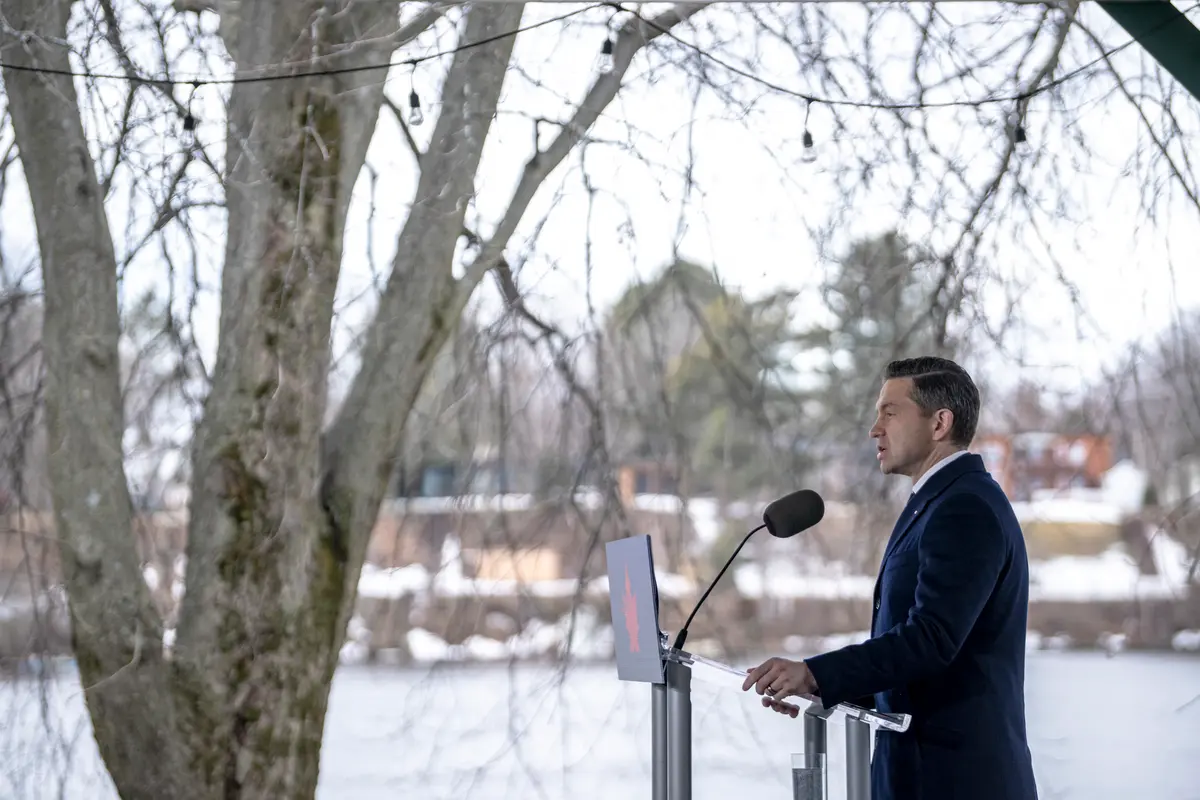
Conservative Leader Pierre Poilievre speaks at a pressconference in Trois-Rivières, Quebec, on April 4, 2025. Andrej Ivanov/AFP/Getty Images
By all accounts, Pierre Poilievre is an anomaly when it comes to Conservative leaders: He still holds his post despite having lost an election.
There’s a long-standing trend of Conservatives turning on their leader. It even has its own diagnosis, dubbed the “Tory Syndrome” by political scientist George Perlin in his 1979 book of the same name.
All party leaders face the challenge that what may endear them to their party base may also cost them support among the broader electorate if they embrace those positions too openly and the opposition portrays them as being out of step with the prevailing zeitgeist. This creates a delicate balancing act for leaders: staying true to their ideological base so party grassroots don’t remove them in leadership reviews, while avoiding alienating the general population so they can win elections.
When it comes to Conservative leaders attempting to reach this equilibrium, the challenge is two-fold.
On the one hand, appealing to a wide range of their supporter base has historically been a challenge, largely because of the party’s loose coalition of ideological camps with different strongly held values and desired policy positions, ranging from social conservatives to libertarians and others. This difficulty is compounded by the acute “Tory Syndrome,” as Perlin terms it.
However, the challenge for Tory leaders appealing to the broader electorate while holding on to their conservative values has become increasingly difficult in recent years, says David Leis, president of the Frontier Centre for Public Policy. This is because the ideas portrayed as representing mainstream opinion in the media and other key institutions are now predominantly left-leaning, narrowing the Overton window ever further, he says.
“This is an entirely different situation than seen in Canada’s history,” Leis told The Epoch Times. “The problem is that so many of our institutions have been captured by an ideology.”
Adding to Poilievre’s challenge is the governing Liberals—who were just a few seats shy of a majority government after the 2025 election—poaching MPs from the Conservative caucus. The latest blow came on July 7, when Prime Minister Mark Carney appointed Conservative MP Richard Martel to the Senate, leaving the Conservatives with one fewer MP on top of the four who had already crossed the floor to the Liberals. This has come with increasingly negative media coverage, even among right-leaning commentators.
Facing the Media
The Conservatives failed to form government in the last four elections.
During the 2015 election campaign that saw the defeat of former Prime Minister Stephen Harper, among the barrage of negative press against the Tories were images of Syrian migrant toddler Alan Kurdi, whose body tragically washed up on Turkey’s shores, amid campaigns to have Canada accept more refugees. “Conservatives grapple with the terrible death of a Syrian boy,” read one headline during the election campaign.
The current housing and health-care crises have reversed public opinion on issues related to immigration, with a plurality now saying Canada takes in “too many” immigrants according to a federal government poll commissioned in 2025, and with Ottawa tightening rules around asylum-seekers.
In press conferences during the 2019 election campaign, Andrew Scheer, who became Conservative leader after Harper, frequently faced questions about his personal views on abortion rather than being given the chance to elaborate on his policy positions, and news coverage of his campaign was dominated by this topic. Scheer had said repeatedly that while he’s personally pro-life, the party wasn’t planning to revisit the issue of abortion.
Having failed to secure a win for the Conservatives, Scheer was targeted by internal strife and eventually resigned. The next leader, Erin O’Toole, in some cases attempted to blunt the targeting of his platform during the 2021 election campaign by introducing policies not usually associated with the Conservatives, such as his own version of carbon pricing and reversing course on a previous commitment to undo the Liberals firearm ban.
After O’Toole lost the election, it wasn’t long before he was also forced out as leader, including through the efforts of Conservative Sen. Denise Batters, for reversing course on Conservative policy positions—a defeat of the balance he attempted to strike in an effort to win the election. (An inquiry into foreign interference also determined that O’Toole and his party were targeted by the Chinese Communist Party during the campaign, since his platform proposed stronger measures to oppose Beijing’s hostilities.)
Former Alberta Premier Jason Kenney appeared to have also lost that balance, winning the general election in 2019, but resigning after getting only a narrow pass during a 2022 party leadership review amid opposition to his pandemic policies.
Stockwell Day, a former Conservative cabinet minister and leader of the Canadian Alliance—one of the predecessors of the modern Conservative Party—says elections are often determined by undecided voters, which makes the impact of the media all the more influential.
“The undecided, with respect, are people who have a hard time making up their minds. They usually respond to the last person they talk to, and the last person an undecided person hears from before going to the polls is the media,” Day said in an interview.
And if the mainstream of media outlets collectively leans to the left at increasing rates in recent years, this makes the job of conservative parties ever harder, he said.
“Until there’s truly a balance of media availability in Canada, it’s going to be tougher for conservatives,” Day told The Epoch Times.
He adds that the issue goes beyond just the media and also involves other key institutions such as universities, which have embraced “cultural Marxism,” affecting how people engage with politics.
“They will tend to vote left, because they’ve been heavily influenced for years by culturally leftist thinking,” he said.
Day says these factors make the job of a Conservative leader today all the more difficult.
Poilievre’s Dilemma
When Poilievre first announced his intention to enter the 2022 Conservative leadership race via a social media video, it received millions of views. He went on to win the leadership race in a landslide that year, with 68 percent of the points in the first round.
What endeared him to many supporters was his fiery and well-articulated style of delivering attack points against the governing Liberals in the House of Commons, as well as other institutions perceived by supporters to be stacked against the conservatives.
A widely publicized moment came during Poilievre’s visit to the Okanagan Valley in October 2023, when a reporter said to him, “A lot of people would say that you’re simply taking a page out of the Donald Trump book.” While eating an apple, Poilievre asked the reporter to clarify who was making such claims, and pressed the reporter to back up his claims. The video went viral, and even caught the attention of Elon Musk and other prominent U.S. figures.
At the time, while the Conservative Party was soaring in the polls against the by-then highly unpopular Trudeau Liberals, past Conservative campaigners appearing on national media praised Poilievre’s unapologetic response to pointed media questions.
“He is a darling of the right in many regards,” Fred DeLorey, who managed past campaigns of the Conservatives, told CBC News at the time. “As a conservative, a lot of times we feel we’re asked to apologize for being conservative and he just takes on these questions with a lot of strength.”
One day after former Prime Minister Justin Trudeau announced on Jan. 6, 2025, that he planned to resign, and before Carney declared his candidacy for the Liberal Party leadership, the same Trump whom Poilievre’s rivals sought to associate him with—a tactic also used against O’Toole during the 2021 election campaign—appeared almost prophetic when he told reporters, “Maybe [Poilievre] won’t win, but maybe he will,” despite polls still showing the Tories well ahead of the Liberals at that point.
Eventually, with Trudeau handing the Liberal leadership and prime ministership to Carney, and amid Trump’s tariff and “51st state” remarks, Poilievre’s Conservatives lost the election. Besides these two major factors, commentators such as National Post columnist Raymond J. de Souza cited Poilievre’s “apple munching ways” as among the factors hurting his image in the eyes of the general public.
Adding to Poilievre’s troubles was the loss of his own seat to the Liberal candidate in the election. He returned to Parliament only after Alberta MP Damien Kurek resigned to allow him to contest his seat, which Poilievre won in an August 2025 byelection.
Past Conservative campaigners at this point also said Poilievre needs to change his ways, with DeLorey this time telling CBC News, “Does he want to be prime minister or does he want to continue with who he is? Because right now, who he is will not be prime minister.”
Polling from Abacus Data published on July 5 suggests that while positive impressions of Poilievre across the country are at 38 percent, negative views are at 43 percent.
Former Conservative MP Michelle Ferreri, herself a former news anchor, says while it is a “tough battle” for Conservative leaders when facing the mainstream media, they can be strategic in how they answer when facing questions from “left-leaning” media.
But if much of the mainstream media falls on one side of the ideological spectrum, wouldn’t the image Conservative leaders adopt when they temper their message to fit the media’s prevailing views pressure them to move away from core conservative principles?
Ferreri says it’s important that the leader also doesn’t “compromise on morals” while “meeting people where they’re at.”
“The leader is always going to have to stand by their values. If they compromise on those morals, they’re in trouble,” she told The Epoch Times. “If you’re trying to change hearts and minds, you have to figure out where that heart and mind is and why.”
Poilievre told the Conservative convention in January, during which he passed his leadership review with 87.4 percent of the vote, that he won’t “abandon our conservative principles.”
He has also frequently commented on cultural issues, including parental rights, though not always to the extent that people like anti-child transition advocate Chris Elston, known as “Billboard Chris,” want him to address.
Many grassroots Conservatives who gave Poilievre more than 87 percent approval in the leadership review also remain deeply loyal to him.
“I think the media are afraid of the change he’ll bring, and that’s why there’s all the negative press,” Ron Friesen, president of the Conservative Party’s Electoral District Association of Winnipeg South, told The Epoch Times.
“They say people don’t like Poilievre. What’s not to like? Yes, he’s a critic, he’s a paid critic, and he’s the leader of the Opposition. He’s supposed to find the cracks that you really need in your arguments and find solutions.”
But as much as party grassroots may be loyal to him, Poilievre’s continuation as leader also remains subject to the approval of his MPs, who can remove him under the Reform Act, and the way he is portrayed in right-leaning media can also influence how right-of-centre voters view him.
The National Post’s only two commentaries on the conference held in early May by the key conservative organization Canada Strong and Free Network (formerly the Manning Centre) both cast Poilievre in a negative light. The headlines read: “John Ivison: The buzz in Conservative circles this week isn’t about Pierre Poilievre,” and “Adam Zivo: Desperately seeking an energized Conservative revival,” with a sub-headline that warned, “complaining about Carney isn’t enough anymore.”
Seasoned Postmedia columnist Lorne Gunter, a past president of Civitas—a well-regarded society of conservatives and libertarians for discussing ideas—was initially dismissive of the impact of Conservative MP defections to the Liberals on Poilievre’s leadership, when just two had crossed the floor: Chris d’Entremont and Matt Jeneroux.
But as the pace of defections picked up and after Michael Ma also defected in December 2025, Gunter said it can’t be denied that “Poilievre has a leadership problem,” though he correctly predicted that Poilievre would still win his January leadership review. He cautioned, however, that Poilievre Conservatives should avoid favouring “stunts over substance” if they want to win, referring to a Tory motion that asked for all MPs to declare their position on an Ottawa-Alberta pipeline agreement that had caused some rift in the Liberal caucus. Poilievre went on to lose another MP, Marilyn Gladu, to the Liberals in April.
More recently, the Toronto Sun’s Brian Lilley faulted Poilievre for “picking unnecessary fights with Conservatives,” saying such actions would hurt his chances of becoming prime minister. He was referring to Poilievre’s July 5 comments at a Calgary Stampede barbecue with the newly elected B.C. Conservative Leader Kerry-Lynne Findlay, where he said she is “fresh off a big win against Liberal lobbyists from out east.”
His remark was an apparent shot at Kory Teneycke, election campaigner for Ontario’s Progressive Conservative Premier Doug Ford, who was also on the team of Caroline Elliott, Findlay’s rival for the B.C. Conservative leadership race.
During the 2025 federal election campaign, Teneycke, a former federal Conservative campaigner, accused Poilievre’s team of “campaign malpractice” for losing the party’s lead in the polls, and has been a critic of Poilievre.
In the aftermath of Poilievre’s Stampede comment, Teneycke continued his criticism, saying on the podcast program “Curse of Politics” that aired on July 14: “His entire ego and self-image is wrapped up and frozen in time in 2024, where it looked like he was going to be prime minister.”
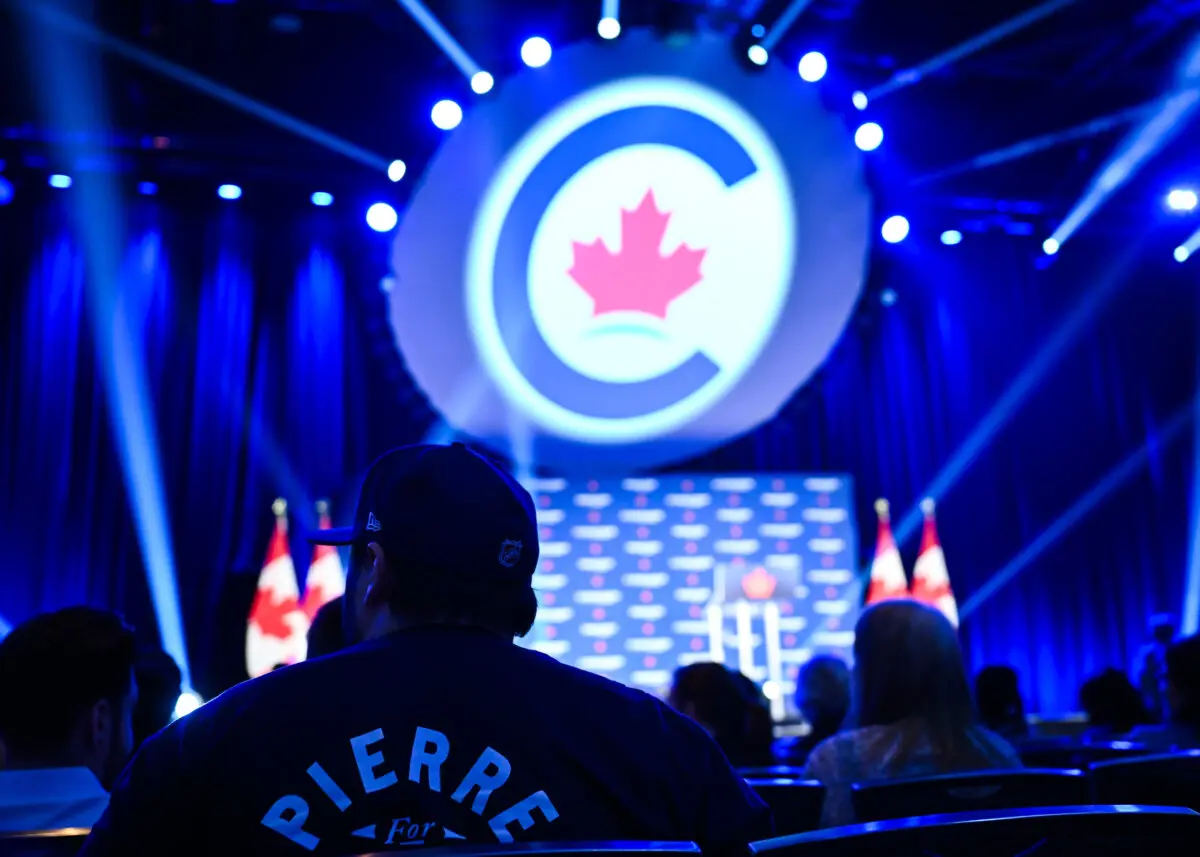
A supporter for Conservative Leader Pierre Poilievre watches the results during the Conservative Party election night event at Rogers Centre Ottawa, in Ottawa on April 28, 2025. Minas Panagiotakis/Getty Images
Elliott also responded to Poilievre’s comment, saying that he needs to “unite, not divide.”
Even Poilievre’s former campaigner, Anthony Koch, cautioned that there’s a limit to the critic role before it could hurt electoral fortunes.
“The role of the Official Opposition from a parliamentary perspective is different from the objectives of the opposition party,” Koch said on social media on July 8. “We are trying to win government (or we should be). If people are more content running a never ending 24/7/365 outrage machine, have at it, we’ll lose.”
Amid the focus on Poilievre’s demeanour, some of his MPs are noting that he is changing his tone, while stressing that he is the right leader for the party.
“I have particularly appreciated the gradual change of tone (without sacrificing principles) that has come with his hard-fought experience,” longtime Conservative Edmonton area MP Mike Lake said on social media in April, as Poilievre fielded criticism after more MPs left his caucus to join the governing Liberals.
Without a clear contender for Poilievre’s leadership position, and with his strong support among party members, there doesn’t appear to be an immediate risk to his position.
Conservative strategist Ginny Roth cautions that if Poilievre were ousted, it would result in the party splitting. The latest incarnation of the Conservatives is the result of the merger of the Canadian Alliance and the Progressive Conservatives in 2003, with Harper becoming the first post-merger leader. Before that, the PCs had been driven to the margins in the 1993 election with just two MPs elected, as Alliance’s predecessor, Reform, took up most of the conservative votes.
“This isn’t to say that the health of the party depends on one person. My concern is that the post merger CPC [Conservative Party of Canada] requires a leader who understands and can speak for western Canadians, fiscal conservatives, social conservatives and increasingly, young working people,” Roth said on social media in April.
“Those wanting a leadership change seem to want to pursue a strategy that would surely alienate these types of party members and conservative voters. And I think that would ultimately lead to the fracturing of the party.”
Roth is also among those who urge the Conservatives not to abandon cultural issues as they pursue electoral victories. That is also the advice of former Harper deputy chief of staff Howard Anglin.
“Above all, conservatives, reactionaries, and plain old apolitical sceptics should not be afraid of the culture wars — what else, after all, is worth fighting for?” Anglin wrote in the Hub, citing as examples issues related to taking down historical statues and deciding what “is the value of life and who decides when it begins and ends.”
Conservative MP Jamil Jivani, who has been outspoken on cultural issues, has in the past held a series of events at university campuses to oppose “cancel culture.”
Fellow Tory MP Aaron Gunn also defends Conservatives standing up for cultural issues, saying “left wing governments across the West” have introduced “a series of radical, ideological policies that took aim at the foundations of western culture and values,” and that “conservatives are fighting back.”
Winning as a Conservative
For the Conservatives to win in elections, according to Reform Party founder Preston Manning, they need to identify the top issues of concern for people, such as affordability, and to “stand out” on those issues. Secondly, he says, they need to cease the “bottom up, democratic populism” energy to advance their cause.
“Conservatives should recognize that bottom-up democratic, basically anti-left-wing elitist phenomena and harness it to advance the conservative objective,” he said in an interview.
Manning says his own Reform Party, which rose from an upstart party to the Official Opposition in the 1997 election, wasn’t winning seats in the East with its marquee “The West Wants In” message, but by focusing on the issue of balancing the budget.
“Whether that kind of thing can be repeated or not, I don’t know, but Conservatives could and should do better by identifying key issues that lend themselves to conservative solutions, and they should be the quickest to recognize the populist phenomena and try to get in front of it,” he said.
Manning says these tactics can help propel a conservative party to government, without the party having to compromise on its values, and then try to deal with key issues once in government.
He cites Alberta Premier Danielle Smith as a successful leader of a conservative party, the United Conservative Party, that has managed to win and hold government.
While the reality for Eastern Canada that voted mostly for Liberals in the last election could be that they’re less likely to support right-of-centre parties, former Harper cabinet minister and Ontario MP Tony Clement says the Tories can win on economic issues and issues related to public safety and fighting crime.
“We need one or two million more voters to win [the next election], and it takes being able to have better policies when it comes to housing, when it comes to prices,” he told The Epoch Times.
What may make that more challenging is Carney’s focus on the economy and on changing many of the policies of the Trudeau Liberals which, ahead of the 2025 election, Carney had said are based on the ideas of the “far left.”
But in many ways, the governing Liberals’ approach to government has also mirrored their party’s political ideology, changing to the right or left as electoral realities demand: While the Carney government has paved the way and eased regulatory processes for certain projects deemed to be of “national interest,” the new powers place those regulations at the government’s discretion, allowing it to change course as circumstances evolve. This is in contrast to Conservative-proposed policies of removing laws such as the Impact Assessment Act and the industrial carbon tax altogether to allow the private sector to proceed with projects with less restrictions.
Clement says a major part of the Conservatives’ political fortunes depends on how the Liberal government itself performs.
“A lot of things depend on what the government says and what the government does. That’s always the way it is in the Opposition,” he said.
Day says it can sometimes take the fallout from bad policies, such as continued spending and deficits leading to a weak economy, that “wakes people up.”
But if Day believes society is affected by the prevalent “cultural Marxism” in the zeitgeist promoted by media and educational institutions that stands in the way of conservative parties’ electoral fortunes, does the culture need to change first before a change is seen at the polls?
“We do say politics is downstream of culture, but it’s really the job of an elected person to also impact the culture, not in a way that the voters don’t support,” he said.
“You can only go as far as your voters, but we’ve got to go to university campuses and explain things to young people, in understandable terms, why left-leaning economic policies are going to fail,” he added.
“It’s constant teaching and some basic messages.”
For now, Poilievre Conservatives seem to be focused on the issue of affordability, with Poilievre saying after his recent shadow cabinet shuffle that his MPs will be focused on “three priorities: affordability, affordability and affordability.”
Currently, polls show the Conservatives trailing the Liberals at 35 percent to 44 percent, with the Liberals projected to win a majority government if an election were held today.