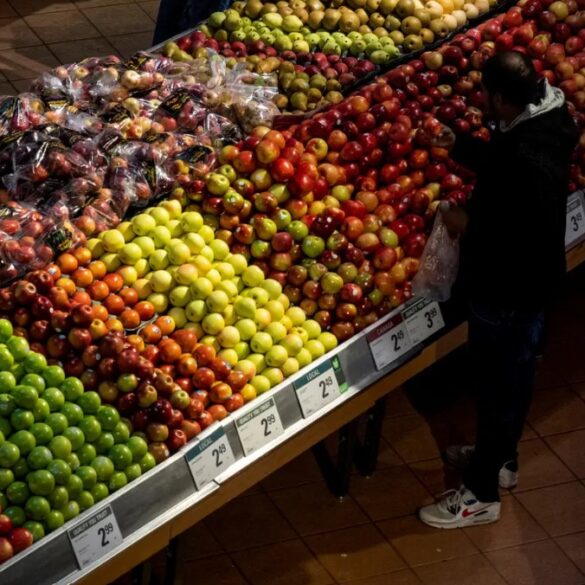
A man checks an apple while shopping at a grocery store in Toronto on Nov. 22, 2022. (Reuters/Carlos Osorio)

Although the latest inflation figures stayed below 2 percent in June, food prices have remained high.
A number of factors are keeping food prices high, including tariffs and counter-tariffs and their lingering effects even after removal, shifting political and trade strategies, and the industrial carbon tax and other domestic policies, according to a leading researcher in food security and policy.
“The important thing to remember is that the food industry really deals with very, very slim margins and perishability, and to apply tariffs on anything that has to do with the food industry is very dangerous,” Sylvain Charlebois, director of Dalhousie University’s Agri-Food Analytics Lab, said in an interview with The Epoch Times.
Food prices rose 2.2 percent in 2024 compared to 2023, according to Statistics Canada.
Meanwhile, among the top food price increases in Canada since January 2025 are strawberries, up 53 percent; oranges, up 37 percent; squash, up 31 percent; and beef, up 30 percent, Charlebois said in a July 9 post on X, citing Statistics Canada.
Charlebois attributes some of the current food inflation to the impact of counter-tariffs applied under former Prime Minister Justin Trudeau. Despite Prime Minister Mark Carney’s decision to scrap various counter-tariffs, with the rescinding order taking effect on May 7, their effect had already set in.
“Once you actually slap a tax or a tariff on a product, typically prices don’t drop [even after its removal], and that’s the problem,” Charlebois said. “It was actually the right decision to pause tariffs, not to impact food generation, but it was too late. It has impacted many, many categories.”
A counter-tariff on imported coffee has in part contributed to a 19 percent spike in ground coffee prices since January this year, according to Charlebois.
While some counter-tariffs on items like alcohol and citrus made sense, Charlebois questioned those on tea and coffee, noting that neither Canada nor the United States produces these goods. Because packaging is often done in the United States, products originally from Vietnam, Brazil, and Colombia were inadvertently penalized.
“At the very beginning under the Trudeau regime, I think there was just a lot of whiteboard thinking to support a lot of the trade policies we saw coming out of Ottawa, which made little sense,” Charlebois said.
“The Carney government is trying to reverse many of these things it inherited, really a lot of bad baggage. It’s doing its best. It’s just sometimes the timing is a bit off.”
While produce has been hit hard by tariffs, red meat has been particularly impacted by prolonged drought conditions. According to Charlebois, ranchers haven’t rebuilt herds at the pace they did after past droughts, such as in 2014.
“We’re not expecting beef prices to stabilize until probably early 2026,” he said.
“While dairy, fruit, and even vegetables have cooled, meat inflation hit 5.6% in April and is still hovering near 5%. It’s now the most inflationary food category—and consumers are feeling it at the butcher counter,” he wrote in a July 15 post.
Carney’s move to cut the consumer carbon tax had little impact, as he has maintained the industrial carbon tax, Charlebois told The Epoch Times. “The industrial [carbon] tax remains the main issue for agrifood,” he said.
Regarding trade diversification, he said that while there are opportunities in markets like Brazil, India, and the Asia-Pacific, they don’t compare to the importance of a stable trade relationship with the United States.
“It appears as though Mr. Carney is favouring Europe, which I’m not sure is the right thing to do,” he said, adding that European trade rules are complex and burdensome.
“We have to get along and get a deal with the Americans,” Charlebois said. “Because our economies are so integrated, it’s really a natural and logical thing to capitalize on both countries’ competitive advantages.”
He also said Canadian shoppers are in a much worse position than their U.S. counterparts.
“The American food economy is more capable of absorbing any geopolitical shocks than Canada,” Charlebois said. “When President Trump told Walmart to eat up tariffs, he knew Walmart could. But a lot of Canadian companies just can’t. They’re just not competitive enough.”
‘Uncertainty Tax’
Tariff instability has led to grocers “buffering” prices as part of risk management in anticipation of changes, Charlebois said.
“As soon as you start playing around temporarily with price points and policy, which would impact price points, you are likely to create an inflationary cycle,” he said. “Grocers will raise prices for one reason or another. If they can increase margins, they will.”
Charlebois called this phenomenon an “uncertainty tax.”
“The industry is just pricing that uncertainty in to make sure that they make a profit,“ he said. ”Sometimes companies will price products to make sure that they remain profitable, and that could actually inflate prices, penalizing consumers.”
Canada’s Competition Bureau has also weighed in on grocery pricing, saying it is taking action to protect consumers, including ensuring that property controls aren’t used by grocery stores to stifle competition.
Competitor property controls are restrictions on the use of commercial real estate that limit how a property can be used by others. For example, they can make it hard, or even impossible, for businesses to open new stores there, or limit the products that can be sold in a store.
“We continue to investigate the use of property controls in the retail grocery sector to ensure competition in grocery markets across the country for the benefit of Canadians,” Anne Brodeur, a communications adviser from the Competition Bureau, told The Epoch Times.
For long-term reform, Brodeur emphasized the need for structural changes.
“Canada needs a Grocery Innovation Strategy aimed at supporting the emergence of new types of grocery businesses and expanding consumer choice,” she said.
This would include expanding consumer choice, having stricter unit pricing requirements from provinces, and limiting restrictive property controls that prevent competitors from entering the market.
“Federal, provincial, and territorial support for the Canadian grocery industry should encourage the growth of independent grocers and the entry of international grocers into the Canadian market,” Brodeur said.