Trump said ‘there’s no deal until there’s a deal’ and said he would consult with NATO and Ukrainian President Volodymyr Zelenskyy.
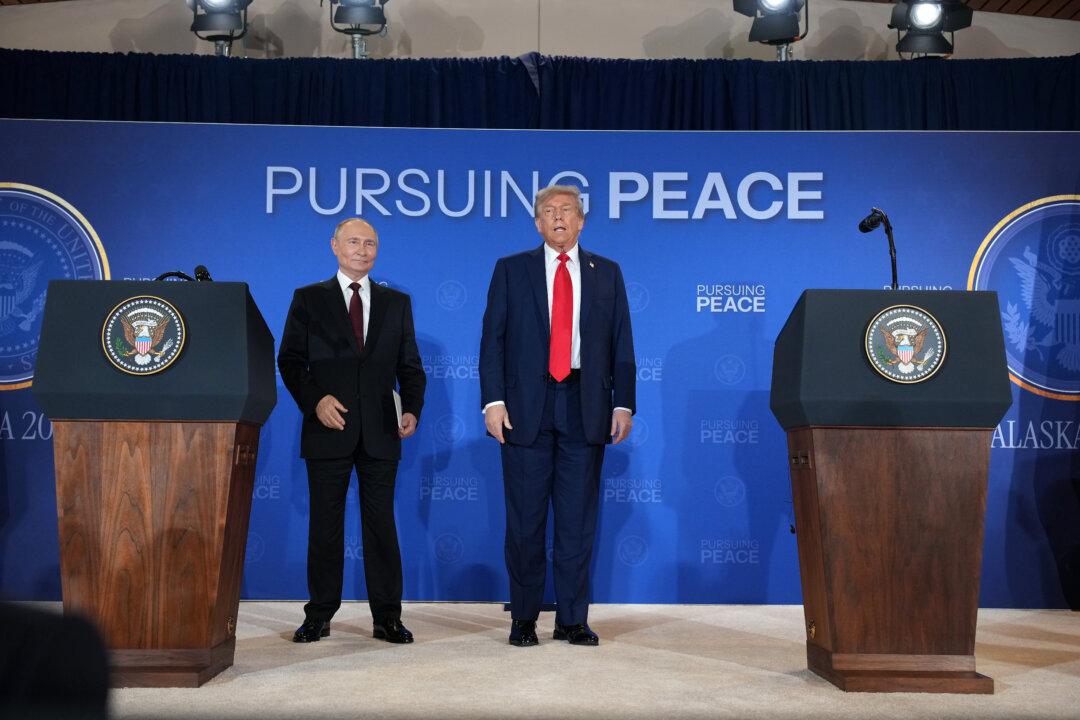
President Donald Trump (R) and Russian President Vladimir Putin leave following a press conference at Joint Base Elmendorf-Richardson in Anchorage, Alaska, on Aug. 15, 2025. Andrew Harnik/Getty Images

ANCHORAGE, Alaska—U.S. President Donald Trump and Russian President Vladimir Putin concluded their high-stakes summit in Alaska on Friday, announcing progress but no immediate cease-fire in the ongoing Russia-Ukraine conflict.
Following about three hours of direct talks, the two leaders spoke briefly at a joint press conference without taking any questions. Both leaders said the meeting was productive, but shared few specifics about the possible deal to end the 3 ½-year conflict in Ukraine.
“I expect that today’s agreement will be the starting point not only for the solution of the Ukrainian issue, but also will help us bring back business-like and pragmatic relations between Russia and the U.S.,” Putin said, speaking first.
Trump described the meeting as “very productive,” stating that both sides “made some great progress.”
The U.S. president said: “There were many, many points that we agreed on. Most of them, I would say.
“A couple of big ones that we haven’t quite got there, but we’ve made some headway.”
The leaders met at Joint Base Elmendorf-Richardson, Alaska’s largest military facility, on Friday, in an effort to end more than three years of war, the deadliest conflict in Europe since World War II.
Putin said he agreed with Trump that Ukraine should have security guarantees following the war. The Russian leader didn’t elaborate on what those security guarantees might look like but said “we’re prepared to work on that.”
Ukraine has sought entry into the North Atlantic Treaty Organization (NATO) for years, but Putin has opposed that idea and has made it a wartime goal to prevent such an outcome.
Putin’s Alaska visit marked his first trip to the United States since 2015. This was also the first face-to-face meeting between Trump and Putin since the invasion of Ukraine in February 2022.
The Russian leader said his country is ready to work toward peace in Ukraine and hoped Kyiv and European capitals would view that constructively and not “throw a wrench in the works.”
Putin also said Trump came away from the meeting with an understanding of Russia’s national interests.
Trump told Putin before ending the press conference, “We will probably see you again very soon.” Putin responded, “Maybe next time in Moscow.”
Trump called the suggestion “an interesting one,” adding he would “get a little heat on that one, but I could see it possibly happening.”
Putin also said he agreed with Trump that the war with Ukraine would not have happened if the latter had been the U.S. president at the time of Russia’s invasion.
‘Make a Deal’
In an interview with Fox News host Sean Hannity following the summit, Trump said his advice to Zelenskyy would be to “make a deal.”
During the interview, Trump declined to disclose the key issue where he and Putin remain divided, saying he “would rather not” make it public. However, his remarks suggested that the biggest sticking point centered on the concessions Ukraine would have to make.
“Ukraine has to agree. I mean, you know, President Zelensky has to agree,” Trump told Hannity. “But it’s a terrible war where he’s losing a lot—and both of them are—and hopefully it can get completed. That would be a great achievement for them.”
Trump added that European nations must also “get involved a little bit” to help push toward an agreement. He confirmed that a meeting is being arranged between Zelenskyy and Putin, noting that he will join as well.
“They both want me there, and I’ll be there,” Trump said.
China Sanctions
Trump also told Hannity he would soon consider imposing new tariffs on countries that purchase oil from Russia, like China—though the Alaska summit may have bought Russia’s trade partners a little time.
“Because of what happened today, I think I don’t have to think about that now. I may have to think about it in two or three weeks,” Trump said about potential tariffs against China for buying sanctioned Russian oil.
Last week the U.S. government increased tariffs on Indian imports to 50 percent. India is one of the top buyers of Russian fossil fuel exports.
India has continued purchasing oil from Russia despite the new tariffs.
Historic Meeting
The Alaska summit marked a historic meeting on U.S. soil, not just for its high-stakes agenda but also for the rare personal exchange between the two leaders.
Trump and Putin touched down at the military base around 30 minutes apart, with Trump arriving early.
Following a warm greeting on the tarmac, Trump and Putin walked together towards a riser as U.S. warplanes—B-2 Spirit stealth bombers and F-35 Lightning stealth fighters—made a flyover.
They then rode together in “The Beast,” the U.S. president’s heavily armored limousine, to the summit location.
The leaders then sat down for their bilateral meeting together with their respective delegations. Behind them, a blue backdrop bore the words “Pursuing Peace,” underscoring the summit’s stated goal.
In the lead-up to the summit, Trump struck a positive tone, stating that both Putin and Zelenskyy were open to a cease-fire.
Meanwhile, Zelenskyy on Friday accused Putin of ordering a new wave of attacks on Ukraine’s eastern Sumy region and elsewhere in Ukraine just before the summit, saying there was no sign Russia wanted to end the conflict.
Russia’s Ministry of Defense denied Zelenskyy’s attack claims in a statement it shared with the state-run RIA Novosti news agency. The ministry counter-accused the Ukrainian leader of trying to undermine the Alaska summit.
Speaking to the reporters en route to the summit, Trump postulated that the reported Russian strikes were a strategy by Putin to “make a better deal” at the negotiating table in Alaska.
“It actually hurts him, but in his mind, that helps him make a better deal,” Trump said. “If they can continue the killing, maybe it’s a part of the world. Maybe it’s just his fabric, his genes, his genetics.”