Bessent suggested that the Supreme Court ruled that only IEEPA cannot be used to impose tariffs on imports from other countries.
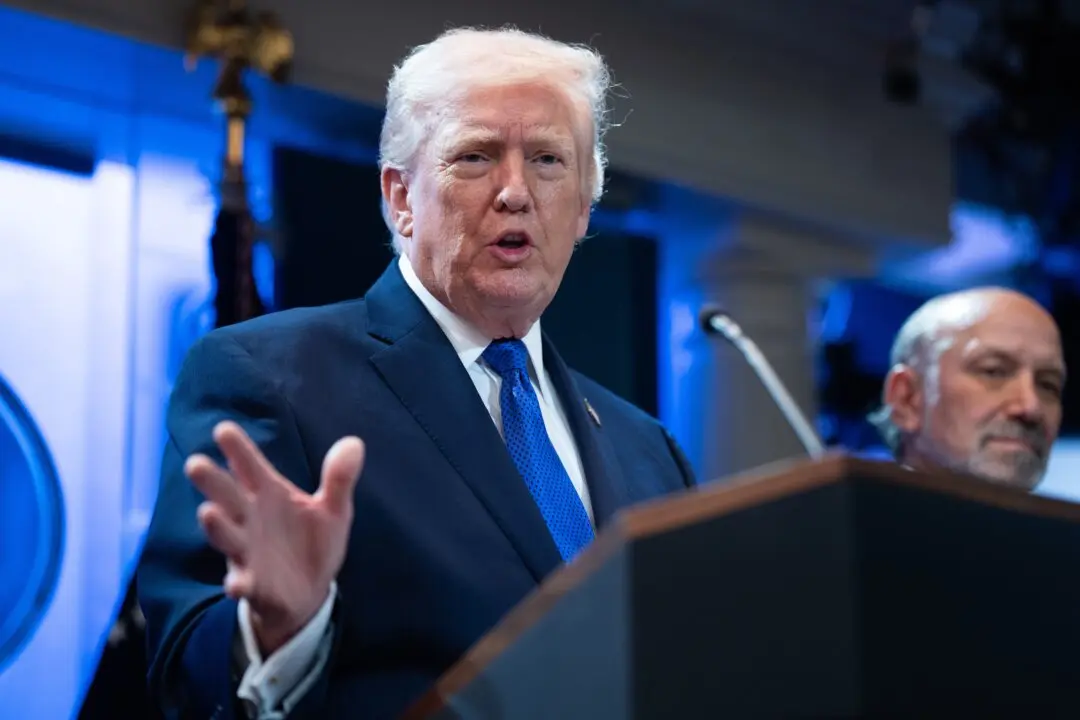
President Donald Trump answers questions during a press briefing held at the White House in Washington, on Feb. 20, 2026. Aaron Schwartz/Getty Images
President Donald Trump raised tariffs on all countries to 15 percent on Feb. 21, one day after the Supreme Court ruled against the global tariffs his administration imposed in 2025 under the International Emergency Economic Powers Act (IEEPA).
“I, as President of the United States of America, will be, effective immediately, raising the 10 [percent] Worldwide Tariff on Countries, many of which have been ‘ripping’ the U.S. off for decades, without retribution (until I came along!), to the fully allowed, and legally tested, 15 [percent] level,” Trump wrote in a Truth Social post on Feb. 21.
The president initially announced a 10 percent global tariff on Feb. 20, soon after the Supreme Court ruled 6–3 that the administration lacked authority to levy tariffs on dozens of countries under IEEPA.
On Feb. 21, Trump said that the updated 15 percent tariff boost was “based on a thorough, detailed, and complete review of the ridiculous, poorly written, and extraordinarily anti-American decision on Tariffs issued yesterday.”
The president said in the post that the administration will spend the next few months seeking alternative ways to impose “legally permissible Tariffs.”
The Trump administration has stated that it believes there are alternative ways to tax foreign goods.
Bessent suggested the Supreme Court ruled only that IEEPA cannot be used to raise revenue from other countries.
“This Administration will invoke alternative legal authorities to replace the IEEPA tariffs,” Bessent said.
“We will be leveraging Section 232 and Section 301 tariff authorities that have been validated through thousands of legal challenges. Treasury’s estimates show that the use of Section 122 authority, combined with potentially enhanced Section 232 and Section 301 tariffs, will result in virtually unchanged tariff revenue in 2026.”
Section 122 of the Trade Act of 1974 allows the president to enact tariffs up to 15 percent to address trade imbalances, but such tariffs require congressional approval to be extended after 150 days.
The Treasury Department stated that the federal government had collected more than $130 billion in tariff revenue this fiscal year as of Feb. 17.
But the Feb. 20 ruling could force the federal government to refund billions of dollars to companies that paid tariffs under IEEPA.
More than 1,000 companies have filed lawsuits against the U.S. government concerning tariffs.
Senate Minority Leader Chuck Schumer (D-N.Y.) and Senate Finance Ranking Member Ron Wyden (D-Ore.) criticized the administration’s latest attempt to impose new tariffs.
“We’re all going to have to keep paying higher prices,” Wyden wrote on X.
Despite fears that tariffs would drive up prices, inflation dropped to 2.4 percent in January, which was below expectations, according to data from the Bureau of Labor Statistics.