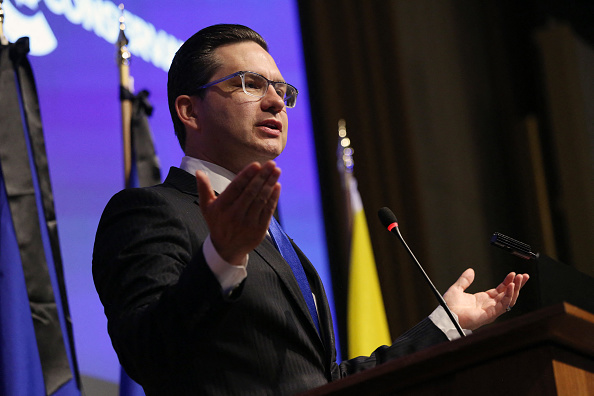
Canadian Conservative Party leader Pierre Poilievre speaks during the National Conservative caucus meeting in Ottawa, Canada on September 12, 2022. (Photo by Dave Chan / AFP)

Conservative Leader Pierre Poilievre is being given another shot at securing a seat in Parliament as voters in the Alberta riding of Battle River-Crowfoot head to the polls for a byelection on Aug. 18.
It will be a crowded race, as 213 other candidates are registered in the rural riding. Poilievre is expected to win handily, as it is one of the safest Conservative seats in the country. His predecessor, Damien Kurek, won the riding by over 46,000 votes in the April election.
Voting will be held from 8:30 a.m. to 8:30 p.m. local time.
While byelections typically see a lower voter turnout than general elections, there have been a total of 14,454 ballots cast in advance polls in Battle River-Crowfoot, compared to 14,434 ballots cast during the April 28 election.
While Poilievre is the assumed frontrunner, attention will be paid to exactly what margin he wins the riding by. Poilievre was asked by a reporter at an Aug. 18 press conference if he believed he could stay on as leader of the Conservatives if he failed to win the riding by a larger margin than Kurek. He did not answer, instead saying it would be a “privilege to champion the people who feed, power, and protect our country.”
The byelection results will also set the stage for a leadership review set to be held in January. The Conservative Party recently voted to implement the Reform Act, which allows MPs to vote on whether to keep their party leader.
Following the Conservatives’ federal election loss in April, prominent Tory caucus members have continued to throw their support behind Poilievre, and none have publicly called for him to step down.
Poilievre lost his Ottawa-area riding of Carleton, which he had held for over two decades, in the April 28 election. Liberal candidate Bruce Fanjoy won the riding by over 4,500 votes.
Following the election, Poilievre suggested that his loss in Carleton was due to his stated plans to reduce the size of the federal government, which could have proven unpopular with the many government workers in the riding.
Kurek, who had held the riding since 2019, officially resigned his seat on June 17 to give Poilievre the opportunity to run in a byelection and return to Parliament. Kurek said it had been “nothing short of a privilege” to serve the people of the riding, and he looked forward to supporting Poilievre in the race and then “running here again in the next general election.”
While Conservative MP Andrew Scheer has been serving as leader of the Opposition in the House of Commons, Poilievre has spent several months campaigning in communities in Battle River-Crowfoot, much of the time alongside Kurek.
The Alberta riding is also being targeted by the Longest Ballot Committee (LBC) protest movement, which is the same organization that targeted Poilievre’s former riding of Carleton, and resulted in 91 names being on the ballot.
The LBC has signed up a total of 201 candidates in the riding, with all of them registered under its Official Agent Tomas Szuchewycz. However, Elections Canada announced in late June that the byelection would have a special ballot where voters would write down the name of the candidate they are voting for, as opposed to the standard list of all candidates.
Elections Canada said votes for candidates would be counted even if their names were spelled incorrectly. They also said that a list of all the candidates will still be provided to voters.