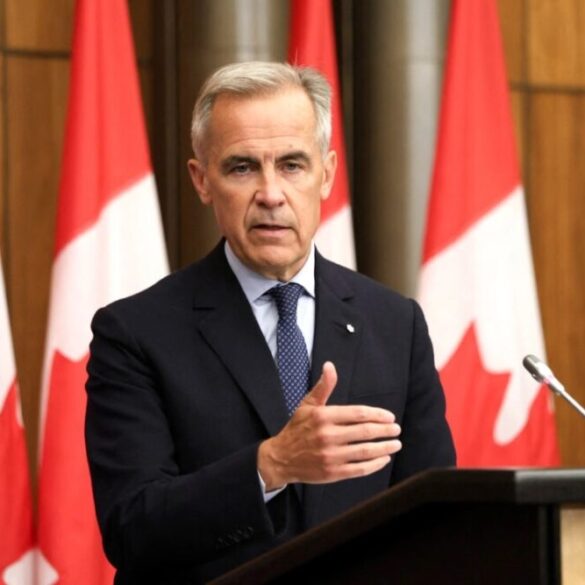
Canadian Prime Minister Mark Carney speaks during a press conference after a Cabinet meeting to discuss both trade negotiations with the Unite States and the situation in the Middle East, at the National Press Theatre in Ottawa, Ontario, Canada, on July 30, 2025. Dave Chan/AFP via Getty Images

Prime Minister Mark Carney has announced the first set of projects that the federal government is recommending for approval under the recently created Major Projects Office (MPO).
The Liberal government passed the One Canadian Economy act, also known as Bill C-5, in June. The legislation enables the government to streamline federal approval processes to have major projects built faster, with the aim of capping approval times to two years.
On Sept. 11, Carney announced the first five major projects being referred to the MPO for consideration, as well as several “strategies for projects” that are at earlier stages and require more development.
Here are six takeaways from the announcement.
5 Projects and 6 Strategies
The first five major projects announced by Carney include the second phase of LNG Canada in Kitimat, B.C., which will double its production of liquefied natural gas (LNG), and the Darlington New Nuclear Project in Clarington, Ont., which will create small modular reactors.
The Contrecœur Terminal Container Project, which would expand the Port of Montreal’s capacity by around 60 percent, was included. Carney also announced two mining projects are being referred to the MPO, including the expansion of the Red Chris Mine in northwestern B.C. to mine copper and gold, and the McIlvenna Bay Foran Copper Mine Project in Saskatchewan to mine copper and zinc.
The numerous “strategies” also announced by Carney included fast-tracking critical minerals projects in areas such as Ontario’s Ring of Fire; the Wind West Atlantic Energy project in Nova Scotia; the Pathways Plus carbon capture and storage product in Alberta; the Arctic Economic and Security Corridor; the expansion of the Port of Churchill in Manitoba; and a high-speed rail from Toronto to Quebec City.
LNG Expansion, But No New Oil Pipeline
The LNG expansion in B.C. would make the facility the second-largest of its kind in the world, according to the Prime Minister’s Office. The stated aim of the expansion is to attract private sector capital to Canada, grow the country’s GDP, and support jobs in local communities.
The Liberal government said this “low-carbon energy” would be shipped to Asian and European partners.
However, the announcement of projects being referred to the MPO did not include an oil pipeline, which Alberta has been pushing for. Carney had previously said he wanted Canada to become a “superpower” in both “clean and conventional” energy, and that there would be opportunities for an oil pipeline to bring “decarbonized oil” to markets in Asia and Europe,” but had not confirmed a pipeline.
What’s There for Alberta
The first round of projects to be referred to the MPO did not include any located in Alberta. However, the LNG expansion in B.C. would be to the benefit of Alberta, which produces around 67 percent of Canada’s natural gas.
The government said that as part of developing the Pathways Plus carbon storage project to be built in Alberta, it would examine a “pipeline that will substantially reduce emissions with additional energy infrastructure.” The government said the combination of the pipeline and carbon capture facility would support the energy sector while reducing emissions from Alberta’s oil sands.
Alberta Premier Danielle Smith had said prior to a First Ministers meeting in June that she would be pushing for a “grand bargain” of Ottawa supporting both a pipeline running from northwest B.C. to the port of Churchill, Man., as well as the Pathways carbon capture and storage network project. She said while the Pathways project would cost $10 billion–$20 billion, it could be paid for with revenues from more oil being sold to Asian countries.
Smith met with Carney on Sept. 10, and said in a statement following the meeting that she was “more optimistic than ever that the concerns of Albertans are finally being heard,” despite details still needing to be worked out over the coming weeks.
Emphasis on Critical Minerals
The McIlvenna Bay Foran Copper Mine Project would create 400 jobs around mining and smelting copper and zinc, which would “strengthen Canada’s position as a global supplier of critical minerals for clean energy, advanced manufacturing, and modern infrastructure,” according to the announcement.
The Red Chris Mine expansion, meanwhile, would increase the country’s annual copper production by 15 percent and employ around 1,500 workers.
The press release also mentions Canada’s critical minerals strategy, saying the MPO will prioritize the approval of more projects related to it, including in the Ring of Fire in northern Ontario, which is rich in chromite, nickel, copper, platinum, gold, and zinc.
Carney has previously spoken about the importance of critical minerals like nickel, cobalt, and lithium, saying Canada’s NATO defence commitment could be linked with its critical minerals strategy.
Carney recently announced Canada would meet the NATO defence spending target of 2 percent of GDP by the end of the fiscal year, and has agreed to adopt NATO’s new 5 percent defence target by 2035. While 3.5 percent of the new target involves traditional military spending, 1.5 percent can include industrial infrastructure investments, which can include critical minerals used in satellites, fighter jets, drones, and missiles.
G7 leaders also recently announced a critical minerals action plan to counter “non-market policies and practices,” without mentioning any specific country. Western leaders, however, have separately raised concerns about China’s dominance of the critical minerals market and the importance of this sector for global competition.
First Nations Connections
Two First Nations are mentioned in the projects being referred to the MPO: the Peter Ballantyne Cree Nation that will work alongside the federal government on the McIlvenna Bay Foran Copper Mine Project, and the Tahltan Nation to work with Ottawa on the Red Chris Mine expansion.
The MPO will have an indigenous advisory council made up of Métis, First Nations, and Inuit representatives to advise on the implementation of the projects and ensure indigenous perspectives are included in the decision-making processes.
Carney also met with Métis, Inuit, and First Nations groups in June and July to hear their perspectives.
Prior to the passage of Bill C-5, indigenous groups had raised concerns that the legislation would weaken existing requirements related to indigenous consultation and environmental protections.
Minister of Crown-Indigenous Relations Rebecca Alty said the MPO and Indigenous Advisory Council will soon begin “critical discussions about how they can be built in partnership with First Nations, Inuit, and Métis,” and said the projects will deliver “lasting benefits” for the groups.
Potential Projects Around Port Infrastructure, Renewable Energy
The federal government appears to be focused on building additional port and clean energy infrastructure. The expansion of the Port of Churchill, located in the town of less than 1,000 people in Northern Manitoba, would allow for “increased and diversified trade with Europe and other partners.”
The proposed expansion of Churchill with an all-weather road, upgraded rail-line, and marine ice-breaking capacity comes at a time when Canada is seeking alternative trading partners in response to a series of U.S. tariffs.
Carney would also be prioritizing renewable energy with the approval of the Wind West Atlantic Energy project, which would allow for 60 GW of wind power in Nova Scotia and more across the Atlantic provinces. Additionally, the Eastern Energy Partnership could include interties between New Brunswick and Nova Scotia, transmission cables between Prince Edward Island and New Brunswick, and further development of Quebec and Newfoundland and Labrador’s Churchill Falls and Gull Island.
Matthew Horwood is a reporter based in Ottawa.