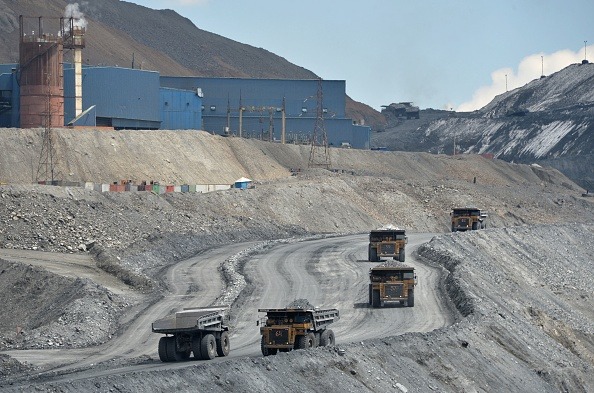
Dump trucks carrying the extracted gold ore from the mine site in a file photo VYACHESLAV OSELEDKO / AFP
The federal government has not raised national security concerns about a Chinese company’s planned acquisition of a Canadian gold miner, clearing the way for the transaction.
Shareholders of Allied Gold Corp. voted in favour of China’s Zijin Gold International Co. Ltd.’s proposed $5.5 billion acquisition of the company last week.
Industry Minister Mélanie Joly reviews all proposed foreign takeovers of Canadian companies in case of national security vulnerabilities. The reviews include assessing how the deals will affect Canada’s defence capabilities, critical supply chains, and the potential for enabling foreign espionage.
The federal government had a 45-day window to raise concerns about the deal, but it did not do so, meaning it was approved by default. The government would still be able to block Zijin’s acquisition of Allied if it fails to pass the ongoing net economic benefit review, which examines the deal’s impact on the Canadian economy, jobs, and supply chains.
Innovation, Science and Economic Development Canada said in a statement to The Epoch Times that the government is aware of the transaction, but said it can’t comment on specific transactions due to confidentiality provisions in the Investment Canada Act.
Zijin, which has indirect ties to the Chinese regime through its ownership structure, struck a deal in January to acquire Allied for $44 per share in cash—an all-time high for the stock. Allied operates mines in the African countries of Côte d’Ivoire, Ethiopia, and Mali, and produces around 375,000 ounces of gold a year.
Neither of the companies responded to an Epoch Times request for comment.
Under former Prime Minister Justin Trudeau, Ottawa tightened rules on Chinese ownership in the Canadian mining sector, citing national security concerns over China’s growing control of the global critical minerals supply chain. The government was particularly concerned about Chinese control of lithium, cobalt, and rare earths.
The federal government warned in 2022 that some foreign investments in Canada could be “motivated by non-commercial imperatives that are contrary to Canada’s interests.”
Canada has typically allowed Chinese investment in Canada’s gold sector in recent years, as the metal is not classified as a critical mineral. But in 2020, Ottawa blocked Shandong Gold Mining Co. Ltd.’s attempted acquisition of TMAC Resources Ltd. TMAC’s mine is located near tidewater in the Northwest Passage, which is a strategic shipping route in the Canadian Arctic.
Since Mark Carney became prime minister in early 2025, he has moved to deepen ties between Ottawa and Beijing in a bid to diversify trade away from the United States. During a visit to China in January, Carney announced he was reducing tariffs on imports of Chinese electric cars, and said Canada is open to more investment from China.