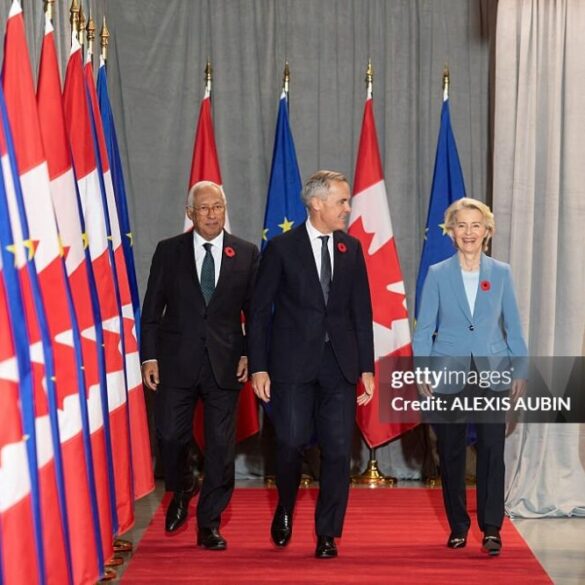
Canadian Prime Minister Mark Carney (C), European Council President António Costa (L) and European Commission President Ursula von der Leyen (R) arrive for a joint press conference following the Canada-European Union summit in Montreal, Quebec, Canada, on October 30, 2026. (Photo by Alexis Aubin / AFP via Getty Images)
Canada’s ambassador to the European Union has confirmed that Brussels removed references to ratifying the Canada-EU trade agreement from a joint statement issued at the end of last week’s summit in Montreal.
Jonathan Wilkinson discussed the revised joint statement while testifying before the Senate Foreign Affairs Committee on Nov. 5, and confirmed media reports that the EU had removed the wording.
Canada and the EU signed an “Alliance for the Future” pact during the two-day Canada-EU summit last week to co-operate more deeply on matters such as energy and security.
The joint statement originally emphasized the importance of member states ratifying the nine-year-old Canada-European Union Comprehensive Economic and Trade Agreement (CETA).
Wilkinson said Brussels removed the wording after some member states objected that the EU should not be dictating to member countries.
“There was some objection from member states … that it wasn’t the role of the commission to be telling member states what to do,” Wilkinson said. “And so we found some other wording that people were more comfortable with.”
Although the European Parliament approved CETA in 2017, the agreement cannot fully take effect until all EU member states complete their national ratification processes.
Eighteen of the 27 EU nations have finished their internal ratification processes. Belgium, Bulgaria, Cyprus, France, Greece, Hungary, Ireland, Italy, and Poland still need to ratify CETA, but Wilkinson said he expects four or five of those to do so within the next 12 months.
The ambassador said each state has a different set of issues holding up the trade deal’s ratification.
In France, the delay stems from agricultural sector concerns that Canadian products may impact French farmers, while Greece has concerns about the labelling of feta cheese, he said.
“We are working to try to address concerns that people have, and to get momentum to actually ratify,” he said.
The summit opened in Montreal on Oct. 29 and saw Prime Minister Mark Carney welcome European Commission President Ursula von der Leyen and European Council President António Costa.
The summit resulted in Canada signing its “Alliance for the Future” pact with the bloc, with plans to work toward an associate membership for Canada by next summer.
Von der Leyen first floated the idea of associate membership in September, and advocated for it again while speaking in Quebec at the summit.