2026 budget projects $62.3-billion deficit
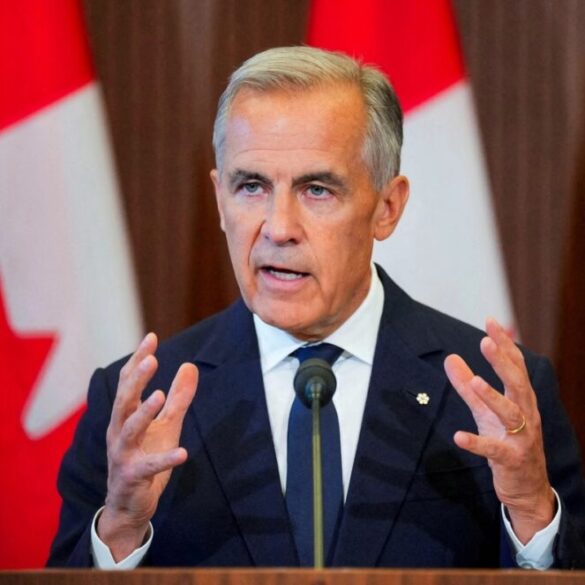
Prime Minister Mark Carney speaks with the news media after he suspended trade negotiations with the United States, in Ottawa, Ont., on Aug. 22, 2026. Chris Tanouye/Reuters
Finance Minister François-Philippe Champagne tabled his government’s 2026 budget on Nov. 5, which includes $142 billion in new spending and tax breaks over the next five years with the goal of spurring economic growth and addressing affordability issues.
The budget includes $36 billion for the new Productivity Mega Deduction program that allows businesses to write off the cost of capital investments, $43.5 billion in support for individuals and businesses affected by U.S. tariffs, $11.2 billion to tackle homelessness, new increases to GST rebates to help ease cost of living increases, and large expenditure in Canadian arts and culture programs.
The federal government projects a $62.3 billion deficit for the 2026-27 fiscal year, $3 billion lower than it predicted in the spring economic update. Ottawa projects that the deficit will decrease to $52.9 billion by 2030-31. Government revenues have been buoyed thanks largely to higher oil prices.
The government projects that it will meet both of its fiscal anchors of balancing day-to-day operating spending with revenues by the 2027-28 fiscal year—a year ahead of its initial commitment—and maintaining a declining deficit-to-GDP ratio over the budget planning horizon.
The government also projects that the economy will grow by 1 percent in 2026, 1.7 percent in 2027, and 2 percent in 2028.
The Parliamentary Budget Office’s Oct. 20 outlook had projected that Ottawa would not meet its fiscal anchor of a declining deficit-to-GDP ratio, with expectations that it would continue to rise over the next two years. It also projected GDP growth of 0.9 percent in 2026 and 1.5 percent in 2027.
The budget also includes the government’s immigration targets for the next few years, with a goal of bringing in 380,000 permanent residents and 370,000 temporary residents in 2027, 2028, and 2029. The targets are similar to the targets from Budget 2025, which called for 380,000 permanent residents for 2026, 2027, and 2028, and 385,000 temporary residents in 2026, followed by 370,000 in both 2027 and 2028.
Prior to the tabling of the budget, Prime Minister Mark Carney said the budget represents the “next big step in our action plan to make this country more independent, more sovereign, masters of our destiny.”
Champagne said the budget would help Canada build the “strongest economy in the G7” while making life more affordable for Canadians. “And we will defend our sovereignty while celebrating who we are,” he said.
Conservative Leader Pierre Poilievre said “Carney’s Costly Credit Card budget” will lead to higher inflation as it’s adding more debt. “Budget should be named Mastered by Debt,” he said on social media.
Conservative MP and Shadow Finance Minister Michael Chong said the budget fails to establish a “credible fiscal anchor to reduce the debt and balance the budget.” He said government borrowing is accelerating inflation and making “life more unaffordable for individuals, families, and companies.”
Chong noted that business capital formation has declined in five of the last six quarters, unemployment remains above pre-COVID-19 pandemic highs, and GDP is “flatlining.”
Champagne responded that the deficit will decline over the next few years. He said his government has brought direct program expenses from 8 percent to 2 percent and is “kick-starting an investment supercycle” through its budget.
“Christmas came early for CEOs,” said NDP MP Don Davies, adding that the budget puts “corporate interests over those of struggling Canadians.” He said the government did not put forth new spending for pharmacare, dentalcare, or childcare, but is allocating “one in five tax dollars to military spending today, increasing to a staggering one in $4 in 2030.”
Champagne said that Davies didn’t mention the government’s allocation of billions of dollars to end homelessness, and encouraged him to “join in and help us end homelessness in this country.”
Bloc Québécois MP Gabriel Ste-Marie said the budget does not pay back Quebec for asylum requests or increase health transfers to the provinces, which he called a “serious problem.” Champagne responded that Ottawa is investing in culture and small businesses, while also renewing funding for mental health, which he said will benefit the province.
Measures for Tariffs, Affordability
The budget details a range of existing and new program expenditures to help with tariff relief and affordability issues. It says the government has allocated $10 billion to support workers, $12.9 billion to business financing and liquidity, and $20.6 billion to support affected companies.
The budget includes a one-time 50 percent top-up to the GST rebate. This update to the groceries and essentials benefit would give an eligible family of four up to $2,570 in cash payments this year. It would, apply to 12 million people and cost $4.1 billion.
Ottawa is also allowing more low-income families to qualify for the Build Canada Workers Benefit, a refundable tax credit that supplements the earnings of low-income workers, by lowering the income threshold at which it begins to phase in from $3,000 to $500.
The budget includes the goal of “ending homelessness within 10 years” through a new Integrated Supports Fund to support projects that “bring housing together” with health and mental health” and support the development of supportive housing. It also allocates $2 billion for community mental-health and addictions facilities.
Ottawa will also spend $2 billion over eight years to retrofit up to 1 million homes, with the government saying the measure will reduce heating and cooling bills. Ottawa will also spend $845 million over four years to make the Canada Caregiver Credit fully refundable, and $610 million over four years to expand funding for Nutrition North Canada meant to lower the cost of imported food for northern communities.
Expenditure Meant to Spur Growth
One of the largest line items in the budget is the new Productivity Mega Deduction, which will allow businesses of all sizes to immediately write off the costs of new investments in equipment, software, machinery, and other items. This is estimated to cost $36 billion over the next five years.
The budget says this new initiative will reduce the tax on new investment to 6.4 percent, which is less than half the rate of the United States, and “by far the lowest rate in the G7.” Ottawa says that this could boost GDP growth by about 0.5 percent by 2030.
The budget also details the Canada Growth Incentive, which encourages entrepreneurs to reinvest up to $15 million in capital gains “from a successful startup into the next Canadian success story.”
It also contains new details about the previously announced Canada Strong Fund, which will see the federal government spend an initial $25 billion to take ownership stakes in some major projects and businesses. Canadians can purchase “Canada Strong Notes” through their banks beginning in 2027 to share in the fund’s growth, and their initial investments will be protected.
The budget details Ottawa’s commitment of $50 billion to the Power Canada Strong – National Electricity Strategy, with the goal of doubling the country’s electricity grid capacity by 2050. The government is also committing $518.5 million to the Nuclear Energy Strategy.
The budget also allocates $2.3 billion to the Critical Minerals Strategy to expand domestic production and processing, $6.5 billion over six years to modernize Canada’s forestry sector and improve its productivity, and commits to fully funding the 800-kilometre Mackenzie Valley Highway in the Northwest Territories.
Other Programs and Expenditures
The budget includes $783.1 million over five years to support Canadian museums and cultural institutions, and makes $45,000 of income of artists from their creative work tax-free.
The budget allocates $6 billion over 10 years to support the expansion of the capabilities of the Canadian Security Intelligence Service. It also allocates $28 million to support military personnel and families affected by the deadly fire at the CFB Wainwright military base in Alberta.
Another $12 million is allocated to archiving the records of former Prime Minister Justin Trudeau.
Ottawa is also imposing new rules to eliminate fees to activate, change, or cancel cellphone and internet plans, which the government says will save Canadians $100 million annually.
The Canadian Press contributed to this report.