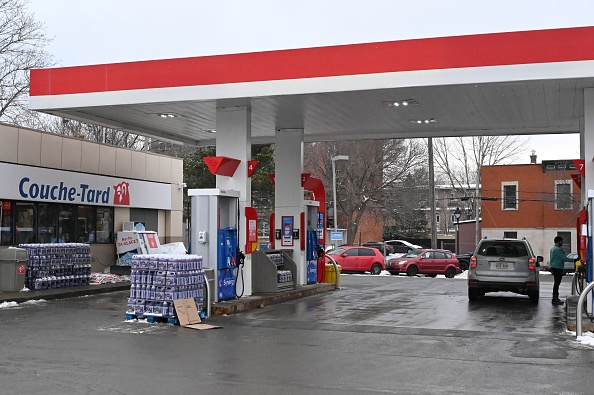
A Couche-tard convenience store at an Esso gas-station is seen in Montreal, Quebec on January 13, 2021. (Photo by ERIC THOMAS/AFP via Getty Images)
Albertans will see some extra money coming into their bank accounts starting today as the federal government releases the first batch of 2022 carbon tax returns, according to the Canadian Taxpayers Federation (CTF).
The first round of the quarterly-based Climate Action Incentive (CAI) rebate starts with a “double-up” payment that returns proceeds from the first two quarters of the 2022-2023 fuel charge year. Two further single-quarter payments will be released in October 2022 and January 2023.
Single adults will receive $269.50. For a couple, or in the case of a single parent, the first adult or the single parent will also receive $269.50, while the second adult in the couple or the first child of the single parent will receive $135.
Additional children under 18—starting with the second child in the case of single parents—will receive $67.50 each.
Under the Liberal government’s carbon pollution pricing system, a price is slapped on provinces that do not have their own system which meets the federal benchmark—specifically Alberta, Ontario, Manitoba, and Saskatchewan.
The federal government will return proceeds of the pollution pricing to the province of origin through the CAI payment; about 90 percent of the direct proceeds will be rebated to residents, while the other 10 percent is being used to support small businesses, farmers, and indigenous groups.
PBO Report
The federal government says that in the four provinces where Canadians receive CAI payments, “most households will receive more than they pay,” but the CTF disagrees, pointing to a report from the Parliamentary Budget Officer (PBO), that says the government is “using magic math,” and the carbon tax will come at a higher cost for the average household.
The PBO report, released in March, demonstrates that the federal carbon tax will cost the average Alberta household $2,004 this year whereas they will receive $1,333 in return. Accounting for the rebates, the carbon tax will still cost the average Alberta household a net total of $671 in 2022. Similarly, the average household will spend an extra $360 in Ontario, $299 in Manitoba, and $390 in Saskatchewan after the rebates.
“Families are still paying hundreds of dollars in carbon taxes every year even with the rebates,” said Franco Terrazzano, the federal director of the CTF, in a July 14 statement.
He noted that in addition to the carbon tax, the federal government also charges a sales tax and fuel excise tax on gasoline. Ottawa is also planning to impose a second carbon tax through fuel regulations in 2023, which will not include a rebate to Canadians.
The federal carbon tax is currently $50 per tonne in Canada, and is set to gradually increase to $170 per tonne by 2030. Right now, Canadians pay about 11 cents per litre on gasoline and 13 cents per litre on diesel.
According to a CTF analysis, in the provinces where Canadians will receive the CAI, the cost of the extra carbon tax cost to the average household will accumulate significantly in the coming years.
CTF estimates that from 2022 to 2030, the carbon tax will cost the average household a net total of $13,041 in Alberta, $8,091 in Saskatchewan, $8,059 in Ontario, and $6,439 in Manitoba.