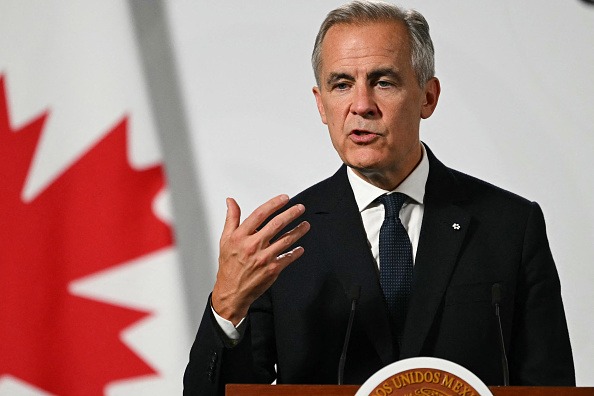
Prime Minister Mark Carney speaks during a joint press conference at the National Palace in Mexico City on September 18, 2025. (Photo by Yuri CORTEZ / AFP)

Prime Minister Mark Carney has announced new aid measures aimed at helping Canada’s aluminum, steel, and lumber sectors affected by U.S. tariffs, including reduced steel imports, lower domestic freight costs, and increased relief funding for softwood lumber companies.
“These new measures focus on three core objectives—first, to further limit foreign steel imports so as to increase domestic demand for Canadian steel producers; second, to make it easier to buy and build with Canadian steel and lumber; and third, to invest in workers and businesses so they have the tools and the resources that they need to drive this industrial transformation,” Carney said at a Nov. 26 press conference.
To limit foreign steel imports, the prime minister announced Canada will reduce the tariff-free steel imports from non-free trade agreement partners from 50 percent to 20 percent of 2024 levels. For partners that are not part of the United States-Mexico-Canada free trade agreement, he said Canada will reduce tariff-free steel imports from 100 percent to 75 percent of 2024 levels.
Additionally, Canada will impose a global 25 percent tariff on targeted imported steel derivative products, including wind towers, prefabricated buildings, fasteners, and wires.
The prime minister also said Ottawa will toughen its border compliance measures to prevent foreign steel dumping by equipping the Canada Border Services Agency with a dedicated steel compliance team and enhanced detection tools.
Ottawa will end the temporary remission of Canadian tariffs on imports on Jan. 31, 2026, for steel used in Canada for manufacturing, food and beverage packaging, and agricultural production. Carney said the measure aims to move Canada away from relying on imported steel and give Canadian companies time to adjust their supply chains to use Canadian steel.
Carney said Ottawa will subsidize rail companies in Canada to cut freight costs for interprovincial rail shipments of Canadian steel and lumber by approximately 50 percent beginning next spring.
Ottawa’s new Build Canada Homes agency will prioritize “shovel ready, multi-year projects” that can begin in the next 12 months and that use Canadian lumber products. The federal agency is expected to create $70 million to $140 million of demand for Canadian wood products, the prime minister said.
Carney also announced a number of measures to help employers retain workers, including expanding Ottawa’s work-sharing programs, increasing income replacement benefits from 55 percent to 70 percent, and providing an additional $500 million to the Business Development Bank of Canada Softwood Lumber Guarantee Program.
Ottawa will also provide $500 million in funding to support softwood lumber firms facing liquidity pressures under the Large Enterprise Tariff Loan facility, and launch a Canadian Forest Sector Transformation Task Force to seek input and recommendation from provinces, territories, and industry on how the forestry industry can maintain competitiveness.
Ottawa’s move to further aid the metals and softwood lumber sectors comes as both steel and aluminum producers continue to face 50 percent import duties imposed by the United States. Meanwhile, tariffs on Canadian softwood lumber going into the United States were increased from 35 percent to 45 percent at the end of September.
Canada-US Trade Talks
Momentum appeared to be building in trade discussions between Carney and U.S. President Donald Trump following Carney’s second visit to the White House on Oct. 7. Carney had said “detailed, constructive negotiations” had taken place with the Trump administration around the metals and energy sectors.
U.S. Ambassador to Canada Pete Hoekstra said the two countries were expected to announce a deal on metals and energy around this time.
However, trade talks between Canada and the United States broke down last month after the Ontario government sponsored a $75 million anti-tariff advertising campaign in the United States that featured portions of a 1987 address by late U.S. President Ronald Reagan.
Trump called off trade negotiations with Canada on Oct. 23 because of the ad campaign, saying it misrepresented Reagan’s address and was meant to interfere with a U.S. Supreme Court decision on his administration’s use of tariffs. The two countries have not participated in formal trade discussions since.
Carney dismissed a reporter’s question on Nov. 23 about when he last spoke with Trump by saying “who cares.” Carney then said during question period in the House of Commons on Nov. 25 that he had made a mistake in saying “who cares,” noting it was “a poor choice of words about a serious issue.”
Carney also said on Nov. 23 that he looks forward to “speaking to the president soon,” but noted he doesn’t have “a burning issue to speak with the president about right now.”
“When America wants to come back and have the discussions on the trade side, we will have those discussions,” he added.
As the trade impasse with the United States remains unresolved, Carney has been working toward his goal of doubling non-U.S. exports over the next decade.
Noé Chartier contributed to this report.
Olivia Gomm is a news reporter with the Canadian edition of The Epoch Times.