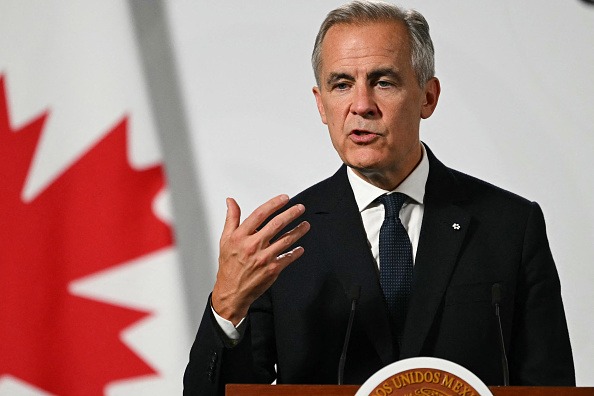
Prime Minister Mark Carney speaks during a joint press conference at the National Palace in Mexico City on September 18, 2025. (Photo by Yuri CORTEZ / AFP)

Prime Minister Mark Carney said federal public servants will soon be receiving updated rules on how much time they are required to do in-person work.
Carney said requirements will likely vary depending on the role and seniority of civil servants as well as the responsibilities they handle.
“There will likely be different levels of return depending on seniority, depending on the role and obviously, depending on capacity,” Carney said during a Dec. 8 discussion with Ottawa Mayor Mark Sutcliffe during an event with the Ottawa Board of Trade.
“We will come to a much sharper view on it over the course of the next several weeks,” Carney noted of the new in-person requirements, adding that public servants are needed “at this critical time.”
Sutcliffe told media that it’s reasonable to require public servants to come into the office one or two more days per week and said it will also help Ottawa’s economy.
“I’m looking forward to seeing how [return-to-office] plans roll out,” Sutcliffe said. “I’ve seen some of the reports. We want to see our downtown thriving and prosperous. It’s been a challenging time over the last few years since COVID.”
The last updates to civil service rules were made in May 2024, when Ottawa required employees who were qualified for hybrid work to come into the office at least three days a week and executives were required to do in-person work at least four days per week.
Public Service Cuts
The announcement of upcoming updates to in-person work rules for federal civil servants comes amid news that around 68,000 civil servants received letters last week letting them know they are eligible for early retirement incentives.
The federal government plans to cut 30,000 public service positions in the next five years, having already eliminated an estimated 10,000 positions over the past year.
Ottawa is aiming for a civil service workforce of around 330,000 by 2028–29, along with a reduction of around 1,000 executive positions over two years.
The public service grew considerably in the past decade, rising from 287,983 workers in 2019 to 367,772 in 2024 and falling to around 357,965 this year, according to data from Statistics Canada.
Speaking Dec. 8, Carney said the civil service had grown to an unsustainable size in the past decade, but said most of the cuts will occur through voluntary retirements, employees who accept early retirement incentives, and “other adjustments.”
Carney noted the government has prioritized using artificial intelligence (AI) to perform “the less interesting” parts of civil service work and will be working to use AI more for such tasks.
Public-sector unions said last week that hundreds of their members have gotten notices warning about the possibility of upcoming cuts, including in the Public Service Commission of Canada, Crown-Indigenous Relations, Natural Resources Canada, the Department of Finance and Northern Affairs Canada.
Professional Institute of the Public Service of Canada President Sean O’Reilly has said the early retirement incentives in particular will drive out the civil service’s most “experienced” staff.
“This program will drive out some of the most experienced people in the federal public service. Instead of retaining talent, the government is actively incentivizing its most seasoned professionals to leave,” O’Reilly said in a Dec. 3 statement.
For its part, the Public Service Alliance of Canada said it wants all details about early retirement incentives and the elimination of any positions before reaching a full position, but said any changes “must honour the hard-fought contractual benefits enshrined in our collective agreements.”
This past July, Finance Minister François-Philippe Champagne directed fellow cabinet ministers to find 7.5 percent savings in their departments starting in 2026, growing to 10 percent in 2027 and 15 percent in 2028.
Treasury Board spokesperson Mohammad Kamal said Ottawa intends to rely primarily on voluntary departures and attrition, though legislation must still be passed before incentives take effect. Under budget timelines, the program could become law as early as January, with applications opening within 120 days of Jan. 15 or 120 days after enactment. Employees who accept would need to retire within 300 days.