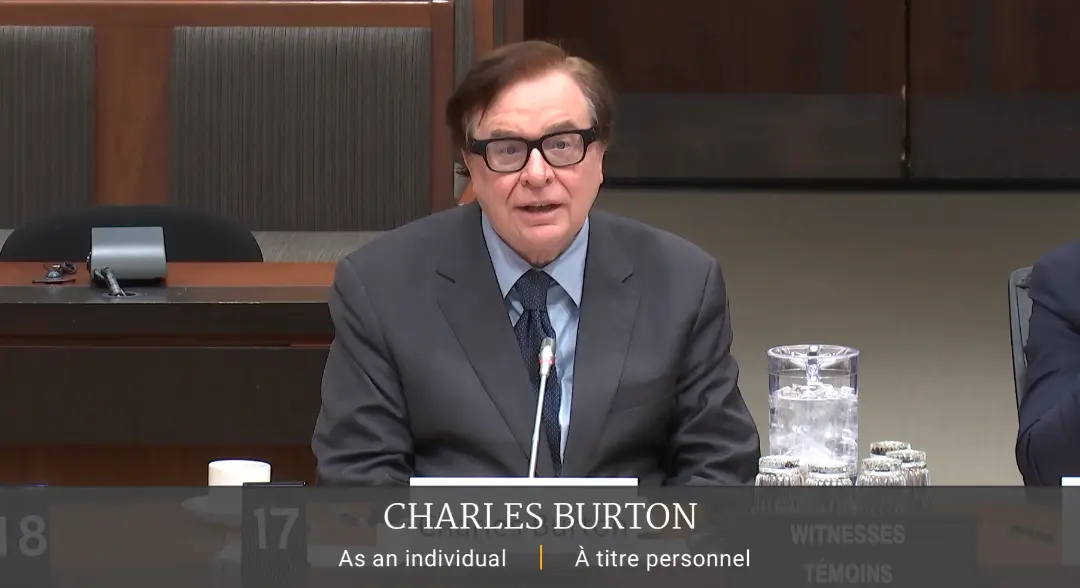
China scholar Charles Burton testifies before the House of Commons procedure and house affairs committee on Nov. 27, 2025. House of Commons/Screenshot via The Epoch Times

When Canada does not expel Chinese spies operating within the country, it signals to China and the United States that Canada is “open territory” for Chinese infiltration, says Charles Burton, a China scholar and senior fellow of the Sinopsis think tank.
“We’re not expelling people that I believe CSIS knows are espionage agents,” Burton told MPs as he testified before the House of Commons procedure and house affairs committee on Nov. 27.
Burton said Canada expelled Zhao Wei, a Chinese diplomat who reportedly targeted Conservative MP Michael Chong and his family, in 2023, after the media exposed Wei’s actions.
“I just don’t want any Chinese spies to be operating freely in our country,” Burton said. “The fact that we don’t expel any of them, we don’t make any of them persona non grata, or bring their proxies to Canadian courts to be made accountable for these alleged activities, I think sends a signal to China that Canada’s open territory for this kind of thing.”
Burton also said Canada failing to expel Chinese spies sends a signal to the United States that Canada is open for Chinese infiltration and raises the question of whether Washington can trust Canada in collaborating on security and military issues.
He noted the Chinese regime’s large diplomatic footprint in Canada. While Japan has approximately 40 diplomats in Canada and India has approximately 30, China has 176 diplomats in Canada, he said, adding that Canada doesn’t have “anything like that number of diplomats in China.”
“The question is, are Chinese diplomats so inefficient that they need such large numbers to engage in legitimate diplomatic function, or is it that about 70 percent of them are engaged in espionage, influence operations, harassment of Canadians of Chinese origin, and other things which are not consistent with their diplomatic function?” Burton said.
Chong, the Conservative MP for Wellington—Halton Hills North in Ontario and a vocal critic of Beijing’s human rights abuses, said in 2023 he was disappointed the government didn’t inform him that Chinese diplomat Zhao Wei had been targeting his family in Hong Kong. He said he only learned about it through a Globe and Mail report citing intelligence sources.
Ottawa declared Zhao persona non grata a few days later.
“We will not tolerate any form of foreign interference in our internal affairs,“ then-Foreign Affairs Minister Mélanie Joly said at the time. ”Diplomats in Canada have been warned that if they engage in this type of behaviour, they will be sent home.”
Foreign Affairs Minister Anita Anand said during a parliamentary committee meeting on Nov. 27 that all diplomats must respect the Vienna Convention on Diplomatic Relations, which states that diplomats can’t interfere in the internal affairs of host countries.
“We will never tolerate any form of foreign interference or meddling in our democracy,” Anand said during a meeting of the Standing Committee on Foreign Affairs and International Development.
Foreign Influence Registry
In June 2024, Parliament passed Bill C-70, “An Act respecting countering foreign interference.” The legislation provided for a foreign influence registry of those are working in Canada as agents on behalf of foreign governments, as well as for a foreign interference transparency commissioner following consultation with opposition parties.
Burton testified he had thought the commissioner would be appointed in the fall of 2024 and said Public Safety Canada indicated the registry would be operational by June 2025, a year after Bill C-70 passed. However, no commissioner has been named.
In August of this year, the public safety minister said the appointment would be announced in September. “That didn’t happen either,” Burton said, adding the department is now suggesting an appointment could happen before Parliament’s winter break.
Public Safety Minister Gary Anandasangaree said earlier this month that his department was “working towards the appointment” and the commissioner would be appointed “in short order,” without providing a reason for the delays.
“For the coalitions [of rights groups] that I work with, these unexplained delays feel like cynical stakeholder management rather than sincere consultation with Canadian Chinese and other stakeholders,” Burton said.
“The concern is that institutional resistance or murky forces within the establishment is stalling the registry,“ he said. ”It appears there are current and former members of Canada’s political elite who fear transparency, lest it expose how they’ve been induced to serve a foreign state’s agenda against the interests of Canada.”
Burton said by not implementing the registry, Canada is not dealing with Chinese espionage in the country or taking “effective measures” against agents of the Chinese regime who are involved in intimidation and harassment. He said the Chinese regime infers it can continue if Canada isn’t serious about the registry.
Anand told MPs on Nov. 27 that as stated previously by the public safety minister, the foreign influence registry would be implemented by the end of the year.
Anand added that during Canada’s hosting of the G7 summit in Alberta earlier this year, G7 nations signed a joint statement condemning transnational repression, pledging to support those who may be targets of this “aggressive form of foreign interference.”
“Canada is showing leadership at a crucial time right here in our own country, including with our G7 partners,” Anand said. “There is no tolerance for foreign interference, including transnational repression targeting Canadians or individuals on Canadian soil.”
Relations With China
Prime Minister Mark Carney and Chinese leader Xi Jinping met on Oct. 31 during the Asia-Pacific Economic Cooperation forum in South Korea, with Carney saying Ottawa’s relationship with Beijing is at a “turning point” and that this opens the door to more business opportunities.
When asked during a Nov. 1 press conference whether he raised human rights and foreign interference with Xi, Carney said he discussed foreign interference, and that the Chinese side didn’t appear to “recognize the level of concerns we have about these issues,” adding that Canada has “a structure to manage them.”
Burton said Canada is “essentially saying we’re going to do Canada-China relations in the way that China wants to do it,” calling it “extraordinary” to have a partnership with a country like China. He noted the House of Commons has determined that the regime is “engaged in genocide and facilitates third world dictatorships by providing them with Chinese surveillance technologies.”
Following a meeting with the Chinese foreign minister in October, Anand said Canada is in a “strategic partnership” with Beijing. Although Canada agreed to a strategic partnership with China in 2005, relations between the two countries have deteriorated in recent years, particularly after China arbitrarily detained two Canadian citizens in 2018 in retaliation for Canada’s arrest of Huawei executive Meng Wanzhou on a U.S. extradition request. In its 2022 Indo-Pacific strategy, Ottawa described China as an “increasingly disruptive global power.”
Burton said, “I don’t feel that Canada should partner up with a regime whose values are so discordant with what makes our country great.”
Matthew Horwood contributed to this report.
Olivia Gomm is a news reporter with the Canadian edition of The Epoch Times.