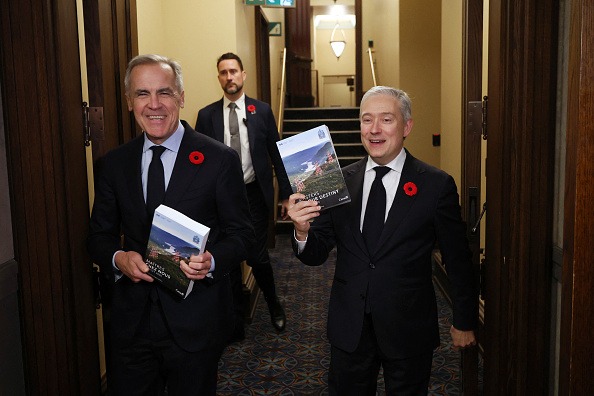
Prime Minister Mark Carney (L) and Finance Minister Francois-Philippe on Parliament Hill in Ottawa, Ontario, Canada on November 5, 2026. (Photo by Dave Chan / AFP via Getty Images)
News Analysis
Ottawa is betting that billions in new spending outlined in Budget 2026 will drive economic growth, while at the same time, mounting debt and persistent deficits present potential risks should Canada face an economic downturn.
Governments often invest in infrastructure projects during economic slowdowns to stimulate industrial activity. However, persistent deficits and rising debt carry risks, particularly if higher interest costs create an increasingly difficult fiscal cycle to manage. Economists also warn that extensive government involvement in the economy could distort market competition by favouring certain industries and businesses over others.
The Nov. 5 budget projects a $62.3 billion deficit for the 2026–27 fiscal year. The government has also reiterated its commitments to balance day-to-day operating spending with revenues by the 2027–28 fiscal year and maintain a declining deficit-to-GDP ratio.
Spurring Investment Through Spending
Budget 2026 includes several new measures that aim to increase private sector investment and boost productivity. Ottawa proposed the Canada Growth Incentive, allowing investors and business owners to exempt up to $15 million in capital gains from taxation on eligible Canadian company shares, while also deferring capital gains taxes when reinvesting proceeds from the sale of qualifying shares into other small businesses. This is estimated to cost $715 million over four years.
The budget includes investments such as $1 billion over six years for large-scale research and development and innovation projects, up to $750 million in investments through the Business Development Bank of Canada to support early-stage and growing businesses, and $2.3 billion to promote domestic production and processing capacity for the critical minerals sector.
The budget also proposes a $25 billion sovereign wealth fund to take equity stakes in strategic companies, citing Ottawa’s recent pledge to invest up to $1.6 billion in Toronto-based AI firm Cohere as an example.
The budget also highlights a previously announced $7.5 billion package to support workers and businesses affected by U.S. tariffs, including financing for small businesses and targeted assistance for affected industries.
One of the largest new measures is the Productivity Mega Deduction, estimated to provide $36 billion in tax relief over five years. The measure allows businesses to deduct the full cost of eligible equipment, technology, machinery, and other productivity investments in the year they are put into use, rather than spreading the deductions over several years.
Carney warned during a 2024 speech that Canada needed to increase its productivity, or else its prosperity would be “severely compromised.” Ian Lee, associate professor at Carleton University’s Sprott School of Business, said Canada’s productivity has lagged other G7 countries for 50 years, “so I applaud what [Carney] is doing on that front.”
Lee also said the government is moving “in the right direction” in speeding up natural resource projects and preventing “these endless appeals where they get tied up for years and years.” Ottawa’s “one project, one decision, one year” initiative aims to streamline federal reviews and approvals for major resource projects.
Lee also said there needs to be a review of Canada’s taxation framework, particularly when it comes to corporate and capital gains taxes. He said this could be similar to the Carter Commission established in 1962 under Prime Minister John Diefenbaker, which recommended sweeping reforms to taxation, many of which were implemented.
Jack Mintz, president’s fellow of the School of Public Policy at the University of Calgary, said it’s “quite appropriate” for the government to spend money on items like ports, railways, roads, and transmission lines.
“There are a number of things the government should be doing and involved in, which requires public support, because the private sector won’t be doing it,” he said.
However, Mintz said the government should not subsidize companies and sectors that are “going to make profits anyway.” He said companies in sectors like mining and AI can attract private investment once regulatory barriers have been addressed, without requiring substantial government subsidies.
Steve Ambler, professor emeritus of economics at the University of Quebec in Montreal, said the budget contained “a bit too much picking winners.” He said the Productivity Mega Deduction could distort investment decisions across Canada’s economy by making certain types of businesses or capital investments more attractive than others.
Risks From Mounting Debt, Deficits
The budget projects that Ottawa will meet both its fiscal anchors: balancing day-to-day operating spending with revenues by the 2027-28 fiscal year—a year ahead of its initial commitment—and maintaining a declining deficit-to-GDP ratio over the budget planning horizon.
The budget does not promise to balance the overall federal budget or reduce the federal debt, which now sits at $1.36 trillion.
The Parliamentary Budget Office’s Oct. 20 outlook projected that Ottawa would not meet its fiscal anchor of a declining deficit-to-GDP ratio, with the ratio expected to rise over the next two years.
The budget also stated that the deficit for the 2024-25 fiscal year was lower than expected due to higher revenues, at $36.3 billion compared to the government’s previous forecast of $48.3 billion.
The budget also projects Ottawa will collect an average of $23.9 billion more in annual revenue between 2026–27 and 2030–31 than originally forecasted, but the government will put that into additional spending.
Lee said the budget doesn’t remove some older programs that no longer work as intended, such as billions of dollars in annual corporate subsidies, including money for electric vehicle battery factories.
“We’ve got some programs on the books that could be pruned, and they could have used that money to reduce the size of the deficit,” he said.
Lee warned that when the next global crisis hits, Canada will need to spend even more to stimulate the economy, pushing deficits even higher. “No country has the capacity to borrow to infinity. You can hit a wall,” he said.
Mintz said that continued borrowing to finance deficits could eventually undermine investor confidence and push up borrowing costs further, as happened in the 1990s in tandem with a recession. This led to the federal government addressing investor concerns about debt by shrinking the size of the government while bringing in small tax increases.
Ambler said the budget projects spending will rise from $552.1 billion to $685.7 billion, outpacing economic growth. He said once government spending exceeds around 25 percent of GDP, it could lead to slower economic growth, which is a principle known as the Rahn Curve.
He also noted that public debt charges are expected to grow at 9.83 percent per year, meaning the “debt charges themselves are going to be taking a bigger and bigger chunk out of government spending.” Ambler questioned the budget’s assumptions about future borrowing costs, saying the projections depend on interest rates remaining relatively low, and this “could be a big assumption.”
Affordability Measures
The budget is also focused around increasing affordability for Canadians facing a cost-of-living crisis. The document proposes a one-time 50 percent increase to the Canada Groceries and Essentials Benefit for lower and middle-income Canadians for the 2026-2027 benefit year. Ottawa says this, combined with an earlier increase, would bring total payments to $2,570 for an eligible family of four for the 2026-2027 benefit year.
The budget also proposes lowering the minimum earnings threshold for the Canada Workers Benefit from $3,000 to $500. Ottawa says this will allow more low-income workers to qualify for the refundable tax credit.
It also details $845 million in funding over four years to make the Canada Caregiver Credit fully refundable starting in the 2027 tax year, as well as $610.3 million over four years to support Nutrition North Canada, a program meant to lower food costs in remote rural communities in Canada’s north.
The budget includes the goal of “ending homelessness within 10 years” through a new Integrated Supports Fund to support projects that “bring housing together” with health and mental health and boost the development of supportive housing. It also allocates $2 billion for community mental-health and addictions facilities.
Lee said the budget appears to prioritize the bottom third of income earners, an approach he said he favours over universal programs that would also provide benefits to higher-income Canadians.
“Why allow doctors and lawyers who are making a lot of money to get subsidized daycare or subsidized pharmacare? We’ve got to get rid of that pernicious, destructive value called ‘the belief in universality’, and go back to means-tested [policies]” Lee said.
Ambler said the Canada Groceries and Essentials Benefit does not eliminate costs, but instead shifts them to taxpayers. He warned that borrowing to finance such programs means “it’s our children and our grandkids that are going to be paying for it.”
Conservative Leader Pierre Poilievre has criticized the budget for adding to Canada’s debt, noting that interest on the debt is the “single biggest item of spending growth in this budget,” ahead of healthcare, military spending, and seniors programs.
Poilievre said additional spending will inflate the cost of fuel, food, and homes for Canadians, while noting that the budget doesn’t take taxes off of gasoline and diesel like the Tories had requested.
Prime Minister Mark Carney told reporters on Nov. 5 that the budget deficit is not too big, adding that the metric is coming down. He said the government is spending money on “building the country stronger,” by investing and increasing affordability.
Finance Minister François-Philippe Champagne said the budget includes more than $22 billion in new affordability measures over five years to “ease the day-to-day financial pressures on Canadians.”