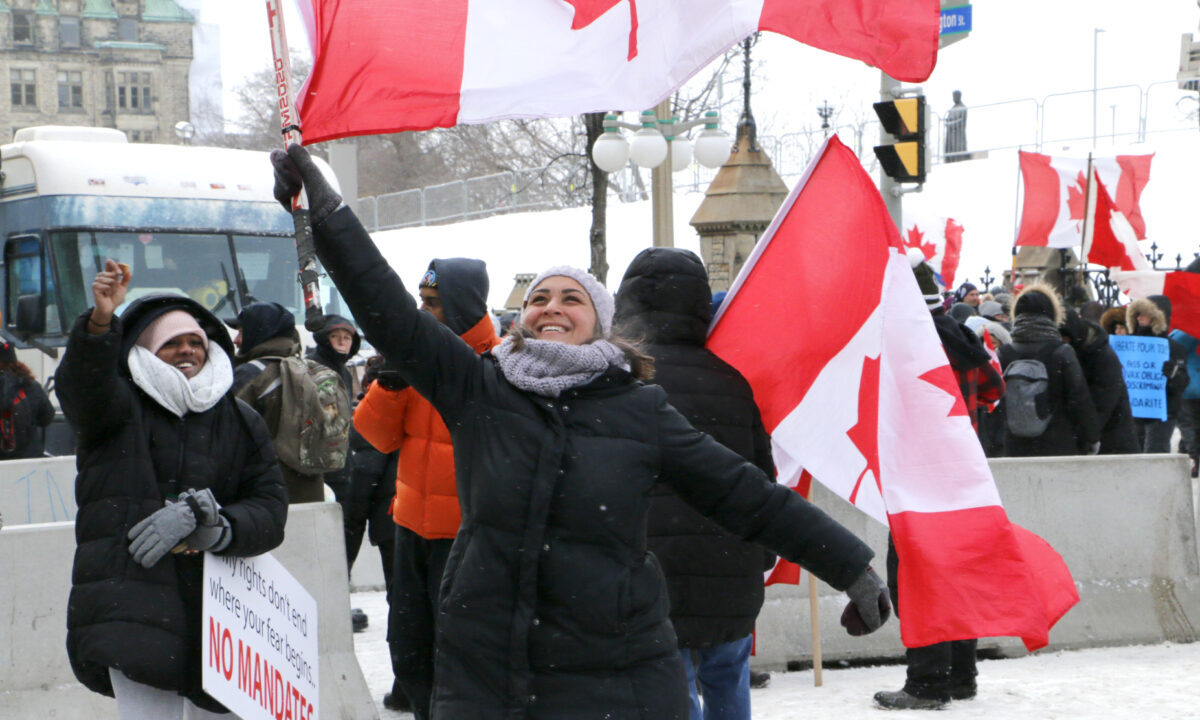
A woman dances and waves a Canadian flag during the Freedom Convoy protest in Ottawa on Feb. 12, 2022. (The Epoch Times/Noé Chartier)
By
People who took part in the Freedom Convoy protest in Ottawa last winter believed they were being patriotic and standing up for civil liberties, says a declassified briefing by Canada’s spy service.
“The Canadian flag was the most prevalent flag on display in the crowd, likely reflecting participants’ belief that they are patriotic Canadians standing up for their democratic rights,” says the Canadian Security Intelligence Service (CSIS) analytical brief obtained by Blacklock’s Reporter and reviewed by The Epoch Times.
The brief, dated Feb. 2, 2022, focuses on the flags and other imagery seen at the trucker-led protest which started on Jan. 29 and was dispersed three weeks later after the Liberal government invoked the Emergencies Act.
During the first days of the protest, a Nazi flag and a few Confederate flags were displayed, which was honed on by the prime minister.
“We vigorously condemn the hatred and the intolerance that we have seen in the streets of Ottawa over the past number of days,” said Justin Trudeau in the House of Commons on Jan. 31.
CSIS commented on the “small number of flags” reflecting “racist and bigoted world views.”
“The presence of these flags … is not unique to this event and are often seen at anti-lockdown/mandate events across the country,” says the briefing originally classified Secret/Canadian Eyes Only.
Several portions of the briefing were redacted, but most were initially marked unclassified, indicating the information likely came from open sources.
CSIS described the protest as sparked by truckers opposed to the vaccination mandate at the border that came into force in mid-January as part of the broader anti-COVID restrictions movement.
“As with any movement, only a small, fringe element supports the use of violence or might be willing to engage in it,” says the briefing.
CSIS said the protesters were united by their opposition to COVID-19 restrictions, with grievances such as vaccine mandates and government “overreach.”
‘Relevance of Flags’
The CSIS brief was produced by the organization’s Intelligence Assessments Branch (IAB), staffed by the career intelligence analysts with subject-matter expertise.
The brief’s section “The Relevance of Flags” provides a summary analysis of the different imagery displayed by protesters.
It noted that some of the Canadian and provincial flags were being flown upside down “likely as an indication of the bearer’s belief that nation is in distress.”
CSIS also provided its interpretation of drawn swastikas which appeared on placards and flags.
It said this was “not necessarily to self-identify as Nazis… but to imply that the prime minister and federal government are acting like Nazis … by imposing public health mandates.”
Conservative MP Michael Cooper was criticized and asked to apologize for meeting convoy protesters and being filmed in front of one such Canadian flag featuring a hand-drawn swastika.
“We want the rest of the country to know that MP Cooper’s presence at this rally in no way reflects the values of Edmontonians and St. Albertans,” tweeted Edmonton Mayor Amarjeet Sohi, a former Liberal cabinet minister.
Cooper, who represents the Alberta riding of St. Albert-Edmonton, later defended his attending the protest in a statement and said “Whoever flew this flag is personally responsible for that reprehensible decision and should be eternally ashamed of him or herself.”
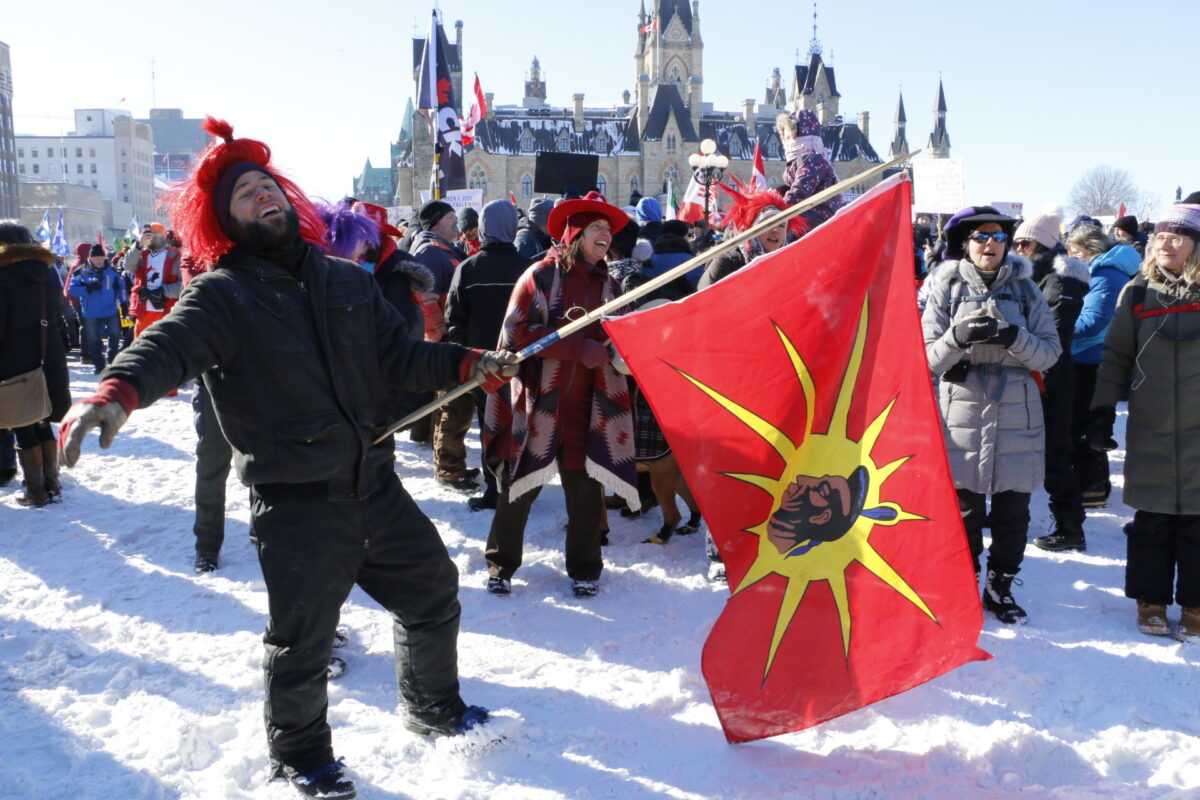
The brief also commented on the presence of symbols such as the Patriotes flag (associated with Quebec nationalism), the Gadsen flag (“Don’t Tread on Me”), and the Mohawk Warrior flag.
“Often, these flags have been used by more than one group/cause, thereby making it difficult to determine any particular allegiance of the bearer without additional context and nuance,” according to the brief.
Presence of Extremists
The CSIS brief alluded to the presence of extremists within the convoy, suggesting some were being tracked by the organization, but said it wasn’t aware of the presence of specific groups per se.
“Aside from individuals who specifically identified themselves as part of the convoy group, the Service is unaware of the presence of IMVE groups at this weekend’s protest,” says the brief.
“IMVE” is the acronym for “Ideologically-motivated violent extremism,” a catch-all concept adopted by the government in recent years. It encompasses political violence from across the spectrum, but CSIS is largely focused on violence from the right.
Similarly, various types of terrorism linked to religious causes is no longer described with specific qualifiers but rather called “religiously-motivated violent extremism.”
The first portion of the section “Implications” in the brief, where CSIS provided its assessment of the issue, was redacted.
The latter part indicated that “Freedom of expression is constitutionally protected in Canada.”
“CSIS investigative thresholds may be met once a threat actor facilitates or advocates for serious violence in support or furtherance of ideological, political or religious objectives with the intent of affecting societal change.”
It adds CSIS doesn’t investigate “lawful advocacy, protest or dissent,” unless it is linked to activities considered a threat to national security under the CSIS Act.
CSIS Director David Vigneault and his deputy Michelle Tessier are set to testify at the Public Order Emergency Commission for which public hearings begin on Oct. 13. A commission is required by law after the the Emergencies Act is invoked.