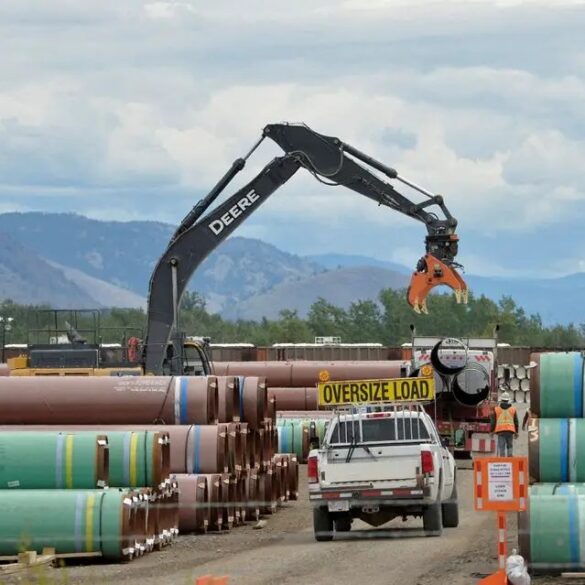
A pipe yard servicing government-owned oil pipeline operator Trans Mountain is seen in Kamloops, British Columbia, on June 7, 2021. (Reuters/Jennifer Gauthier/File Photo)
The federal government is classifying the proposed Alberta-B.C. oil pipeline as a project of national interest, accelerating federal approvals and regulatory reviews.
“A pipeline to the West Coast is part of our mission to transform our economy, to double our non-U.S. exports over the next decade, to create hundreds of thousands of good jobs,” Prime Minister Mark Carney told reporters in Fort McMurray, Alta., on Oct. 1.
The roughly 1,250-kilometre West Coast Oil Pipeline, which Carney said will henceforth be known as “Pacific Link,” will transport one million barrels per day of crude from Bruderheim, Alta., to a deepwater port near Delta, B.C., where it would be loaded onto tankers for shipment to international markets.
“That means more customers, more choice, higher prices for all Canadian energy producers, and it means greater long-term security of demand,” Carney said.
The federal government estimates the project could create about 140,000 jobs during construction and generate more than $20 billion in GDP annually, as well as more than $100 billion in government revenue by 2060.
The project will be developed by an ownership group involving Trans Mountain Corp., the Alberta Petroleum Marketing Commission, and Pembina Pipeline Corp. Trans Mountain will be responsible for planning and constructing the pipeline, while Pembina will work with the company on its development and operation.
The proposed corridor would largely follow the existing Trans Mountain route. The federal government says the southern route “protects British Columbia’s North Coast and avoids highly sensitive ecosystems,” while the final route remains subject to further development and consultation.
Alberta has said it wants the pipeline completed no later than 2034.
Carney said the world was facing an energy crisis involving the affordability and availability of oil, a “structural challenge” around energy security, and the “existential challenge” of climate change.
“Even under any plausible net zero scenario, the [International Energy Agency] forecasts the world will still need tens of millions of barrels of crude a day. So the question is, who will emerge as the world’s trusted suppliers? It should be us. It must be Canada,” Carney said.
Pipeline Development
Designating the pipeline under Schedule 1 of the Building Canada Act establishes a framework for moving the project through the federal approval process, including environmental assessments, with the aim of expediting its review.
Carney said the Major Projects Office (MPO) will aim to finalize the conditions for the pipeline by Sept. 1, 2027, subject to the federal government’s duty to consult with indigenous peoples. The conditions will establish requirements for the project’s construction and development.
Meanwhile, project proponents will continue developing the project, including through route mapping, ecological surveys, cost estimates, procurement and workforce planning.
The prime minister said that previously, proponents would need to spend many years and billions of dollars planning projects “before even knowing whether the federal government stood.”
“So, for many builders, the risk wasn’t worth it, and so Canada stopped building big. Now we’re making our position clear at the beginning of the process, rather than at the end,” Carney said.
Alberta Premier Danielle Smith called the announcement “a monumental day for our province and for our country.” Smith said the pipeline’s operations will allow the provincial government to collect tens of billions of dollars in royalties, which will be used to fund “essential services that Albertans rely on.”
Ottawa and Alberta first signed a memorandum of understanding on the pipeline in November 2025, which included commitments by Alberta to pair the proposed pipeline with a carbon capture project, while also increasing the province’s industrial carbon-pricing system.
The two governments announced a revised agreement in May 2026 that set a target effective industrial carbon price of $130 per tonne in Alberta by 2040, a decade later than previously planned. The agreement followed a federal proposal that would have seen the industrial carbon price rise to $170 per tonne by 2030.
When asked about indigenous consultations for the pipeline, Carney said the government had consulted with more than 130 indigenous communities near or along potential routes in Alberta and British Columbia. He said further “intensive” consultations would take place.
The federal government has said indigenous communities will be offered a minimum 10 percent ownership interest in the pipeline, financed through the Canada Indigenous Loan Guarantee Corporation and Alberta Indigenous Opportunities Corporation.
Conservative Leader Pierre Poilievre said the party supports the proposed pipeline but criticized the federal government’s progress on major projects, saying it took “nearly a year and a half” to add a proposal to the national interest list.
“Now we need to ensure that the pipeline is actually built, not just listed. Meanwhile, 500 projects awaiting federal approval are gathering dust on the prime minister’s desk because of taxes and bureaucracy,” he said Oct. 1 on social media.
He argued that reducing taxes and regulatory barriers, expediting approvals and repealing anti-development laws would attract private investment, eliminate the need for taxpayer-funded pipelines and major projects, create jobs, and make Canada more affordable and economically self-reliant.