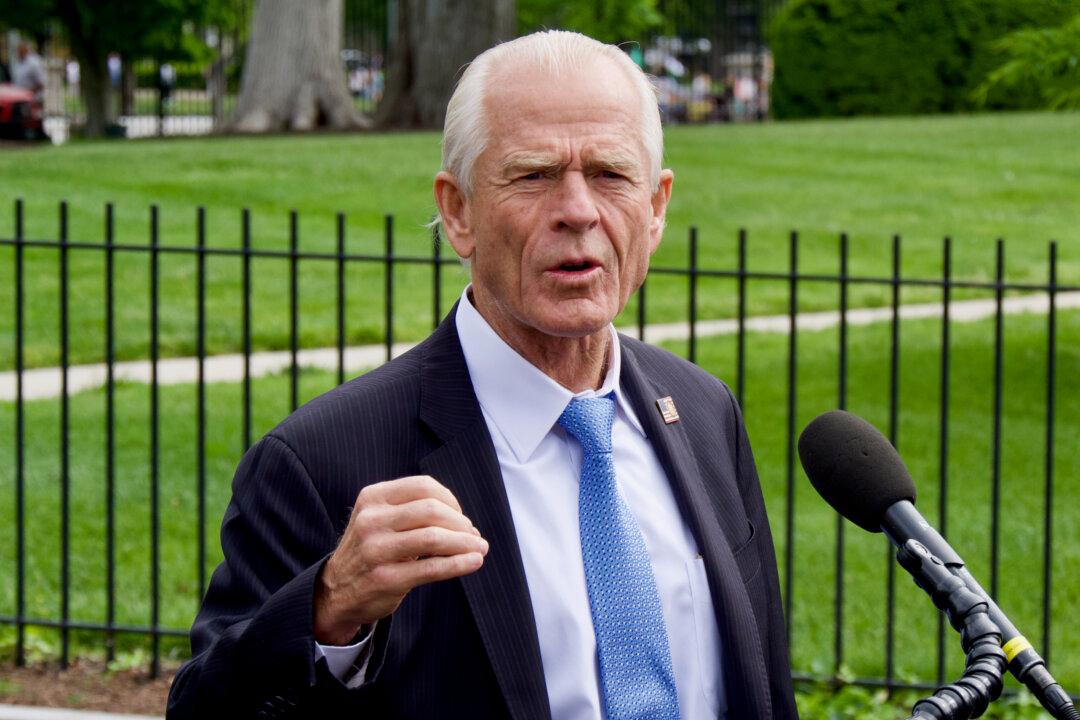
Peter Navarro, senior adviser to U.S. President Donald Trump, speaks to reporters at the White House in Washington on April 30, 2025. Travis Gillmore/The Epoch Times
White House trade adviser Peter Navarro says there are “significant issues” with the United States-Mexico-Canada Agreement (USMCA), but he stopped short of suggesting U.S. President Donald Trump wants to scrap the deal.
“I can tell you this, that USMCA has some significant flaws in it, and it’s going to be reevaluated in July,” Navarro said during a Feb. 12 interview with Bloomberg Radio.
Navarro was asked about media reports citing anonymous sources that said Trump had inquired of his aides about fully withdrawing from the USMCA, the trade deal he negotiated during his first term to replace the North American Free Trade Agreement (NAFTA). Navarro did not answer the question directly, but replied that “nothing ever happens” in the White House without the input of Trump, particularly when it comes to trade.
Navarro added that Mexico and “to an extent, Canada,” are being used as “staging areas” for China, Japan, South Korea, and Europe to access American markets tariff-free. “They leveraged NAFTA, and now USMCA, to get into our markets in a way which essentially is tariff avoidance at best, and tariff evasion at worst,” he said.
Trump said in a Feb. 11 Truth Social post that Canada had “taken advantage” of the United States on trade matters for many years, and imposing tariffs on Canada creates a “win” for his country. The president’s post came after the U.S. House of Representatives passed a resolution to end the president’s border-security and fentanyl-related tariffs on Canada. Trump, however, has the power to veto the bill.
There have been renewed trade tensions between Canada and the United States in recent weeks. Trump announced on Feb. 9 that he would not allow the Gordie Howe Bridge between the two countries to open unless the United States receives compensation. Trump said the agreement signed under former President Barack Obama did not benefit the United States because Canada would own both sides of the bridge and U.S. steel and workers were not used in its construction.
Prime Minister Mark Carney said a day later that he spoke with Trump about the bridge and explained that Canada paid $4 billion for its construction, that ownership is shared between the Canadian government and the state of Michigan, and both Canadian and U.S. steel and workers have been used in its construction.
“The situation will be resolved,” Carney told reporters in the House of Commons on Feb. 10, adding that the bridge is a “great example of cooperation between our countries.”
Trump also announced on Jan. 29 his plan to decertify the Canadian-made Bombardier Global Express and “all Aircraft made in Canada” in response to Canada refusing to certify several models of U.S.-made Gulfstream jets. He also threatened 50 percent tariffs on Canadian aircraft if “for any reason, this situation is not immediately corrected.”
This came a week after Trump threatened to impose 100 percent tariffs on Canada if Ottawa pursued an unspecified trade deal with China.
Prime Minister Mark Carney recently signed an agreement with China to reduce Ottawa’s tariffs on Chinese EVs from 100 percent to 6.1 percent on 49,000 EVs per year, with the expectation that Beijing will lower tariffs on Canadian canola, lobsters, crabs, and peas.
Carney and Trump Tensions
Tensions between Carney and Trump have risen since the two leaders criticized each other’s policies in their respective public speeches at the World Economic Forum in Davos, Switzerland, in late January. Carney criticized the White House’s desire to take over Greenland in his Jan. 20 speech, while calling for countries not to comply with unspecified “great powers.” This led Trump to say the following day that Carney “wasn’t so grateful” toward the United States, and that Canada “lives because of the United States.”
Carney said on Jan. 26 that he expected the upcoming USMCA review to be “robust,” and that Trump is a “strong” negotiator. “I think some of these comments and positioning should be viewed in the broader context of that,” Carney added.
Canada-U.S. Trade Minister Dominic LeBlanc said on Jan. 26 that he felt “reassured” following talks with U.S. Trade Representative Jamieson Greer the day prior. LeBlanc said they discussed Canada’s commitment under the USMCA not to enter free trade discussions that “do not have a market economy.”
LeBlanc said he reiterated to Greer that Canada was not pursuing a free trade agreement with Beijing, and Greer “understood very clearly what the agreement is and what it’s not.”
Greer said in a Feb. 10 interview with Fox Business that while Mexico is being “quite pragmatic” in the current USMCA negotiations, Canada has been “more challenging” to deal with.
Greer said Canada continues to have “certain barriers,” to trade, such as Canadian provinces like Ontario and Manitoba refusing to sell American wine and spirits. Trump and White House officials have also brought up Canada’s supply management system, which imposes tariffs on specific dairy products that surpass established quotas, calling it a trade irritant.
“We’re right next to Canada, and it means that we have to have a relationship that is effective for both of us,” Greer said, adding that the two countries cannot have an “antagonistic relationship.”