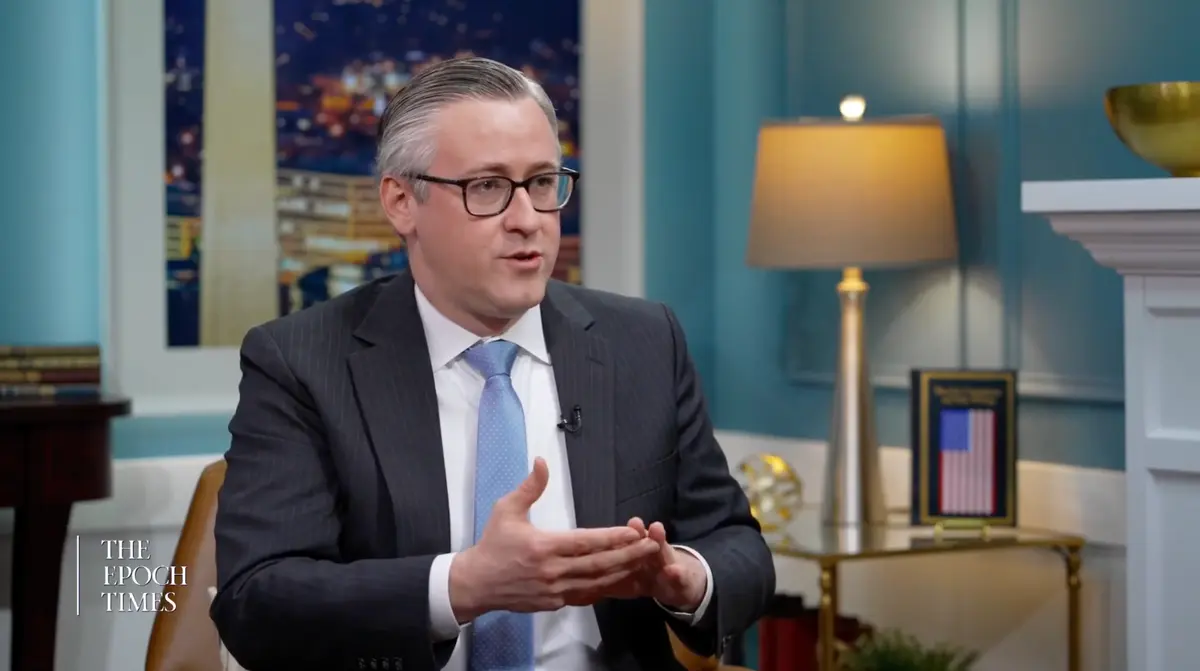
Peter Mattis, president of U.S.-based think tank The Jamestown Foundation, speaks during an interview on “American Thought Leaders,” hosted by Jan Jekielek, a senior editor at The Epoch Times, on April 20, 2026. The Epoch Times
As a NATO member and U.S. ally, Canada is a natural target for Beijing’s overseas influence operations, according to Peter Mattis, China expert and president of the U.S.-based think tank The Jamestown Foundation.
However, Canada is particularly vulnerable, Matti says, as the Chinese Communist Party (CCP) views it as an easy target for several reasons.
One factor is a lack of strong controls against CCP interference in Canada, Mattis said in an interview with Jan Jekielek, senior editor and host of The Epoch Times’ “American Thought Leaders.”
The CCP’s influence operations have faced “less pushback” in Canada over the last two or three decades, Mattis said, noting that the last “really public, visible pushback” against interference from Beijing was Project Sidewinder in the 1990s.
Project Sidewinder, a 1997 report by a joint task force of the RCMP and the Canadian Security Intelligence Service, warned of collaboration between Chinese intelligence, wealthy Chinese tycoons, and criminal triad gangs in infiltrating Canada to influence business and politics.
However, a publication in 2000 by the Security Intelligence Review Committee, the governmental body that oversaw the operations of CSIS at the time, dismissed the concerns raised in the Sidewinder report, saying it “found no evidence of any substantial and immediate threat” described in the report.
The CCP hasn’t had to deal with the same level of pushback in Canada that it faces in the United States, Mattis said, adding that Canada is only now getting to the point of having a foreign influence registry to track individuals in Canada acting on behalf of foreign states.
Last month, the government announced the appointment of former B.C. chief electoral officer Anton Boegman as Canada’s first foreign influence transparency commissioner. Meanwhile, the long-awaited foreign influence registry has not yet become operational, even though Parliament passed legislation in June 2024 enabling its creation.
Mattis noted Ottawa’s delay in creating a foreign influence registry means groups acting on behalf of the Chinese regime in Canada haven’t had to hide or be careful, and can “move and operate” at will.
“The fact is, it’s always easier to operate in the open than it is to operate with camouflage and all of the things that you need to do for security if you’re really concerned about being investigated,” he said.
Smaller Resources
Another reason Canada is especially vulnerable to CCP interference is its limited law enforcement and intelligence resources, Mattis said.
“Law enforcement, intelligence resources in Canada are relatively small to be going after this,” Mattis said, adding that the Chinese regime has been able to develop organizations in Canada to carry out its influence operations because it “didn’t really have to worry about being investigated.”
Mattis compared Canadian law enforcement and intelligence to that of the United States, where there have been congressional hearings, investigations, and convictions related to foreign interference, which he said leads the Chinese regime to have a “very good reason to take U.S. capability seriously.”
A former Chinese intelligence agent, who defected to Australia in 2023 and goes by the pseudonym “Eric,” previously told The Epoch Times that the United States has “far more robust intelligence and counterespionage” capabilities than Canada does, giving the CCP “more room to operate” in Canada.
CCP’s United Front
A February report by The Jamestown Foundation found the CCP has built a network of more than 2,000 overseas organizations across Canada, the United States, the United Kingdom, and Germany linked to its United Front system, which it uses to advance its agenda abroad.
The Jamestown Foundation’s research found at least 575 such groups in Canada alone. Canada has the second-largest network of organizations tied to China’s United Front Work Department (UFWD) after the United States, but the highest density per capita, with its population of roughly 40 million, the report said.
The CCP aims to influence democratic societies through its UFWD, which “coordinates and carries out work in power centers outside the Party’s direct purview, including by mobilizing groups to further the Party’s ambitions,” the report said.
Mattis told MPs during testimony before the House of Commons Subcommittee on International Human Rights on April 20 that the United Front system targets civil society organizations, wealthy proxies, universities, companies, politicians, local governments, media organizations, celebrity personalities, and any other institution that might shape interactions with the CCP.
He called this a “never-ending process” by the Chinese regime to identify threats and maintain control over ideas that could be considered “dangerous” to it.
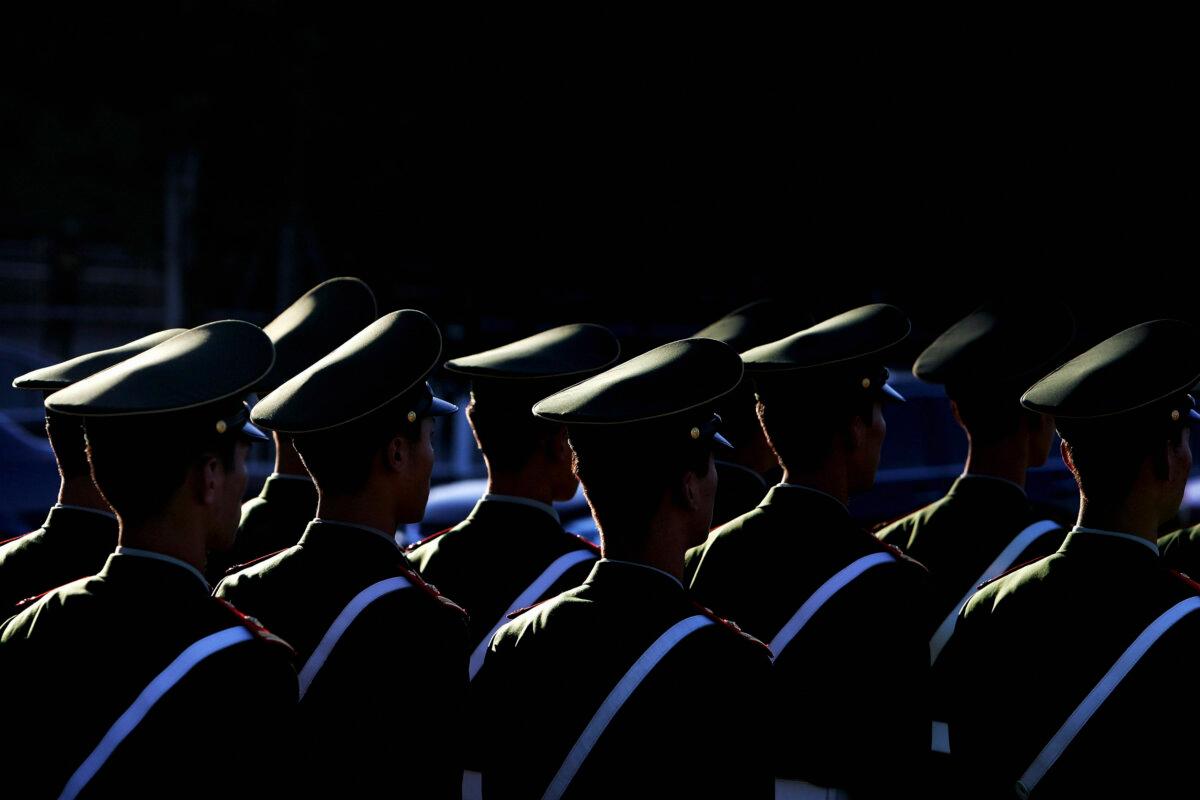
Chinese police officers stand guard ahead of the opening session of a Chinese Communist Party meeting, on Tiananmen Square in Beijing, in a file photo. Guang Niu/Getty Images
Money Laundering, Drug Trafficking
Another factor that may make Canada more vulnerable to CCP influence operations is that illicit activities such as money laundering and drug trafficking have, in some cases, been easier to carry out in Canada than in other countries, Mattis said.
“Canada is a place where the CCP’s role in drug smuggling and money laundering has just been easy—easier to do than it is in other places,” Mattis said, adding that this is partly due to restrictions facing Canadian law enforcement.
Public Safety Canada has said that many illicit narcotics entering Canada, including fentanyl and other opioids, as well as the precursor chemicals used to manufacture them, “come from China and surrounding areas.”
Former RCMP investigator and former chief anti–money laundering officer Garry Clement said recently that Chinese criminal groups operating in Canada and involved in fentanyl trafficking and money laundering often “operate in parallel” with the CCP’s United Front, contributing to efforts aimed at diaspora influence and elite capture.
“In my view, by allowing the precursors to flow in, they’re creating disruptive warfare, just like what happened during the Opium Wars,” Clement said at a Toronto event last December on CCP foreign interference and transnational repression in Canada. “That’s the price we’re paying for it.”
RCMP and Canadian military intelligence veteran Scott McGregor recently warned in an interview that many alerts regarding CCP-related fentanyl and money laundering activity in British Columbia have originated from U.S. agencies rather than Canadian authorities.
Why Canada Is Important to the CCP
One reason Canada is so important to the Chinese regime is that it serves as a “soft underbelly” to the United States, and to the rest of NATO, Mattis said.
“China has made it very clear that the party does not like alliances,” he said. “They don’t like things that bind democracies together, that enhance the strength of these countries, and give them more capacity to defend themselves and to do other things out in the world.”
Chinese defector spy Eric previously told The Epoch Times that one of the reasons Beijing sees Canada as a “key target” is due to its membership in key organizations that are highly sought targets of the CCP.
Infiltrating Canada would allow the CCP to access sensitive data from Canada’s allies shared through these alliances, he said. And due to Canada’s proximity to the United States, the CCP “sometimes prefers to send agents there first,” he added.
“It’s safer to enter and exit the United States from Canada than to operate directly under America’s powerful counterintelligence scrutiny,” Mattis said.
He also noted that immigrants come to Canada from Hong Kong and China in “varying waves,” which is seen by the CCP as a “threat,” as it means Canada has a disproportionate number of “potentially free-thinking” Chinese people.
“Therefore, it has to be present, has to make sure that potential is kept down or, ideally, under control,” he said.
Mattis’s comments come after Prime Minister Mark Carney signed several agreements with Beijing during his visit to China in January, including on electric vehicles, law enforcement cooperation, energy, and finance. During the visit, Carney said Canada and China were in a “strategic relationship” and relations between the two countries had entered “a new era.”
Canada’s new “strategic partnership” with China is concerning for Canada as well as for the United States and Mexico, Mattis said.
He noted that in seeking to deepen ties with China, the Canadian government appears to have forgotten earlier points of concern, including Beijing’s arbitrary detention of Canadians Michael Kovrig and Michael Spavor for more than 1,000 days, which followed Canada’s 2018 arrest of Huawei executive Meng Wanzhou on a U.S. extradition request.
“That impetus to forget is really, really troubling,” Mattis said. “This is kind of a meta-problem, if you will, that suffuses democracies.”
Canada has a free trade agreement with the United States and Mexico, he noted, adding that if Canada is “unwilling to put in really strong controls,” the issue extends beyond Canada itself and could also be viewed as a concern for both the United States and Mexico.